Part
IV: Claude’s Kaleidoscope . . . and
Carl’s
Click here
for Part
I - Part
II - Part
III
Ideas have a radiation and development, an ancestry and posterity of their own, in which men play the part of godfathers and godmothers more than that of legitimate parents.
– Lord Acton, cited by
Gertrude Himmelfarb in
Darwin and the Darwinian
Revolution
Who can
marvel sufficiently that the most distinguished minds in each branch of human
achievement have happened to adopt the same form of effort, and to have fallen
within the same narrow space of time?
– Velleius
Paterculus,
Res Gestae divi Augusti
All the
creative power that modern man pours into science and technics the man of
antiquity devoted to his myths.
This creative urge explains the bewildering confusion, the kaleidoscopic
changes and syncretistic regroupings, the continual rejuvenation, of myths in
Greek culture.
– Carl
Jung, Symbols of Transformation
One, two, three – but, my dear Timaeus, of those who yesterday were banqueters and today are the banquet-givers, where is the fourth?
--
Socrates, in Plato’s Timaeus
Robert
de Marrais
Transcript of the Author Caught Muttering to Himself Before Actually Writing This Up
For those who’ve tuned in late to this mini-series, the first episode performed a sort of sitcom setup of the main conundrum: Derrida’s deconstruction launched itself using Lévi-Strauss’ structuralism – as epitomized in his Mr. Fixit figure of the “bricoleur” – as thrust-block . . . the irony being that the latter “failed” analytics of myth proved a harbinger of advanced mathematical toolkits whose utility in linguistic and cultural studies has been burgeoning, while the former “success story” has shown itself to be ever more hollow – intellectually, morally, and spiritually.
In Part Deux, we blowfished
the argument, treating the core event – the 1966 Johns Hopkins conference
where Derrida struck his “deal with the Devil” – as itself a sort of myth
requiring structural analysis, inspecting it through the lens of Derrida’s
1987 reminiscences about the postmodernist “quotation market” and his own role
in fomenting it . . . and then beefed up our discussion of Lévi-Strauss’ own
“canonical law of myths” with Catastrophe Theory mathematics and the tasteful
injection of celebrity quotes, movie reviews, and pornographic movie ads
to, um, “flesh out” the argument.
Strike three, though, was
where the ubiquitous form-language of the so-called “A,D,E Problem” and its
lowly instancing as a new sort of Timaeus-style creation myth – based on kaleidoscopes instead of
an odd lot of triangles and things whose names rhyme with Tipi Hedron[1]
but don’t look half as fetching –
was taken much too seriously, with the limitations in Husserl’s
phenomenology shamelessly contrasted (unfavorably)
with the concentric run-out groove at the end of the Beatles’ Sgt.
Pepper album. The point
being, naturally, that the Madhyamika Buddhism of Nagarjuna’s “full void”
was allowed to underwrite the superposition principal
of quantum mechanics in spite of its looking like something Derrida liked to
mutter about, while all the while all of this was subsumed in some mare’s
nest of comparisons between the structures of mythical argument, their
“reincarnation” in the forms of classical music, and the Glass Beads that
Hermann Hesse’s Magister Ludi was known to like to play with when
he thought no one was watching.
Of course, if we’re going to
keep a load like that down without providing our readers free
Pepto-Bismol, it would behoove us to make the people reading this think the
linchpins of the argument were somehow intrinsic. Put another way (which is our
specialty here), we could say that it’s all very nice that this “A,D,E Problem”
gives us kaleidoscopes as the Meaning of Life and like that there, but wouldn’t
it be so much better if we got the same basic mishmash without all the
abstraction – if the kaleidoscope could legitimately be seen as some kind
of “archetype” in its own right, which “just happened” to bring in
Catastrophe-type “shock waves” into the argument without all the
hand-waving . . . and all without losing all the rest of our baggage, once the
argument has landed? (Something
like that . . . Time to throw out a long quote while I figure out what to twist
and shout about this time . . . )
*
*
*
*
*
*
*
It was in
the year 1811, while writing an article on “Burning Instruments,” that Brewster
was led to investigate a theory of Buffon, which was to construct
a lens of great diameter out of one piece of glass by cutting out the central
parts in successive ridges like stair steps. Brewster did not consider Buffon’s
proposal practicable. However,
it sparked an idea which produced awesome scientific
results. Thus was born an
apparatus of then unequaled power – the construction of a lens by
building it upon several circular segments. Here was a useful invention, later
perfected, which produced the lighthouse as we know it, creating
light-stabs of brilliance that pierced far into the night to guide
mariners.
This
breakthrough was followed by yet other honors. Brewster was admitted to the Royal
Society of London and was later awarded the Rumford gold and silver medal for
his theory on the polarization of light, which states that light
reflected from a glass surface is completely polarized when the
reflected and refracted rays are perpendicular to one another. Success followed success; and in
1816, the Institute of France adjudged him 3,000 francs – half the prizes – for
the two most important scientific discoveries to have been made in the two
previous years.
Then, as an
added jewel to his already glittering optics crown, Brewster invented the
kaleidoscope! This was
the year 1816. Brewster was 35
years of age, and was already an established philosopher, writer, scientist, and
inventor.
Brewster’s
kaleidoscope created unprecedented clamor.
In a history of Brewster’s
Kaleidoscope, found in the June 1818 volume of Blackwood’s Magazine, Dr. Roget
said: “In the memory of man, no
invention, and no work, whether addressed to the imagination or to the
understanding, ever produced such an effect. A universal mania for the
instrument seized all classes, from the lowest to the highest, from the
most ignorant to the most learned, and every person not only felt, but
expressed the feeling that a new pleasure had been added to their
existence.”[2]
A mania like
that engendered by the kaleidoscope is not unknown to us: I can recall, from my college days, the
amazingly widespread obsession with Rubik’s Cube, which even infected the
puckish “Metamagical Themas” columnist of Scientific American,
Gödel, Escher, Bach author Douglas Hofstadter (with his eleven
pages on the topic even inspiring the “Magic Cubology” cover art for the March, 1981 issue of that
learned magazine). But Dr. Rubik
never won the Nobel Prize in Physics, much less for any research having the puzzle as
its logical spin-off – whereas Brewster (by winning, alongside those other
honors mentioned by Cozy Baker, the Copley Medal) did the equivalent for his own
time and place.
As Hofstadter’s column
indicates, the symmetries of the Cube lend themselves to algebraic analysis
of a sort that would have made its invention thinkable as a spin-off, say,
of Murray Gell-Mann’s Nobel-winning efforts leading to the “Eightfold Way”
of particle classification; only if Gell-Mann, Ne’eman, Glashow or maybe
Feynman had created the Cube en route to their greatest achievements, would we
have a truly comparable situation!
But even then, it wouldn’t be fully comparable, since – as Dr.
Roget pointed out long ago – the “universal mania” caused by Brewster’s tube was
the first ever for a techno-toy.
What we have, then, is a
singular sociological phenomenon as well – a sort of “crowd
psychology” effect emerging in the very early days of “crowd psychology” as
such! And maybe this isn’t mere
coincidence (“maybe,” indeed, is too tame a word choice, as we’ll see shortly
when we look at the writings of Walter Benjamin). Here, we might point to another
modern phenomenon – the sudden, massive popularity in the States of the
musical Beatles in the immediate wake of the first Kennedy assassination – for
guidance. For the immediate context
of the St. Vitus’ Dance-like mania for tube-twirling in the Teens of the
Nineteenth Century was the sudden lifting of a pan-European state of war,
ongoing for over a generation, marked by the final capitulation of
Napoleon. Trade revived, the key
cities surged in size, and people were able to get on with their lives in ways
they hadn’t been able to contemplate since the falling of the Bastille some
three decades prior. (In their
first three months on the market, some 200,000 kaleidoscopes were sold in
Paris and London alone – and these were not the cheapo dime-store instruments of
today, either. As Dr. Roget
elaborated, “Large cargoes of them were sent abroad, particularly to the East
Indies. They very soon became known
throughout Europe, and have been met with by travelers even in the most obscure
and retired villages in Switzerland.”
Clearly, something was up!)[3]
Indeed, if someone had done
a “Rip Van Winkle” and gone to sleep the day before the French Revolution’s
inaugural event, and then awakened a quarter century later, he or she would have
suffered an analogous shock upon seeing how totally things had changed in the
interim. Such shocks were indeed
experienced by many (among them, many great artists and writers) who hadn’t had
the luxury of such a long nap, and this is where Walter Benjamin’s researches
into the newly “modern” age of Balzac, Edgar Allen Poe, and Baudelaire prove
pertinent. For this was the “boom
time” marking the true irruption of mass production and industrialization into
general consciousness – just as the last quarter century’s “bull market”
sensibility has marked the true irruption of computerization into the worldview
of our own time.[4]
Indeed, the Rip Van
Winkle-like “shock effect” is probably the most frequently elicited aspect of
the kaleidoscope’s workings in analogies.
And such analogies frequently relate the “twirling” to the workings
of the historical process whose non-stop “Progress” was just becoming evident at
the time of its emergence. The
twirl of kaleidoscopes; revolutionary upheaval: the one often stands in for the other when
contemplating history, and the late 1960’s and 1810’s were not the
only periods of radical change during which kaleidoscope images popped up. In his monumental socio- and psycho- logical portrait of fin
de siècle France, Marcel Proust provided a stunning usage of just this
conjunction of imagery while describing the shake-ups in the upper strata of
society just prior to the Dreyfus
Affair. His remarks are
sufficiently general in their applicable range, as well as archly
insightful and insidiously funny, as to bear citing here in
full:
In the days of my early
childhood, everything that pertained to conservative society was worldly, and no
respectable salon would ever have opened its doors to a Republican. The people who lived in such an
atmosphere imagined that the impossibility of ever inviting an “opportunist” –
still more, a “horrid radical” – was something that would endure for ever, like
oil-lamps and horse-drawn omnibuses.
But, like a kaleidoscope which is every now and then given a turn,
society arranges successively in different orders elements which one would have
supposed immutable, and composes a new pattern. Before I had made my first Communion,
right-minded ladies had had the stupefying experience of meeting an elegant
Jewess while paying a social call.
These new arrangements of the kaleidoscope are produced by what a
philosopher would call a “change of criterion.” The Dreyfus case brought about another,
at a period rather later than that in which I began to go to Mme Swann’s, and
the kaleidoscope once more reversed its coloured lozenges. Everything Jewish, even the elegant lady
herself, went down, and various obscure nationalists rose to take its
place. The most brilliant salon in
Paris was that of an ultra-Catholic Austrian prince. If instead of the Dreyfus case there had
come a war with Germany, the pattern of the kaleidoscope would have taken a turn
in the other direction. The Jews
having shown, to the general astonishment, that they were patriots, would have
kept their position, and no one would any longer have cared to go, or even to
admit that he had ever gone any longer to the Austrian prince’s. None of this alters the fact, however,
that whenever society is momentarily stationary, the people who live in it
imagine that no further change will occur, just as, in spite of having witnessed
the birth of the telephone, they decline to believe in the aeroplane.[5]
The Proustian imagery
implies a curious paradox:
formally, it is the symmetric arrangement of mirrors in the kaleidoscope
which bears an exact “A,D,E”-style analogy to the taxonomy of Catastrophic
unfoldings; yet it is in fact the twirling of the tube (a feature
independent of the mirrors’ arrangements) which most readily bears analogy to
Catastrophe Theory’s trademark sudden replacements of one stable regime with
another. Moreover, this
twirling effects its changes on the “accidental” aspect of the instrument –
the bits of colored glass and other oddments whose exact nature vis à vis
the kaleidoscope’s “type” is irrelevant, and in fact gratuitous (since
the instrument will impose its symmetries on an empty scene just as readily as
it will on object-box detritus).
The way toward resolving this “paradox” is through the realization
that the kaleidoscope operates, as we’ve seen (Part II, Note 18), on two
levels: as formal cause of an
invariant, hence “ideal” pattern, and as efficient cause of the jostling of
“these odds and ends,” which Lévi-Strauss, in his contemplation of
Brewster’s toy, told us “appear as such only in relation to the history which
produced them and not from the point of view of the logic for which they are
used.”
Such a description obtains,
as well, for the behavior of crowds on sidewalks as it does for bits of
glass: the heterogeneous nature of
their members, as well as the relative randomness of their motions, are at odds
with the directedness of the individuals comprising them when considered each in
isolation. If we in fact remove the
kaleidoscope’s features which are irrelevant to Proust’s image, we obtain a
highly influential Victorian notion of “stability” which was an explicit
harbinger of Catastrophe Theory in evolutionary thinking (the route through
population genetics via C. H. Waddington was touched upon in Part II), as well
as involving a “twirling” of a polygonal (or polyhedral) framework operating on
just such crowd scenes.
In his 1869 Hereditary
Genius, Darwin’s smarter cousin, Sir Francis Galton, introduced the
motif (frequently reverted to in later writings, of his own as well as of his
geneticist followers) of a “polygon of stability.” This model served to indicate a
way to “save the phenomenon” of
natural selection’s operating smoothly while yielding discontinuous
results – “how is the law of continuity to be satisfied by a series of changes
in jerks?” He answered his own
question in this manner: “The
mechanical conception would be that of a rough stone, having in consequence of
its roughness, a vast number of natural facets, on any one of which it might
rest in ‘stable’ equilibrium.” When
the stone is pushed, it will totter on an edge, but will regress to its first
position when pressure is withdrawn.
However, if a very strong push is given, the stone will be
forced
to overpass the limits of the facet on which it has hitherto found rest, it will tumble over into a new position of stability, whence just the same proceedings must be gone through as before, before it can be dislodged and rolled another step onwards. The various positions of stable equilibrium may be looked upon as so many typical attitudes of the stone, the type being more durable as the limits of its stability are wide. We also see clearly that there is no violation of the law of continuity in the movements of the stone, though it can only repose in certain widely separated positions. [6]
Some twenty pages later in the same work, Galton recasts his “polygonal
slab” analogy, the better to bring
it to bear explicitly on the behavior of congested crowds struggling to push and
shove their way through narrow passageways:
If by a great effort, a man drives those in front of him but a few inches forwards, a recoil is pretty sure to follow, and there is no ultimate advance. At length, by some accidental unison of effort, the dead lock yields, a forward movement is made, the elements of the crowd fall into slightly varied combinations, but in a few seconds there is another dead lock, which is relieved, after a while, through just the same processes as before. Each of these formations of the crowd, in which they have found themselves in a dead lock, is a position of stable equilibrium, and represents a typical attitude.[7]
In a landmark paper on “A Theory of Heredity” published in between the
two editions overseen by Galton of Hereditary Genius, he presents the
third stage of the model – direct application is made to the dynamic
process of inheritance as it was then understood (i.e., as a “struggle
for survival” among animated, self-replicating particles Darwin had dubbed
“gemmules”). Seething multitudes of
these germinal beings are assumed to
act on many sides, in a
space of three dimensions, just as the personal likings and dislikings of
an individual in a flying swarm may be supposed to determine the position that
it occupies in it. . . . the germs must be affected by numerous forces on all
sides, varying with their change of place, and . . . they must fall into many
positions of temporary and transient equilibrium, and undergo a long period of
restless unsettlement, before they severally attain the positions for which
they are finally best suited.[8]
It must be noted that such crowd-scene imagery is as typical of Victorian
science as it is atypical of the science that went before it: indeed, the creation of a “statistical
mechanics” where vast ensembles of nondescript molecules flit about like
brickbats on “drunken walks” was one of the great achievements of that era,
leading to the creation of a whole new vocabulary of “mean free paths,” “entropy
of interaction,” and so forth.
Major insights were catalyzed by stepping into (Poincaré’s aha! about
Fuchsian groups) or just sitting in (Kekulé’s presentiment leading to the famous
“dragon biting its tail” dream in which he saw the structure of the benzene
ring) that epitome of impersonal crowding, the bus: as Georg Simmel
noted,
The interpersonal
relationships of people in big cities are characterized by a markedly greater
emphasis on the use of the eyes than on that of the ears. This can be attributed chiefly to the
institution of public conveyances.
Before buses, railroads, and streetcars became fully established during
the nineteenth century, people were never put in a position of having to
stare at one another for minutes or even hours on end without exchanging a
word.[9]
“That the eye of the city dweller is overburdened with protective
functions,” says Walter Benjamin by way of introducing this quote, “is
obvious.” What is no longer so
obvious to us today, however, is just how oppressive – even frightening – this
burden was felt to be in the early days of urban crowding, when the new trend
toward industrialization, among other contemporary factors, brought droves of
newcomers off the farms to toil in sweatshops and factories. “Fear, revulsion, and horror were the
emotions which the big-city crowd aroused in those who first observed it. For Poe it has something barbaric;
discipline just barely manages to tame it. Later,” Benjamin tells us, “James Ensor
tirelessly confronted its discipline with its wildness; he liked to
put military groups in his carnival mobs, and both got along splendidly – as the
prototype of totalitarian states, in which the police make common cause
with the looters.”[10] From the vantage of a century’s
distance, the most telling innovation of the period was the safety match; to
those who lived in the period, revolutionary significance was seen embodied in
the kaleidoscope:
The invention of the match
around the middle of the nineteenth century brought forth a number of
innovations which have one thing in common: one abrupt movement of the hand triggers
a process of many steps. This
development is taking place in many areas.
One case in point is the telephone, where the lifting of a receiver has
taken the place of the steady movement that used to be required to crank the
older models. Of the countless
movements of switching, inserting, pressing, and the like, the “snapping” of the
photographer has had the greatest consequences. A touch of the finger now suffices to
fix an event for an unlimited period of time. The camera gave the moment a posthumous
shock, as it were. Haptic
experiences of this kind were joined by optic ones, such as are supplied by
the advertising pages of a newspaper or the traffic of a big city. Moving through this traffic involves the
individual in a series of shocks and collisions. At dangerous intersections,
nervous impulses flow through him in rapid succession, like the energy from a
battery. Baudelaire speaks of a man
who plunges into the crowd as into a reservoir of electric energy. Circumscribing the experience of the
shock, he calls this man “a kaleidoscope equipped with
consciousness.” Whereas Poe’s
passers-by cast glances in all directions which still appeared to be
aimless, today’s pedestrians are obliged to do so in order to keep abreast of
traffic signals. Thus technology
has subjected the human sensorium to a complex kind of training. There came a day when a new and urgent
need for stimuli was met by the film.
In a film, perception in the form of shocks was established as a formal
principle. That which
determines the rhythm of production on a conveyor belt is the basis of the
rhythm of reception in the film.[11]
The above kaleidoscope image appeared in Baudelaire’s famous 1860 essay
“The Painter of Modern Life”[12];
he has one other, appearing in the second draft of his dedication to Arsène
Houssaye for Le Spleen de Paris (cited, oddly enough, by Derrida in his
turn on a Baudelaire theme called Given Time: I. Counterfeit Money): “I have sought titles. The 66. Although however this work resembling the screw
and the Kaleidoscope could be pushed as far as the Cabalistic 666 and even
6666….”[13] What is “kaleidoscopic” to
Baudelaire here (aside from the Abulafian meditative practice of the “whirling
of letters” – the closest thing in Cabalistic lore to the twirling of object-box
contents – that one may assume he’s referring to) is revealed a few lines
further along in his dedication. As
rendered in Arendt’s translation of Benjamin’s text (which also snips this
Baudelairean bit, but with better and more complete English rendering), the
dream of this last of the popular lyric poets is of “the miracle of a poetic
prose”: a prose which
is
musical without rhythm and
rhyme, supple and resistant enough to adapt itself to the lyrical
stirrings of the soul, the wave motions of dreaming, the shocks of
consciousness. This ideal, which can turn into an idée fixe, will grip
especially those who are at home in the giant cities and the web of their
numberless interconnecting relationships.[14]
One can be “at home in the
giant cities” in different ways.
The poet Nerval walked the boulevards behind a slow-moving lobster
attached to a long colored ribbon.
Around 1840, there was a fad among such “Resistance figures” (those so-called flâneurs –
dandies and artistes – who
refused to succumb to the anonymous mentalité of the
crowd) to take turtles for promenades in the arcades, and let them set
the pace. “If they had had their
way, progress would have been obliged to accommodate itself to this pace. But this attitude did not prevail;
Taylor, who popularized the watchword ‘Down with dawdling!,’ carried the
day.”[15] One can see in this nonchalance a
sophisticated deployment of a “shock defense” – but for most people, less
self-conscious and compelled to rush, the basic defense entailed a more passive
mode of withdrawal, and a more active mode of sensorial
rebalance.
The active mode of sensorial rebalance was announced by the
kaleidoscope itself: the century
spanning the mania which greeted it and people lining up for movie tickets saw a radical distancing of people from
their own sensory apparatus – a coming, in fact, not to trust its unaided
evidence. This was the age when
psychologists like Purkinje began to study “optical illusions,” when the
indirection of “point of view” optics and camera obscura
representation was traded in – the better to study the persistence of retinal
images – by scientists (as well as
proto-impressionist painters like J.M.W. Turner), for direct viewing of the sun
(with permanent blindness, viz. Joseph Plateau, or at least serious visual
impairment, as with Gustav Fechner and Sir David Brewster himself, as a
side-effect). The aim was to attain
to “an abstract optical experience, that is of a vision that did not represent
or refer to objects in the world.”
The key revelation was of the body as “site and producer of chromatic
events” – and the seminal byproduct of such engagement was an
ever-increasing “mechanization and formalization of vision.”[16]
Baudelaire not only wrote about the kaleidoscope; in his 1853 essay
“Morale du joujou,” he discusses two later optical devices which
enjoyed vast popularity: the
stereoscope (perfected, as well, by Brewster, and basing its illusionary
suasiveness on the exploiting of binocular disparity); and, Plateau’s
phenakistiscope (creating the illusion of continuous motion via rotation of
a wheel of static images, the illusion’s effectiveness depending upon retinal
persistence).[17]
The phenakistiscope
substantiates Walter Benjamin’s claim that in the nineteenth century “technology
has subjected the human sensorium to a complex kind of training.” At the same time, it would be a mistake
to accord new industrial techniques primacy in shaping or determining a new kind
of observer…. In fact, the very physical position required of the observer by
the phenakistiscope bespeaks a confounding of three modes: an individual body that is at once
a spectator, a subject of empirical research and observation, and an element of
machine production…. In each [mode], it is a question of a body aligned with and
operating an assemblage of turning and regularly moving wheeled parts. The imperatives that generated a
rational organization of time and movement in production simultaneously pervaded
diverse spheres of social activity.
A need for knowledge of the capacities of the eye and its regimentation
dominated many of them.[18]
The passive mode of withdrawal primarily took the form, as
subjected to deep and subtle scrutiny by Richard Sennett in The Fall of
Public Man, of a retreat from playacting (with concomitant
overvalorization of those few who playacted for a living: this is the age of Paganini and Liszt,
the first “superstars,” and the attaining to high status of actors and
performers generally).[19] In the prior century, public attendance
at theatrical events was an occasion for frequently wild engaging of the
audience, who might pay to sit on the stage and enter into the action, or at the
least exhibit public flights of passion and demands for repetition of
moments which affected them:
attendance was as cathartic, that is, in the ancient regime, as it
tended to be silent and undemonstrative in the Victorian Era.[20]
In the earlier period, new
institutions arose, like the coffee house, to facilitate the intermingling
of classes in the new entrepreneurial climate that fomented the innovativeness
of the Industrial Age.
Self-presentation on the stage-set of everyday life was, at times,
corollarily extreme: for those with
the wherewithal, clothing prior to Waterloo was costume drama, while
Victorian sensibilities aimed for the total suppression of self-expression
in dress[21]. While aristocratic values held sway, the
highest form of wit was on display in the highly interactive venue of the urban
salon; but the following bourgeois century stressed the “domestic virtues” of
stay-at-home privacy, romanticizing “family values” as yet another part of
“shock defense.” As that greatest
of the era’s social observers, Alexis de Tocqueville, described
it,
Each person, withdrawn into
himself, behaves as though he is a stranger to the destiny of all the
others. His children and his good
friends constitute for him the whole of the human species. As for his transactions with his fellow
citizens, he may mix among them, but does not feel them; he exists only in
himself and for himself alone. And
if on these terms there remains in his mind a sense of family, there no longer
remains a sense of society.[22]
Beneath active and passive modes both, there was something more abstract
at work: a century after Newton,
there was a new “force model” emerging – one quite different from the attraction
of “central forces” over vast empty spaces of the classical mechanical vision .
. . one which came to be referred to as “field theory.” But as different as this might seem from
what preceded it, there is also a deep continuity connecting them. In order to see it and follow its thread
through both ages (and, ultimately, up to our own) we need a more general
comprehension of two features evinced in Galton’s stability – features which
will let us rotate the “polygonal slab” of our argument not merely from our own
“A,D,E Problem” epoch to Galton’s own outlook, but back to the innovative
thought-world of a once-celebrated, now largely forgotten Enlightenment Jesuit
who hailed from Croatia, and found his way toward an abstraction of the “Rococo
curve” that guided the thinking of Faraday, Maxwell, Kelvin, and in fact the
most innovative scientific visionaries of the century that came after
him.
*
*
*
*
*
*
*
In “My Chances/Mes
Chances: A Rendezvous with some
Epicurean Stereophonies,”[23]
Derrida managed to conjoin both the themes we’re after here: the atomism of Epicurus and Lucretius,
and the theme of the aleatoric or “random” (relating it in an interesting way to
Heidegger’s dice-like “thrown-ness”).
Curiously, the theme of the random at the origin of things – even as
epitomized in the “throwing” of dice – is not merely paramount in modern
physics (Einstein’s famous objection to quantum uncertainty, “God doesn’t throw dice!”, comes
to mind), but central to such non-Eurocentric texts as the
Mahabharata, where the role of chance at the root of things
is hardly taken as an argument for existential angst or aetheism. (And, until Galton’s withering
statistical analysis of “The Efficacy of Prayer” in 1872[24]
, this was the case in the West as well!)
More curiouser still, the theme of atomism among the ancient Greeks
seems, if anything, remote from notions of “atomic theory” as we know it today –
whereas the atomism of Derrida’s favorite Eighteenth Century, which
captivated the imaginations of the following century’s deepest thinkers,
and does have profound bearing on “atomic theory” as
we think it presently, seems thoroughly unknown to him. Moreover, in the Eighteenth
Century, arguments in
favor of Divine Providence
based on the evidence of Chance’s working were commonplace[25]
– and often conjoined with a mathematical notion of atomism which assumed
“point particles” as basic, the better to suggest the regulatory priority of
the Soul over mere material
embodiment.[26] All of which suggests some divergent
attitudes to take toward the kaleidoscope’s colored lozenges – or Galton’s
competing swarms of “gemmules,” for that matter.
It’s worth noting that Derrida considers the “clinamen” of Lucretius as well as simple atomism, and its “first swirling” sort of notion has had a modern vogue among the chaotically inclined, especially the great pioneer of far-from-equilibrium thermodynamical systems, chemistry Nobelist Ilya Prigogine: In Order Out of Chaos, which he co-authored with Isabelle Stengers, he remarks how
the early atomists were so concerned about turbulent flow that it seems legitimate to consider turbulence as a basic source of inspiration of Lucretian physics. Sometimes, wrote Lucretius, at uncertain times and places, the eternal, universal fall of the atoms is disturbed by a very slight deviation – the “clinamen.” The resulting vortex gives rise to the world, to all natural things. The clinamen, this spontaneous, unpredictable deviation, has often been criticized as one of the main weaknesses of Lucretian physics, as being something introduced ad hoc. In fact, the contrary is true – the clinamen attempts to explain events such as laminar flow ceasing to be stable and spontaneously turning into turbulent flow. Today hydrodynamic experts test the stability of fluid flow by introducing a perturbation that expresses the effect of molecular disorder added to the average flow. We are not so far from the clinamen of Lucretius![27]
The eighteenth century’s greatest scientists tried, and ultimately failed, to make sense out of fluid flow – an insuperably difficult problem, which even the most advanced computer-graphics simulations cannot totally clarify.[28] In fact, all things they couldn’t comprehend yet they tended to assume were “imponderable fluids,” vaguely forming little oceans around the microworlds of atoms. According to the highly influential chemistry texts of Thomas Thompson, which held sway in the last years of the eighteenth, and first years of the nineteenth, centuries, there were maybe half a dozen such “fluids”: one or two each for electricity and magnetism, depending on which theory you believed (Oersted’s 1820 one-page announcement of the results of playing with a compass in the vicinity of a wire joining two batteries hadn’t shown their shockingly simple unity yet); at least, by some accounts, two modes of light (Brewster et al. hadn’t unraveled polarization yet, and anomalies like the “birefringence” of Iceland spar had to be explained away somehow); heat (whose “fluid” was called “phlogiston” until Lavoisier’s careful measurements indicated contemporary theories of same would require it to have a negative weight, after which folks spoke of “caloric”) – and perhaps a couple others I can’t remember anymore.
The turbulence nascent in such “fluids” was often put on display in a near-carnival atmosphere: in one grandstanding set-up, thin magnets would be floated in a tank and brought close enough together to start attracting and repelling each other with wildly mysterious intermittency. Ironically, this made especially effective theater precisely because the basic picture assumed by all viewers was one of extreme stasis at the foundations of matter. The opinions of the first great atomist among modern chemists, John Dalton (1766-1844), were typical, and deemed the voice of orthodoxy:
The Daltonian atomic theory had endowed atoms with atmospheres of heat or caloric. It was these atmospheres which kept the atoms from touching and, since caloric repelled caloric, the atoms of gases were surrounded by quite extensive atmospheres. What the person who is accustomed to the modern kinetic theory of gases must realize is that this was a totally static picture. If a gas could be magnified so that its atoms became visible, it would resemble a bowl of gelatine (caloric) in which the gas atoms were imbedded like raisins. It was in this sense that caloric exercised repulsive powers, just as the gelatine resists compression.[29]
The typical viewpoint of the time was that these fluids obeyed Newtonian inverse-square laws (Coulomb’s law of static electricity is a good for-instance, as well as the law concerning the drop-off with distance of luminosity, first formulated by Newton’s illustrious precedessor, Johannes Kepler); but otherwise (like contemporary physicists’ neutrinos), they did not interact much, if at all, with ordinary matter, which acted like the “flies” in their “ointment.” And the imponderables, like our contemporary “particles,” tended to proliferate as well: that celebrated kite-flying experimenter, Ben Franklin, made a compelling case for there being but one electrical fluid instead of one per each charge . . . only to have Luigi Galvani lay claim to having discovered a whole new category of electrical imponderable. In 1791, he
announced the discovery of animal electricity produced by living tissues. This fluid, secreted by the nerves, was completely analogous to all the other imponderables except for its connection with life. The wave of excitement over this epoch-making discovery was accompanied by a ripple of skepticism from those who had recently seen the existence of Anton Mesmer’s animal magnetism denied by the Paris Academy of Science. Among the skeptics was Alessandro Volta of the University of Pavia who, as a physicist, was convinced that the undoubted signs of electricity could be explained in purely physical terms with no need to call upon vital or other mysterious forces.[30]
It would be decades before Eadweard Muybridge’s horses in motion would startle the world with still-shot photographs able to demonstrate the evanescent happenings that literally came and went in the blink of an eye; yet it was on the basis of a mind’s-eye visualization of this variety (one, in fact, more like those famous mid-twentieth-century Harold Edgerton snaps of, say, bullets deeply dimpling the balloons they will explode in another millisecond or so, that grace the walls of M.I.T.’s Infinite Corridor) that Roger Joseph Boscovich saw his way to a subtle contradiction in the Newtonian scheme. This led him to dispense with “imponderable fluids” altogether, replacing them with a purely mathematical notion of alternating zones of attraction and repulsion emanating from infinitesimal points – which just happened to reduce Newton’s laws to rough approximations of subtler things. While writing his De Viribus vivis of 1745,
he investigated the production and destruction of velocity in the case of impulsive action, such as occurs in direct collision. In this, where it is to be noted that bodies of sensible size are under consideration, Boscovich was led to the study of the distortion and recovery of shape which occurs on impact; he came to the conclusion that, owing to this distortion and recovery of shape, there was produced by the impact a continuous retardation of the relative velocity during the whole time of impact, which was finite; in other words, the Law of Continuity, as enunciated by Leibniz, was observed.[31]
The link to Leibniz is important, as it was this philosopher’s notion of “monads” – fundamental unities which were without parts, extension or figure – which would serve to inspire Boscovich’s next advance, when he came to reflect upon the facts determined in De Viribus, and came to enquire as to their causes when his future editor, one Father Scherffer, suggested he investigate the center of oscillation. This should already sound suggestive of Galton’s “rough stone” which can be stably rocked or, if sufficiently jostled, caused to rest upon different of its multiple facets; it also suggests the full-blown “competing swarms of gemmules” vision, too, since Leibniz ascribed to his monads perception and appetition in addition to an equivalent of inertia. Prior to Galton, heredity was seen as the direct result of quasi-physical forces; his own model, then, was merely more of the same “monadological” thinking:
Romanes seems to have envisioned an inertial law of heredity; Spencer speculated that there might be polarized “physiological units” which could carry the hereditary force in much the same way that glass balls carry electric charge; Darwin analogized inheritance to powers which can neutralize or counterbalance each other. Whether the force model was explicit or implied it was there; in light of the success of nineteenth-century physical science it would have been remarkable if such a model had not presented itself.[32]
The result of Scherffer’s suggestion was the Theoria Philosophiae Naturalis of 1758, which Scherffer edited, and in which Boscovich presented his stripped-down picture of physical law in which the “Newtonian idea of mass is replaced by something totally different; it is a mere number, without ‘dimension’; the ‘mass’ of a body is simply the number of points that are combined to ‘form’ the body”[33] – with every pair of points, no matter how distant, exerting a mutual accelerative force upon every other, the magnitude of this force depending only on their degree of separation. At all but the tiniest of distances, this force would obey the Newtonian inverse-square law; but down at the scale where molecules form, spontaneous combustion can be triggered, and atoms would approach each other, the force law takes the form of a Rococo curve: as with a piece of driftwood battened about by tides until, barkless and twigless, it offers to the eye a purity of smoothness in its twistings, the curve would alternately slope upwards (indicative of repulsion) or down (attraction), with crossings of the shortest path between them indicating relative repose.
Arriving at such a conclusion may seem an unwarranted jump based upon the evidence offered; but, if one thought deep and hard on the key matters as Boscovich did, it could appear as an inescapable conclusion, if one’s mental proclivities were sufficiently abstract and philosophical:
To most natural philosophers of the eighteenth century, the collision of two atoms was exactly analogous to the collision of two billiard balls. Boscovich realized that the situation was more complicated. When two billiard balls collide, the result is elastic deformation and recovery; the deformation is made possible by the fact that the molecules of the billiard balls can move relative to one another. It is the displacement of these molecules and their subsequent return to normal position that leads to elastic rebound. With atoms, such a process is clearly impossible. Since atoms have no parts and are perfectly hard, deformation is impossible. What happens, then, when two moving atoms meet? If they are little billiard balls, Boscovich argued, and if deformation is impossible, no time can elapse between contact and rebound. Thus, at the moment of impact, the atoms will have two velocities at the same time. They will have their original velocity and the velocity of rebound. To Boscovich this was logically and physically absurd yet it was a necessary consequence of the theory of material atoms. Boscovich’s solution was a radical one; he eliminated matter completely as a separate entity and replaced it with attractive and repulsive forces. An atom was to be considered as a dimensionless mathematical point. Surrounding this point were forces which were alternately attractive and repulsive…. With this model, Boscovich was able to account for atomic impact with no difficulty. Since the curve of atomic forces was continuous, the repulsion between two colliding atoms increased continuously with time and the absurdity of the Newtonian case was avoided.[34]
Boscovich’s model allowed him to give satisfactory explanations – albeit in a qualitative way only – of many phenomena that had proved baffling: why, when heat was added to a substance, did it suddenly change its physical form at some specific “freezing” or “boiling” point? It was here that the logic was just like Galton’s, with each “zero” on the curve corresponding to a “typical attitude”: at such stable points, heat – in the form of atomic or molecular motion – was added to a body composed of these atoms, and “their oscillations would eventually push them over the ‘hump’ of repulsion to a new stable position at a great distance from one another.”[35] Ditto for crystalline structure, where arrangements analogous to “polygonal slabs” (or polyhedral vertex figures) became practicable. (And, by introducing asymptotic “breaks” in a particular ensemble’s “force curve,” spontaneous combustion and other mysteries became easily comprehended.) It is not surprising, then, that this vision captured the imagination of chemists – not just Dalton (and his amateur-chemist close friend, the poet Coleridge), but Humphrey Davy and his protégé Michael Faraday, were among the many to draw inspiration from it. In our own time, the one-line boil-down of all scientific knowledge which Richard Feynman suggested be passed on to future generations, cited in Part II of these ramblings (and attaching to Note 34 there), is worth repeating: “all things are made of atoms – little particles that move around in perpetual motion, attracting each other when they are a little distance apart, but repelling upon being squeezed into one another.”
It is easy to make the link from Boscovich’s curve to the “behavior spaces” of Catastrophe Theory too: the number of “humps” separating atoms in their vertex figure would demarcate which “cuspoid” figure was stably (if, say, it were crystalline) regulating the “unfolding” of their mutual behavior. And we can come awfully close to the as-yet-uninvented kaleidoscope as well: we merely need to place Boscovich in context, and improvise. For the good Jesuit was lionized for his brilliant researches throughout Europe, invited to join all the most prestigious learned societies, and even lived for some years with a grant of full citizenship in France. His prominence was such that some of the greatest figures of the age deigned to make him their friend or enemy (the mathematician d’Alembert, for instance, whose “dream” was made famous by his co-Encyclopedist Diderot, loathed the Jesuits, who had recently been dissolved anyway, and ergo, by extension, could not tolerate Boscovich; there was a priority dispute with Laplace, too, concerning a method for deriving the orbits of comets, but the astronomer Lalande was devoted to him, and Louis XV, then XVI, protected him).
I imagine him being received and officiated over in the most fabulous architectural extravagance of that “Age of the Baroque” which had only just recently ended – by which I mean the near-exact contemporary of that gargantuan British edifice, Newton’s Principia, which the Sun King had erected at Versailles. And I imagine him – renowned optics researcher, and newly appointed director of “Optique Marine” upon his 1773 visit to Paris and incipient citizenship change – vastly enjoying himself in what for him would doubtless have been the most enticing of “tourist traps” there, the 243-foot-long Galerie des Glace designed by Jules Mansart and decorated by Charles Le Brun, illuminated by seventeen great windows. (At night, in the Sun King’s time, the murals, mirrors, and gilt blazed with the light of three thousand candles.)[36]
We find yet another type of perspective in the “hall of mirrors.” Here visual space and auditory space approach as nearly as possible. As in auditory space every tone is repeated from octave to octave, here every object is repeated from mirror image to mirror image. As, for the center of the dynamic field of tones, presence at one point in auditory space always means presence in so and so many octave repetitions as well, so in the hall of mirrors no object can be present only once; every appearance of an object at one point is an appearance of it at many places in the mirror images. As the entire dynamic field is repeated from octave to octave, so the whole space of the hall of mirrors is repeated from one reflection to the other. And as in auditory space going away from a tone is always also going toward the same tone in its octave, in the hall of mirrors too there is no going away from a place that is not at the same time a going toward the same place in its mirror image.[37]
What might seem somehow forced about Boscovich’s solution when contemplated visually, attains to naturality when thought of as an auditory construct: the alternating zones of attraction and repulsion become just so many octaves. The implicit “haptic balance” of this Age of Reason (if you were not a sans culotte, that is) has seemed intoxicating to some McLuhanites, such as Neil Postman, whose recent Building a Bridge to the 18th Century would tell us, at its subtitle suggests, “How the Past Can Improve Our Future.” What is clear is that the balance was mostly mediated by the intellect, not the heart, and Revolution would soon put an end to it anyhow. (Boscovich, detained by ill health in Milan, was obliged to ask the French government for an extended leave, only to succumb to melanchony and die on February 13, 1787 – thereby just missing getting caught up in the events celebrated on Bastille Day by less than two and a half years.)
We just miss getting the kaleidoscope here, too, because the public amplification of images in the Hall of Mirrors includes the viewer – but “privatizing,” by excluding the latter from visibility, is what the kaleidoscope (and the increasingly bourgeois tenor of its times) requires.[38] The disappearance of the public persona becomes exacerbated by the creation of a new kind of contemplative object – a personification of the Crowd. Prigogine, in the work cited earlier, specifies the source of this in scientific thinking, and indeed goes on (in pages I won’t cite here) to show how the new physics of statistical modeling (as exemplified in the thermodynamics of Maxwell and Boltzmann) drew inspiration from this new abstract notion of an idealized, disembodied Man, discernible in crowds but not to be found in salons:
Maxwell himself appears to have been influenced by the work of Quetelet, the inventor of the “average” man in sociology. The innovation was to introduce probability to physics not as a means of approximation but rather as an explanatory principle, to use it to show that a system could display a new type of behavior by virtue of its being composed of a large population to which the laws of probability could be applied.[39]
Quetelet was the main inspiration for Galton’s own statistical approach to things evolutionary, and Boltzmann was deeply attracted by the idea of evolution: indeed, “his ambition was to become the ‘Darwin’ of the evolution of matter.”[40] Like the inverted images cast on walls by a camera obscura, the linkage of randomness to Divine action needed to go through the Darwinian pin-hole which Quetelet opened before twentieth-century thinkers could blithely assume (or not so blithely, in Einstein’s case) the “naturalness” of the semantic link between godlessness and Chance so peculiar to our narcissistic age.
Benjamin says Baudelaire indulged in the illusion of endowing the crowd with a soul. Just so, Quetelet and Galton treated the “ideal types” of different populations, revealed by their conforming to the Gaussian normal curve, as stable and palpable entities, and even amenable to hierarchical stratification. On the latter, Galton in fact enhanced his technique of “composite portraiture,” not merely to create such “ideal types” from samplings of individual representatives, but to generate higher-order montages, whose Jacob’s-Ladder-like navigating up to some phylum-level abstraction, then down again to actual humans, he managed via judicious use of photonegative overlays in his so-called “Theory of Transformers.”
In the early days of photographs, poses had to be held for perhaps two minutes, since exposure of the plate required that much time to complete. (This is also why nobody smiled in those photos!) Galton, wishing to generate an atlas of generic images of criminal types, say, or family resemblance among close relatives, conceived the plan of rotating sitters during an exposure. If each of a dozen family members were given ten seconds of posing time in front of the same lens, the resulting plate would show a blend of their visages that would highlight the resemblances and blur out the differences. He saw this as offering the first method for empirically determining Hume’s “general ideas” (the extrovert’s pre-emptive strike against Jung’s “archetypes”). And, he saw it as extensible to ever more generalized “ideal types,” whence his “Theory of Transformers,” which allowed a photographic embodiment of a march up and down what today, in programming circles, might be called an “object hierarchy.”[41]
Such structures of population groups bear a strong resemblance to the structures of abstract groups which were one of the most profound innovations of that or any age’s mathematics. The “complex kind of training” to which technology subjected the human sensorium in the Nineteenth Century reduced human response, as much as possible, to a few simple, repeatable motions. The translations, reflections, and rotations at the basis of all ornamental art (see the comments in Note 6 of Part I) are also the basis of a universal vocabulary of such simple motions – and it is these, rather than the concrete geometric patterns they could be used to make wallpaper out of, which became the focal point of the new mathematics of “Groups” pioneered by Galois before his heavily romanticized death at the age of 20.[42]
From a purely formal vantage, Galois’ approach could be seen (and I apologize in advance for the anachronism) as a “deconstruction” of the Cartesian idea of an equation. The central concern was to study the permutations of solutions of algebraic expressions, and show their analogy to the permutations of geometrical objects. Most spectacularly, Galois showed that the performance of sequences of motions belonging to the 5-, 4-, and 3- fold symmetric substructures of the icosahedron’s group of (5 * 4 * 3 = ) 60 rotations, displayed a peculiar kind of sensitivity to their hierarchical ordering.[43] This so-called “absence of normal subgroups” – an absence in the “simple” groups displaying it akin to a prime number’s lack of non-trivial factors – magically indicated that the longstanding problem of exactly resolving fifth-order algebraic equations was insoluble. The details won’t concern us here; but the fact that the modularization of mechanical components and motions, culminating in Henry Ford’s Model T assembly lines, had its parallel in the alleged “pure abstractions” of higher mathematics, is no coincidence.[44] Of greatest importance to our present concerns, such a parallel indicates the incredible ubiquity with which the “laws of form” we’ve been focusing on were disseminated throughout all levels, no matter how crass or abstract, of general culture. It is worth considering, in this light, that at the height of the Kaleidoscope Mania, Galois was a little boy of six or so, and that his father – well-off mayor of a prosperous Parisian suburb, soon driven to take his own life in the wake of the political recriminations following Napoleon’s fall – would certainly have bought one of these symmetry-making toys for his young and precocious (and highly impressionable) son!
The hierarchical “level-sensitivity” peculiar to the age can be seen as its most enveloping feature: in classical rhetoric, a figure of speech which indicates such sensitivity, by substitution of part for whole, genus for species, or the reverse, is called a “synecdoche” (sounds like the upstate New York city of Schenectady). In Giambattista Vico’s famous rhetoric-driven scheme for appreciating the cyclicality of historical change, the third of his “Four Ages” – coming after the Metaphorical Age of Gods and Metonymical Age of Heroes, and before the Ironic Age of Dissolution and Decay – is called the Synecdochic Age of (Quetelet’s Average) Man. Research in “metahistory” of recent decades, both building on and reacting to postmodernist thinkers like Michel Foucault, will lead us to take such hoary constructs seriously (and find them, in fact, lurking within the logical progressions of Lévi-Strauss’ own Mythologiques) in the penultimate installment of this harangue. For now, assuming it significant, let’s dwell on it as backdrop.
The mere use of a term like “backdrop” tells us we’re assuming a stable context in which more volatile matters can struggle, develop, and change: we are confined, in some sense whose depth requires specifying, to some “typical attitude” of the oscillating rock of the historical unfolding of thought. Toward the most fine-grained scale in the study of science’s history that isn’t just “data collecting,” such a backdrop would be called a “law,” as when Catastrophist Chris Zeeman says: “A scientific law is an intellectual resting point. It is a landing that needs being approached by a staircase, upon which the mind can pause, before climbing further to seek modifications.”[45] Toward the other extreme, Vico and “metahistorians” like Hayden White speak of a succession of four “Ages” that sufficiently complex cultures all go through.
This is to suggest a sequence of backdrops akin to what thermodynamicists – or historians like Henry Adams[46] who were inspired by them – would call “phases.” (Or pre-Socratics would call Elements; or, particle physicists might relate to the three “flavor pairings” of quarks indigenous to different strata of primordial “symmetry breaking,” with a fourth “break” moving one toward near-Big-Bang levels of ambient energy where all such material distinctnesses dissolve). The “ice” phase of water, heated sufficiently, will more or less suddenly change drastically into a “water” phase, and this, after more heating, to “steam.” Obviously, many levels of hierarchy are thinkable as residing in between these extremes – in fact, Catastrophe Theory is fundamentally a theory of and comprising just such hierarchies, concerning itself before all else with how entities it describes can be modeled by, or moved between, such zones of relative stability.
The use of the term “backdrop” here also suggests, however, that it will not be of present interest to us as such: for now, its stable, “I know what that’s about” quality will let it do service as a projecting screen, on which the normal sorts of movies historians narrate can be seen. And we know there are at least three screens in the Cineplex – Boscovich, coming before the great giving off of heat indicating the “state change” of the Napoleonic Wars, is one screen down, while Galton (dying three years before the Zimmerman Telegram launching the next comparable conflagration) has his story unfolding a screen away from “A,D,E” and Thom. But unless we have come to view that greatest of the experimental silent-film epics, Abel Gance’s Napoleon, where the sizes, shapes, and colors of the screens themselves are ever-shifting, we must wonder as to the “historical” nature of the connections made above, between Boscovich’s curve, the twirl of Brewster’s toy, and Galton’s polygonal slab.
There is surely a profound sense – and a surprising one, as well – in which these radically disparate, historically distinct manifestations are reflections upon the same thematic; but, though separated in time, this sameness is not progressive – rather, there is an aura of intermittency: like Wagner’s leitmotifs announcing key characters’ entrances, Vinteuil’s “petite phrase” in Proust’s Swann’s Way, Apocalyptic omens, or the swelling of arthritic joints presaging rain, their irruption into awareness signifies the reaching of some sort of temporally constrained, change-portending threshold. But the signifier itself has a radiation and development in the psyche that is timeless, and in some ways never changing. One physicist who also became an eminent historian of his field, Gerald Holton, has referred to such contents as “themata”; given their typically large subjective loading, he first warns us what they are not:
They are certainly not unapproachably synthetic a priori, in the eighteenth-century sense; nor is it necessary to associate them with Platonic, Keplerian or Jungian archetypes, or with images, or with myths (in the nonderogatory sense, so rarely used in the English language), or with irreducibly intuitive apprehensions.
He then suggests that their origin will likely best be unraveled through perception studies, especially “of the psychological development of concepts in young children.” Or, perhaps, from “building upon Kurt Lewin’s dynamic theory of personality” – a theory which attempted, long before Catastrophe Theory could offer a toolkit adequate to the task, a “topological field” approach to psychic development.[47] He then opines that the best way to go is, basically, that chosen here!
But, pending reliable results, the most fruitful stance to take for the moment seems to me akin to that of a folklorist or anthropologist, namely, to look for and identify recurring general themes in the preoccupation of individual scientists and of the profession as a whole, and to identify their role in the development of science.[48]
In an article published while Lévi-Strauss was still completing his Mythologiques, fellow anthropologist Edmund Leach notes that, based on the arguments developed in the last chapter of The Savage Mind, he suspects the French thinker feels “that the only really satisfactory way to make sense of history would be to apply to it the method of myth analysis that Lévi-Strauss is exhibiting in his study of South American mythology!” He then cautions that “Whether such an argument could possibly have any appeal to professional historians or philosophers of history it is not for me to say.”[49] But I agree with him anyway: for all the reasons implicit in the analyses just conducted, that is certainly part of what I’m attempting here!
In Part II, Note 28 we heard Lévi-Strauss contemplate making “an inventory of all the customs which have been observed” in personal relations, in myths, in social customs, in dreams; and express the conviction that the ensemble should ultimately prove reducible to a finite system of types, allowing one to “eventually establish a sort of periodic chart of chemical elements, analogous to that devised by Mendeleiev” in which “all customs, whether real or merely possible, would be grouped by families.” In the introduction to Thematic Origins, Holton notes “the remarkable fact that the range of scale of recent theory, experience, and experimental means have multiplied vastly over the centuries while the number and kind of chief thematic elements have changed little. Since Parmenides and Heraclitus, the members of the thematic dyad of constancy and change have vied for loyalty,” and likewise for themes like structural stability vs. chaos, hierarchical structure vs. monadic unity. A total, Holton guestimates, “of fewer than 50 couples or triads” have apparently “sufficed for negotiating the great variety of discoveries. Both nature and our pool of imaginative tools are characterized by a remarkable parsimony at the fundamental level, joined by fruitfulness and flexibility in actual practice.”[50]
Holton’s own researches – on the development of Einstein’s thought processes, for instance – hold great interest; but his focus is primarily on the subjective role of his “themata” in the private incubation of publicly enshrined scientific notions. Likewise, he has, for pragmatic reasons (e.g., the “nonlinear revolution” was barely afoot when he wrote his book), not seen fit to subject the themata themselves to a scientific analysis – to study their behaviors and contents from the mathematical modeling viewpoint. So while his work certainly paved the way for my own in these pages, a certain parting of the ways is called for. To demarcate this difference, the term “themata” will not be stressed; instead, I’ll refer to “skimming stones.”
Used with “stones,” the verb “skim” connotes throwing in a gliding path, so as to ricochet along the surface of water. (Of course, “skim” by its lonesome has numerous relatable connotations, such as removing the best or most readily obtained contents from something, or scanning a book quickly for the chief ideas or plot elements. These senses are implicit here as well.) Another attraction of the phrase is its verb vs. noun ambiguity: “skimming stones” can be a process description (in response to a question like, “What are you doing?”), or “skimming” can be frozen into adjective status, modifying a most solid noun. This natural case of something like a “wave/particle duality” suggests, in its turn, a well-turned phrase of Alfred North Whitehead concerning milestones, penned in the first days of quantum mechanics:
one of the most hopeful
lines of explanation is to assume that an electron does not
continuously traverse its path in space. The alternative notion as to its mode of
existence is that it appears at a series of discrete positions in space which it
occupies for successive durations of time. It is as though an automobile, moving at
the average rate of thirty miles an hour along a road, did not traverse the road
continuously; but appeared successively at the successive milestones, remaining
for two minutes at each milestone.[51]
If the road be considered a time-line, the image of “reincarnation” springs to mind – an image we found used tellingly by Lévi-Strauss at the close of the last installment. If the road be thought, though, as a spatial extent, then the other half of the last installment’s closing imagery suggests itself: the skimming stones are, in fact, semiprecious baubles, even gemstones – strung on the lanyard of a cross-disciplinary argument as a Glass Bead Game unfolds. Holton speaks of his “themata” as coming in two’s or three’s: I suppose “skimming stones” to come in strands of arbitrary length, and amenable – as on a charm bracelet or array of neck chains – to clustering in other than linear patterns. Our next step will be to examine some of those which can be unfolded from the discussion above, removing or adding a Bead here and there and seeing where this leads.
* * * * * * *
Our three “skimming stones” – or better, three “splash diadems” triggered
by successive ricochets of one such stone off the moving stream of History – all vibrate sympathetically with
Catastrophe Theory’s key urgency:
symbolic miming of the dynamic oscillation between “typical
attitudes.” Manifesting in
different times and places, in disparate fields of contemplation, their
commonality is, in Holton’s sense, “thematic,”
hence psychic or internal.
We wish to see their ensemble interacting with a domain whose
commonality is, on the contrary, determined by the
“synecdochic” backdrop just discussed – by factors, that is,
which are external, hence dependent upon historical context.
At a minimum, we require
semantic traffic with some one content in the backdrop. The elements of such a fourfold
ensemble, in order to “playact” appropriately in suitable roles, would, like the
“food taboos, good manners and utensils used for eating or for personal
hygiene” of Lévi-Strauss’ “Boscovichian reverie” (or of
comparable fetishizing in modern advertising), perform as “mediatory agents
fulfilling a dual function”: they act, on the symbolic plane, as
“insulators or transformers” regulating various psychic “charges”; but,
mundanely, they provide pragmatic models and measures of appropriate consumption
and behavior. This dual
functionality is of the essence:
like conic sections and the “umbilic” catastrophes named for them
(whose collective cycling-through generates the “splash diadems” captured by
Edgerton’s instantaneous photographs), their coordination depends upon
the interactivity of two foci of attention.
The splash diadem triggered
by a skimming stone’s transit can take numerous forms, depending upon the
height, force and angle of the stone, the viscosity of the fluid involved, and
so on. Two of Edgerton’s
photos of milk splashes are showcased in Bonner’s abridgement of D’Arcy
Wentworth Thompson’s classic tome
On Growth and Form,[52]
cited as a major source of inspiration by Thom and Lévi-Strauss both. The sequence of a droplet inducing a
circular wavefront, whose undulating rim degenerates into a corona of spikes,
the spikes breaking off into further droplets, engendering – if conditions be
right – further iterations of the process, suggests a “cascade effect” of
skimming stone sequences, whose progressive “beading” evokes still-vague imagery
in need of sharpening, of “Glass Bead Game” play with the data of History.
Toward the end of the last
installment, we saw Lévi-Strauss describing his deploying of the fourfold
Klein Group “including a theme, the contrary of the theme and their opposites”
as a framing device in organizing his long caravans of mythic evidence in the
formulation of his arguments. He
deployed, specifically, “sets of interlocking four-term structures,
retaining a relationship of homology with each other.” Soon thereafter, we observed the far
less focused “semiotic Sisyphus” approach of Derrida, who would form fickle
relationships with various manifestations of “3+1” structures, none of which
would sustain his interest for more than an essay or two. Let’s take one of these latter – the
“passe partout” picture frame favored by art galleries, one of whose four sides
is open for rapid removals and insertions – and assume we’re on the prowl for an
appropriate image to showcase.
Then, let’s constrain our freedom of choice in selecting it, so that we
get pairings of themes and oppositions per Lévi-Strauss’
tactic.
Boscovich and Galton are at
opposite ends of the time-line, and both are intrinsically linked to the
thematic notion of “structural stability” which unfolds in Catastrophe Theory;
Brewster’s Kaleidoscope is only accidentally related in this way, but
bears a deep (in fact exact) analogy to the superstructure of the
“A,D,E Problem,” of which Catastrophe Theory itself is but an “accidental”
instance. A natural fourth term
would contrast Brewster’s toy with something intrinsically linked to
“synecdochic” history, and contemporary with Brewster’s
work. And, for maximal sharpness,
this term would also oppose Brewster’s status in some “our stuff makes
their Brand X look like the opposite of what they both claim to offer”
formula.
As the Kaleidoscope, and
Brewster’s own exemplary scientific reputation, were both side-effects of his
award-winning work on polarization, the best conceivable “fourth” would be some
scientific revelation accidentally related, like the
Kaleidoscope, to the Catastrophic form-language, while
embodying some key insight into the still-evolving, soon-to-dominate
“field theory” mentality – something which would magically render
Brewster’s own contribution to said evolution in a positively
reactionary light. And
while these specifications may seem overly abstract, hence unamenable to
fulfillment, save by an act of brute force, they point to palpable fact
in spite of that: for, like
a rock star with one chart-busting hit after another who suddenly loses his
touch, Brewster too had a plummet (“fall” is too mild a term for it) from
grace.
What images are evoked for
you by the word “field”? With no
scientific context provided or assumed, you’ll likely see something like sheaves
of wheat being combed by mind’s-eye winds.
Iron filings placed on a thin surface beneath which magnets dance provide
more such imagery of “field lines” and their swirling patterns. But there is a fundamental flaw in such
depictions, which Brewster – like many other scientists both great and small of
his era – could not see his way around.
This “blind spot” in his vision concerned the essence of synecdochic
thinking: the fact that the “field”
itself displayed “Gestalt”-like properties, both conceptually and actually,
making it hierarchically distinct from the “particle” level of
description: Quetelet’s
“Average Man” was not to be conflated with an ensemble of individual people, nor
were the properties of the statistical ensembles studied by Maxwell and
Boltzmann at all reducible to some massive summing of quantitative
attributes of the quadrillions of molecules which comprised them: the “entropy,” “mean free path,”
“phase,” or even “temperature” of a molecule, were neither useful nor
meaningful constructs, except within the context of the ensemble.
If one insisted on thinking
of a “beam” of light as behaving like the simple additive sum of
myriad corpuscles of
illumination (“rays”), one could not see the “wave.” Yet it was basic to
Eighteenth Century mechanics – and indeed, one of its great
achievements – to reduce all measurables to linear quantities: pressure could be measured by
the inches of mercury in a barometer, and temperature analogously by the
newly invented thermometer; even potential energy had a “line” used to measure
it – the height to which some standard weight would need to be raised
(against gravity’s resistance) for it to attain, upon release, the same degree
of kinetic energy at impact.
The wave theory, though, as developed by Auguste Fresnel in France,
assumed the wavefront as the fundamental entity, whose properties could
not be reduced to any simple summing of ray properties. And while Brewster was winning accolades
with his various optical researches in the British Isles, another Frenchman,
Joseph Fourier, was developing a mathematical theory of Heat which replaced
such “line” thinking in a thoroughgoing manner with superposable
“harmonics” of circular motions:
a proliferation of sine and cosine waves, whose equations were written
with the Imaginary numbers whose powers did not increase
“exponentially” like compound interest, but traced out spirals in
the complex plane, the powers of their basic “unit” moving forever in a
circle.[53]
Even on the question of polarization, the solution of whose mysteries
seemed Brewster’s greatest triumph, the new approaches, while accepting (and
re-interpreting) his results, presented new questions and depended upon new
attitudes which made Brewster’s analytic tools seem antediluvian, and his
inability to see things in the “new, improved” way made him progressively
marginalized – so much so, that by the 1830’s he could no longer publish in the
mainstream journals his researches had once dominated!
The signal importance of polarization to
the historical events arises primarily from its close association with
deep-seated views on the nature of rays and beams of light. As understood … by most optical
scientists before about 1830, a beam of light consists of a collection of
objects called rays. These
objects, it was assumed, possess individual identities and so can be
counted, the intensity of a beam being measured numerically by the
number of rays it contains. The
ray, it was further thought, has an inherent asymmetry about its
length. Think of it as a stick with
a crosspiece nailed to it at right angles.
Given the direction of the ray, the orientation of the crosspiece in a
plane at right angles to the ray determines the ray’s asymmetry.
According to this way of
thinking polarization, the
central topic of experiment and theory in the 1810s, does not characterize
the individual rays in a beam but only the beam as a collection of rays. One cannot, that is, speak of the
polarization of a single ray. This
has no meaning because a single ray, as it were, has its crosspiece permanently
nailed on and so is always just as asymmetric as it can ever be. Instead, polarization as a
category applied only to collections of rays, to beams…. Accordingly, the polarization of a beam
is altogether a matter of degree, of the number of rays that are aligned in
various directions. And so this
property of light is very closely tied to instrumental techniques: if a polarization detector is
comparatively insensitive, a particular beam may prove to be unpolarized; but if
the device is very sensitive, the same beam may just as reasonably prove to
be partially polarized. [54]
While Brewster continued to
score successes with his writing and inventions (his perfected stereoscope,
and book about it, both date after the 1831 “break boundary,” beyond which his
purely scientific work became ever more “crank”), he never wrapped his head
around “waves” successfully. The
new generation of British wave theorists, meanwhile, collected around
George Biddell Airy, Lucasian Professor (Newton’s old job; Steven Hawking
holds it now) at Cambridge since 1828.
The second edition of his Tracts, in 1831, marked his
complete acceptance of the wave theory, and John Herschel and William
Whewell respectively climbed on board just before and after him. In 1833, William Rowan Hamilton’s
prediction of the new phenomenon of conical refraction from Fresnel’s
biaxial wave surface (and its almost immediate confirmation in
experiments by Humphrey Lloyd) marked the complete acceptance of the theory
by everybody else.[55] (Almost everybody, that
is: in that year, the first meeting
of the British Association for the Advancement of Science was riven by
factional strife between the wave theory’s adherents and Brewster’s
“selectionists”; the latter were routed, and “Brewster was reduced to
reporting experiments anomalous to the wave theory, while sniping at Whewell
from the columns of the Edinburgh Review.”)[56]
The great triumph of the new
regime, though, came in 1836: this
marked the publication of the Lucasian Professor’s great study of diffraction
(and one of the great early success stories of the new wave-theoretic approach);
and, better yet, it contained one of the most wonderful pieces of accidental
naming in all of physics (even better, for my money, than the “Poynting vector”)
– the “Airy Integral” giving the
complete solution of the optics of . . . the rainbow!
And what Fresnel had done
for optics in general, Airy did for the rainbow in particular. No longer could one be satisfied with
relatively simple and easily understood geometrical diagrams…. What was
essential was a precise analytic expression for the intensity of
illumination at each and every point of the area brightened by the
bow. Extraordinary
mathematical powers were called for, and these were
possessed by Airy, who had carried off the prizes in mathematics during his
student days at Cambridge…. His computations are too forbidding to include
here, for they led him to an integral which can not be evaluated in terms of the
elementary functions. He found that
the intensity of light is given by the square of an integral which since has
come to be known as “Airy’s rainbow integral.” This he wrote as ∫w
cos π/2 (w3 – mw) [integrated over the whole range of w]. The parameter m determines the
angular departure of the ray from the Cartesian ray, and Airy
tabulated the values of his integral (and of its square) to seven
decimal places for intervals of 0.2 from m = -4 to m = +4. The methods of computation, in which use
is made of mechanical quadratures or approximate integration, are
tedious and involved . . . [57]
Three remarks worth making:
first, while this integral, for its time, was a triumph of technical
mastery and calculational persistence, in fact the basic mathematics can be
cranked out using MathCad, Macsyma, Maple, or Mathematica in an eye blink ;
secondly, note the form of the content of the equation in parentheses: it is the simplest possible
instance of a Catastrophic unfolding! (A fully wave-theoretic rendering of
all Catastrophic forms – which has led, in the hands of Michael Berry, to the
first viable theory of the “twinkle twinkle” effect displayed by “little stars”
– was created under the name of “oscillatory integrals” by no less
than Vladimir Arnol’d, creator of the “A,D,E Problem” itself.)[58] Thirdly, the reference to the “Cartesian
ray” points to something else: the
“Airy Integral” is “in the splash diadem” of yet another “skimming stone,” whose
sequence takes us back to Book VIII of Descartes’ Les Météores
(but one component of the massive publication package he launched on
the world in 1637, including his Géométrie and Discourse sur
la Méthode, to which it was the third appendix). Descartes believed, like his
contemporaries, that this was the first attempt at studying the bow
experimentally (although later researchers would find that Dietrich of Freiberg
and Kamal al-Din had covered that ground before him); it was also virtually the
only instance of an application of his mathematical “method” to an actual,
palpable phenomenon.[59]
But there were prior splash diadems: contemporary with the first inklings of
perspective, Dietrich of Freiberg (who, unbeknownst to Descartes, had
experimentally contemplated the rainbow before him) had the crucial insight that
the way to think about it was not as a phenomenon to be modeled upon the
study of a globe of water; rather, one should treat the bow as the artifact of
light’s play upon an indefinite number of globes – the “droplets”
whose condensate makes clouds.[60] And we can go back yet one more
step . . .
Upon reading the first volume of Lévi-Strauss’ Mythologiques, Octavio Paz tells us that
Three symbols caught my
attention: the rainbow, the
opossum, and fishing poison. The
three are mediators between nature and culture, the continuous and the
discontinuous, life and death, the raw and the decayed. The rainbow means the end of rain and
the origin of illness; in both these ways it is a mediator: in the first instance because it is an
emblem of the beneficent conjunction between the sky and earth and in the second
because it embodies the fatal transition between life and death…. The
rainbow is a homologue of the opossum, a lecherous and foul-smelling
animal: one attribute ties it to
life and the other to death (putrefaction). “Timbo” is a poison which the Indians
use for fishing and thus is a natural substance used in an ambiguous cultural
activity (fishing and hunting are transformations of war). In all three symbols the essential
rupture or discontinuity between nature and culture, whose chief and central
example is cooking, becomes thin and attenuated. Their equivocal character does not come
solely from their being receptacles of contradictory properties, but
rather from their being logical categories which are difficult to think
about: in them the dialectic of
oppositions is at the vanishing point.[61]
The dangerously “narrow straits”[62]
which separate Nature and Culture in all three cases are dwelt upon by
Lévi-Strauss in his text: the
rainbow is an explicitly “Catastrophic” symbol for the reasons just discussed
above; but the opossum and fishing poison play analogous roles in the
myths. Note, too, how the three
function as a connected triad, which a close reading of The Raw and the
Cooked makes clear is not something Paz has hallucinated. We will see in the seventh installment
how the four volumes of the Mythologiques create progressively more
complex “Catastrophic” organizing structures, based on ever higher order forms
of (math argot here) “universal
unfolding,” or (to use the anthropologist’s term) “logics.”
We’ve just presented a second “skimming stone sequence,” some of whose
“splash diadems” are clearly synchronous with those we started with. Let’s now introduce a third, which will
engage in “synchronized swimming” with both of these. Dietrich of Freiberg’s “splashdown” of
the rainbow was contemporary with Giotto’s proto-perspectivist frescoes in
Italy. A brief but terrible
interrupt called the Plague (which suffered an especially virulent outbreak we
might think of as demarcating the end of the Medieval period) separated both
Dietrich and Giotto from the “main line” of Renaissance developments. Assuming this “lag” be non-problematic,
let’s take 1453 as the year “officially” beginning the Renaissance, and
recapitulate the initial
“splashdown” of Perspective’s “skimming stone” there. This was a big year in many senses: it marked the authoring of De Visione
Dei sive De icona; the end of the Hundred Years’ War between England
and France; and, even more symbolic for those who lived through it, the
fall of Constantinople to the Turks.
Nicholas of Cusa, who had
been there in 1437, has just brought the frightful news back from Rome, and
amidst the rumors of horrors, violence and blood everywhere, he wrote, a month
before Icona, his De pace fidei (faith as the basis for peace), an
anti-Babelian “vision” of a heavenly “theater” in which, one after another, a
delegate from each nation gets up to bear witness to the movement which supports
it… each [attesting] in the language of his own tradition to the truth
which is one: this harmony of “free
spirits” answers for the furies of fanaticism…. One history is dying. Another is to be born with the utopian
dawning of this new international.
These are the years when printing makes its debut (1450); Leon Battista
Alberti is perfecting his De re aedificatoria (1452); Piero della
Francesca is painting his Legend of the Holy Cross in San Francesco
D’Arezzo (around 1453). A new way
of seeing is giving rise to a way of constructing. Such is the question Nicholas of Cusa
poses in Icona: what does it
mean to “see”? how can a
“vision” bring a new world into being?[63]
The work known as “The Vision of God” in English served as a dedicatory text accompanying the gift to the monks of Tegernsee of one of the newfangled “trompe d’oeil” paintings by which the Cardinal, ever in the vanguard, had been profoundly moved. The eyes of the painting, he said, like the “Vision” of his lecture’s title, seem to follow you, no matter where you stand in relation to them.
If you let your ego delude you, you may come to think that God has singled you out and succumb to spiritual inflation; if you transcend this snare, however, you will get a glimpse of the higher truth that all may singly feel His gaze upon them in just the same manner, hence implying the omnivoyance of the Creator. Five and a half centuries after Alberti and company, this illusion is so well-known as to be a cliché, and is entertainingly discussed, bereft of all metaphysics, in a page of Steinhaus’ delightful classic, Mathematical Snapshots; but in Cusa’s day, its effect was a novelty – and a mystery – of a very high degree.
To make a plane picture of the
three-dimensional object, we appeal to geometrical
perspective. A camera
furnishes it automatically but the ancient masters employed the same means to
obtain the impression of perspective depth. Horizontal parallels always meet on the
“horizon-line” of the picture; if they are perpendicular to the background,
their apex is the “principal [or
“vanishing”] point”… Only by placing the eye on the perpendicular to the picture
issuing from the principal point does one get, without deformation, the
visual impression corresponding to the three-dimensional
reality.
The optical illusion of a portrait following
with its eyes a spectator walking along is easy to explain. In the case of a living immobile model
the view changes as we walk along:
first one ear disappears behind the head, then one eye begins to hide
behind the nose, and so on. Only if
the model turns its head to watch us frontally, do we continue to see both ears,
both eyes, and so on. Now, with a
picture we always see both eyes and both ears, whatever our point of view; thus
the portrait makes the impression of a person’s turning his head to look at
us.[64]
The projective invariance of all “points of view” on one scene is what
makes aerial reconnaissance photography possible: by isolating a suitable “benchmark” (the
sequence of equally spaced slats making a railroad track, say), pictures
taken from arbitrary angles by spy satellites can be computationally
integrated to give a “virtual viewpoint” from any angle. Just as sailors in the ancient world
could determine a ship’s position by triangulation (a key inspiration for
trigonometry), analysis of reconnaissance photos makes use of a
relationship between four points, most readily envisioned as the “point
at infinity,” the 0 and 1 of one’s “measuring stick,” and the position
of some object of interest. The
relationship can be found treated geometrically in
Hellenistic times by Pappus; but its full significance was not suspected or
fully exploited until J. V. Poncelet, a French military engineer captured
during Napoleon’s Moscow retreat, made use of the “luxury” of
internment in a Russian prison to carry out his geometrical
investigations. (His
Treatise on the Projective Properties of Figures appeared in 1822 – the
same year as Fourier’s Analytic Theory of Heat.)
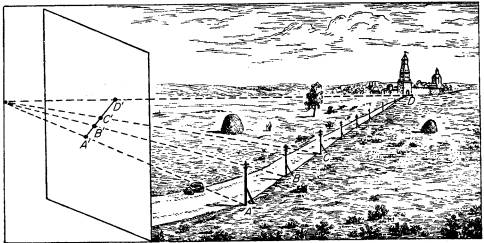
It might seem that there are only a few, very
primitive properties that are preserved under the arbitrary projective
transformations, but this is by no means so. For example, we do not notice
immediately that the theorem stating that the points of intersection of opposite
sides (produced) of a hexagon inscribed on a circle lie on a straight line also
holds for an ellipse, parabola, and hyperbola. The theorem only speaks of projective
properties, and these curves can be obtained from the circle by projection. It is even less obvious that the theorem
to the effect that the diagonals of a circumscribed hexagon meet in a point is a
peculiar analogue of the theorem just mentioned; the deep connection between
them is revealed only in projective geometry. Also it is not obvious that under a
projection, irrespective of the distortion of distances, for any four
points A, B, C, D lying on a straight line the cross ratio AC/CB: AD/DB remains
unaltered
AC : AD = A’C’ :
A’D’
CB DB C’B’ D’B’
This implies that many relations are
maintained in perspective. For
example, by using this fact it is easy to determine the distance of the
telegraph poles A, B, C from the point D on a photograph of the road leading
into the distance, when their spacing is known…. It stands to reason that its
laws are used in architecture, in the construction of panoramas, in decorating,
etc.[65]
The successive splashdowns of this “skimming stone” are implicit in the
text just cited: Desargues was one
of the few people whose mental equipment the insufferably arrogant Descartes
actually respected and admired;[66]
the “mystic hexagram” theorem was the creation of their sixteen-year-old mutual
protégé, Blaise Pascal.[67] Poncelet, of course, is “synchronous”
with the synecdochic splashdowns of our other two skimming stones. Next up is the multiplicity of explicit
perspectives presented in Cubist paintings and quantum mechanics (which latter
sees the region of material description we live in as the result of
“projection” from an infinite number of “Hilbert Space” dimensions).[68] And finally, in the A-D-E Problem, we
have the “theory of buildings” due to the unfortunately named Belgian, Jacques
Tits. But the “accidental”
connection of perspective invariance to Catastrophe Theory is what’s
most compelling here. For of the
numerous “controls” with which one works the strings of the Double Cusp’s
“marionette,” there is one not like the others, which – in the typically
“trifling” style mathematicians are so apt to fall prey to – has all its mystery
rubbed out by being dubbed a mere “parameter.”
But we sense the possibilities for
re-enchantment when we realize that this peculiar control in fact provides a
measure of the “cross-ratio,” and that each of its infinity of possible values
is associated with a distinct manifold: like Cusa’s painting, myriad
differentiably distinct viewpoints (one “Tegernsee monk” per
“differentiable manifold”) are underwritten in a unitary manner from the
topological “God’s-eye view” perspective. The history of this revelation is
subtle and arcane, going back to exotic discoveries in the 1950s showing that,
in certain higher-dimensional contexts, the protean stretchability of the
topologist’s “rubber sheet geometry” no longer implied a similar kink-free
“smoothness” in the cascade of rates (and rates of rates) of change. (Technically speaking, “bouquets of
spheres” were discovered for which homeo- no longer implied diffeo-
morphism.) But there’s a simple way
to envision this profoundly inscrutable result in the context of
Catastrophic unfoldings. For the
Double Cusp, generated by two fourth-order “germs” working in tandem, could
thereby be seen as the result of perturbing the relative crossings of four lines
dropped like Pick-Up Sticks into “general position” on a tabletop.
Why?
Projective geometry’s key feature, first discerned by Poncelet and since
called “duality,” is that
dimensional reduction – like a photo’s 2-D image of the 3-D it’s a “projection”
from – cuts both ways: any theory
about lines, say, intersecting in points in a 2-D projection
from a 3-D space, will have an exactly analogous result concerning points
determining lines. (Return
to the prior long quote, and contemplate the sentence beginning “It is even
less obvious…”: the theorem limned
in the prior sentence is Pascal’s “mystic hexagram”; that sketched in
the sentence just referenced was found by Brianchon a century later; but
Poncelet showed that, from the “projective” vantage, they are exactly
equivalent expressions! Put
another way, “vanishing points” in a picture plane imply “horizon lines at
infinity.”) One can, therefore,
consider the “cross-ratio invariance” not just of four points between which
linear proportions can be measured and related, but between four
line segments which intersect each other in an arbitrary manner.
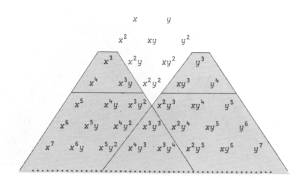
The
"controls" of the Double Cusp attach to the monomials which aren't in
shadow: all combinations of X and Y with no exponent greater than 2.
The terms of the "germ" of the unfolding, the monomials X4 and Y4, are
underlined, and it is their first derivatives which "cast the shadows." In
the usual "Mendel's Ratios" usage of Pascal's Triangle, coefficients of
the monomials (which always sum to a power of 2 on any given line) matter most;
here, the algebraic content does, since each monomial attaches to a
variable ("control dimension"): imagine a zero outside the
drawing, with "marionette strings" leading to each control's monomial; then
imagine these strings are the axes of a multidimensional "control space" (to
which the "behavior dimensions" X and Y also attach). We'll learn how to
navigate this space in the next installment. From Poston & Stewart,
Catastrophe Theory and Its Applications, p. 163.
As high-school algebra plus a pencil and a
piece of graph paper can show us, each of these four lines can be written
in the form aiX + biY, 1 < i < 4,
where the a’s and b’s are constants for a fixed arrangement, or variable
“controls” if the lines are mobile; in the latter case, their general product
would then have the form of X4 + Y4, plus lower-order
terms in X and/or Y on Pascal’s Triangle.[69] Catastrophe Theory tells us this mess of
monomials can be reduced, by a
hand-waving “change of variables” technique known as “Siersma’s Trick,”[70]
to the 3 by 3 rhombus on the Triangle which has a “1” at the top and
“X2Y2” (the “cross-ratio” term) at the bottom, and
X2 and Y2 at the extreme positions on the outer
slopes. (These latter two, you
should recall, are just the “splitting factors” of two Cusp catastrophes, one in
X, the other in Y, whose first powers are “controlled” by their respective
“loading factors”: hence, the
“Double Cusp” nomenclature.) Forgetting the “1” (which, from the
topologist’s vantage, is merely a displacement factor), we thereby get
seven standard “controls” plus the point-of-view-fixing “parameter.”
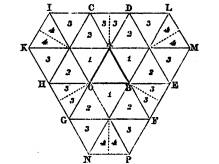
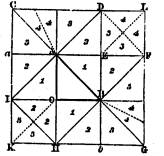
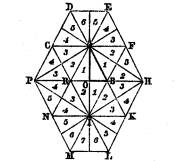
From Sir
David Brewster's The Kaleidoscope, Ch. XIII: On the Construction
and Use of Polycentral Kaleidoscopes.
Basic "wallpaper pattern" for each of the 3-mirror prismatics, each with
"Timaeus triangle" cross-section. The numbers in the triangles indicate
how many reflections are involved in painting its image (an index of its
brightness); each such scope has one un-numbered triangle, which is the aperture
where the viewer looks in at the honeycomb of images.
What does this parameter mean in terms of our general theme? Something very concrete: by another “trick” fundamental to
Catastrophists, the so-called “Splitting Lemma,” an indefinite number of
behavior variables can co-exist and be dispensed with, provided none have terms
of higher than second order: hence,
to the X and Y “behaviors,” we can always assume there’s a third whose
“germ” is Z2. What does
this get you, you ask? Well, since
the days of Fourier at least, it has become “natural” for mathematicians to
write equations in the complex plane, with “real” expressions as mere
“projections” on the walls of Plato’s Cave. And this quickly gives us Plato’s
“Timaeus Triangles” – and 3-mirror kaleidoscopes!
Pictures of these scopes – related to the 3 infinite families of
“non-elementary” catastrophes begun by the three simplest forms with one
parameter – can be found in Brewster’s book. The “triangle,” in each case, is the
cross-section of the prism formed by the three mirrors. If the exponents of the “germ terms” are
related to aliquot parts of semicircular[71]
orbits in complex space, the Z2 reads as 90o (a right
angle, in other words), and the X4 and Y4 of the double
cusp then span 45o each, yielding the right isosceles triangle. (I have a scope based on the equilateral
triangle – X, Y, and Z terms are all cubes – and ones based on the 30-60-90
triangle also abound.) What all
three of these “Timaeus” kaleidoscopes have in common is not one, but an
infinite number, of centers of symmetry – exactly corresponding to the “Vision
of God”-like “parameter effect.”
What does this parameter mean in modeling real things? Well, it depends upon what you mean by
“real.” As we will explore in some
detail in the next installment of this eight-part argument, psychological
phenomena like trance induction can be modeled using the “full” Double Cusp;
when one does so, the “parameter” measures “susceptibility,” in two
senses: first, to paraphrase the
Gospel admonition, “many are called, but few are chosen”; secondly, only a
“narrow strait” of values, symmetrically arrayed around the zero of the
parameter, allow for merger of the distinct individual in the One which
transcends the ego.
The thematic foci of both this current essay and its just-alluded-to
sequel have been wonderfully indicated in a singular work of Carl Jung’s – the
only in his opus which he ever went back to and totally overhauled. (Given that it marked his break with
Freud, this is not surprising; and, as we shall see next time, and have already
foreshadowed in the prior installment, this was also the work where a bevy of
kaleidoscope images portended his upcoming shift to mandala
symbolism.) On the subjects of
crowd psychology (wherein one is ever at risk of “losing oneself” in a
negative way), and the transcendence of the personal in the ineffable
(where one “loses oneself” in quite another sense), Symbols of
Transformation has this to say:
I have often noticed the symbol of the crowd, and particularly of a streaming mass of people in motion, expresses violent motions of the unconscious. Such symbols always indicate an activation of the unconscious and an incipient dissociation between it and the ego.[72]
Individual consciousness is only the flower and the fruit of a season, sprung from the perennial rhizome beneath the earth; and it would find itself in better accord with the truth if it took the existence of the rhizome into its calculations. For the root matter is the mother of all things.[73]
In the pages preceding, we have come to see the possibility of “skimming
stone sequences” being treated as having, to paraphrase Lord Acton, “a
radiation and development, an ancestry and posterity of their own, in which men
play the part of godfathers and godmothers more than that of legitimate
parents.” A mode of history which would
contemplate their synchronous (and eventually, syncopated) deployments
across and within developmental contexts (like the “Age of Synecdoche”
we’ve been focused on herein) has been, perhaps, adumbrated, but clearly
calls for further unfolding, framing, and refining. As a final gesture in these present
considerations, it would do us well to reflect on the construction which has
held our attention (and, indeed, fed it its contents) over the last few
pages. Rather than leave the
four-termed framework that has guided our thoughts in a limbo of
incoherence – is it meant to embody Lévi-Strauss’ Klein Group only? Or his Klein Group only as an instance
of his “canonical law of myths”? Or
is the instantiation of Derrida’s “passe partout” to be given pride of place,
with the Klein Group serving as a constraint to stabilize its protean
tendencies? – let’s give it an identity of its own.
At the time Boscovich’s return trip to France was interrupted by what
proved to be his final illness, Haydn’s six “Paris symphonies” scored a
major triumph in the French capital.
In 1772 – the year before the Jesuits were disbanded, and Boscovich
relocated to Paris – Haydn’s Opus 20 “Sun Quartets” did for the classical form
they made paramount what Elvis’ “Sun Tapes” did for rock ‘n’ roll. The year before the Bastille fell,
Haydn’s Opus 54 and 55 string quartets were published (the second of the latter
set, called the “Razor,” inspiring the architecture of this discourse, as I’ll
explain in my final installment).
In his National Book Award-winning study of The Classical Style: Haydn, Mozart, Beethoven,
pianist Charles Rosen tells us that the string quartet’s pre-eminence in
chamber music, from Haydn’s first triumphs to the death of
Schubert,
is not the accidental result of a handful of
masterpieces: it is directly
related to the nature of tonality, particularly to its development throughout
the eighteenth century. A hundred
years earlier, music had not yet shaken off the last traces of its dependence on
the interval: in spite of the
central importance of the chord – the triad in particular – dissonance was still
conceived in intervallic terms, and the resolution of dissonance, consequently,
even in late seventeenth-century music, very often satisfies the aesthetic of
two-part counterpoint and ignores the tonal implications. By the eighteenth century, dissonance is
always dissonance to a triad, stated or implied...[74]
At the end of the last installment, we heard Lévi-Strauss argue that “the
point at which music and mythology began to appear as reversed images of each
other coincided with the invention of the fugue.” But this process of myth’s
“reincarnation in music” attained its apotheosis in the string quartet: for it was there that the shape of the
“canonical law of myths” itself attains to splendid
self-reflection:
The string quartet – four-voice polyphony in
its clearest non-vocal state – is the natural consequence of a musical
language in which expression is entirely based on dissonance to a triad. When there are fewer than four voices,
one of the non-dissonant voices simply must play two notes of the triad, either
by a double stop or by moving quickly from one note to the other… (The resolution of certain dissonances
will, of course, itself create a triad and therefore demand no more than
three-part writing, but some of the basic dissonances of late
eighteenth-century harmony, like the dominant seventh, require four
voices.) More than four voices gave
rise to questions of doubling and spacing, and the woodwind quartet created
problems of the blending of tone-color (and, in the eighteenth century, of
intonation as well). Therefore only
the string quartet and the keyboard instrument allowed the composer to speak the
language of classical tonality with ease and freedom, and the keyboard had the
disadvantage (and the advantage!) of less striking linear clarity than the
string quartet.[75]
With the death of Schubert, the pre-eminence of the string quartet ends,
and the muddying of the tritone’s chordal logic in the chromaticist excesses of
the Romantics is well under way.
And as the string quartet itself fades from center stage, what other
symptoms of malaise are manifest in the general sensibility? I have tried to give at least a partial
answer to such questions here. With
the fall of public man, the capacity for playacting atrophied, and the age of
public spaces as mute wastelands was initiated. And perhaps the greatest of
the public arts, flourishing with such spontaneity in the salons of the
ancient regime, was soon lost
from view. Taking its cue
from the rhythms of lived emotion as actually spoken, then idealized
in opera buffo, where its acme was achieved in the joyful vocalic interweaves of
Haydn’s intimate friend and frequent partner in string quartet
sessions, Wolfgang Mozart, it attained to a life freed from the constraints
of embodiment, liberated in the polished surfaces of stringed instruments’
impassioned dialectics. Today,
it is totally caricatured and debased in such dismal proofs of
its morbidity as “talk radio”; but its grandiloquence has been captured
forever in the “rehearsed impromptus” of the Vienna classicists’
sonorous crystals of mythical vivacity and charm:
Eighteenth-century prose in England, Germany,
and France had become, in comparison with the previous age, much more syntactic,
relying more exclusively on balance, proportion, shape, and the order of
the words than did the heavier cumulative technique of the Renaissance. The eighteenth century was cultivatedly
self-conscious about the art of conversation: among its greatest triumphs are the
quartets of Haydn.[76]