The New York Times
May 25, 1999BOOKS OF THE TIMES
'Juneteenth': Executor Tidies Up
Ellison's Unfinished SymphonyBy MICHIKO KAKUTANI
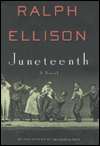

JUNETEENTH
By Ralph Ellison. Edited by John F. Callahan.
368 pages. Random House. $25.
ver the years, Ralph Ellison's unfinished second novel has assumed the status of a literary myth. His first novel, "Invisible Man," published in 1952, established him unequivocally as a modernist master, and over the next four decades he labored to produce a follow-up to that masterpiece. In 1966 a fire at his home destroyed a portion of his manuscript, and during the ensuing years there were reports that the work in progress was slowly changing shape, evolving into an increasingly ambitious saga that, in the words of his literary executor, John F. Callahan, was "multifarious, multifaceted, multifocused, multivoiced, multitoned."
That manuscript was unfinished at Ellison's death in 1994, and from some 2,000 pages of typescript and printouts, Callahan has extracted "Juneteenth," the one narrative he says that "best stands alone as a single, self-contained volume."
"Aiming, as Ellison had, at one complete volume," Callahan writes, "I proceeded to arrange his oft-revised, sometimes reconceived scenes and episodes according to their most probable development and progression. While doing so, I felt uneasily Procrustean: Here and there limbs of the manuscript needed to be stretched, and elsewhere a protruding foot might be lopped off, if all the episodes were to be edited into a single, coherent, continuous work."
The resulting book provides the reader with intimations of the grand vision animating Ellison's 40-year project, but it also feels disappointingly provisional and incomplete. Given all the cutting and tidying up Callahan has done, the book's opaqueness and attenuation come as little surprise: after all, he has effectively changed the book's entire structure and modus operandi. Instead of the symphonic work Ellison envisioned, Callahan has given us a single, tentatively rendered melodic line. Instead of a vast modernist epic about the black experience in America, he has given us a flawed linear novel, focused around one man's emotional and political evolution.
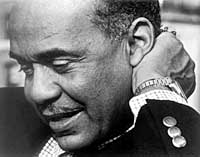
Bob Adelman/ Random HouseRalph Ellison Related Links
Wright Morris Reviews 'Invisible Man' (April 13, 1952) Obituary: Ralph Ellison (April 17, 1994) From Ellison, a Posthumous Novel, With Additions Still to Come (February 11, 1999) Faced With 'Parvenu' or 'Pariah,' an Artist Stood His Ground (May 15, 1999) Invisible Hand from The New York Times Magazine (May 23, 1999) That central story -- featuring a "hi-yaller" boy named Bliss who repudiates his black stepfather and grows up to become a race-baiting Senator named Sunraider -- remains sketchy and psychologically unconvincing. Callahan's narrative does not provide a satisfying emotional basis for Bliss' startling transformation, nor does it make persuasive his eventual efforts to come to terms with his past. Still, there are bravura passages of writing in the volume -- dazzling riffs that remake the American vernacular tradition by juxtaposing old-time Bible-Belt sermons with fire-breathing political rants, call-and-response exchanges with Joycean stream-of-consciousness lines. Such brilliant passages suggest that Ellison's uncompleted saga might have fused Faulkner's mythic impulses with Twain's mastery of the American idiom, that the unfinished work might have used the rich, interpenetrating strands of American language to underscore the ways in which black and white experience overlap and blur, the ways in which individuals use language to both define and reinvent themselves.
As for the tale of Bliss, it contains hints of Ellison's conscious or unconscious determination to create a kind of bookend to "Invisible Man." That earlier novel recounted the story of a nameless black man's search for an identity in a world intent on defining him in terms of race, and in doing so, it unfolded into a Dostoyevskian meditation on existential self-definition. "Juneteenth," in contrast, focuses on a man's evasion of identity, as he attempts -- in vain, it turns out -- to erase his personal history by embracing racial hatred.
By cutting back and forth between the point of view of Bliss and his surrogate father, the Rev. Alonzo Hickman, Ellison gives the reader dozens of jigsaw puzzle pieces to fit together into a story. We learn that Hickman has arrived in Washington (sometime in the mid-1950s, it seems) to try to warn Senator Sunraider of impending danger. When the senator is wounded by an assassin, the one person he wants to see is the black minister -- the man, it turns out, who raised him as a boy.
As Hickman sits by the senator's hospital bed, the two men review the past, sometimes talking to each other, sometimes drifting into reveries and rationalizations of their own. Bit by bit, it is revealed that Hickman adopted baby Bliss from a white woman, whose accusations led to the lynching of Hickman's brother. By turning the boy into his protege, Hickman hopes to redeem this senseless death and transcend the racial hatred that his people have endured.
Although the "promising babe" wins the love and acceptance of Hickman's Baptist congregation, something happens during a Juneteenth celebration that derails Bliss' life. During the service, commemorating the anniversary of June 19, 1865 (the day, two and a half years after the effective date of the Emancipation Proclamation, that Union troops landed in Galveston, Tex., and informed the slaves that they were free), a crazed white woman appears and declares that Bliss is her long-lost son.
Hickman's congregation thwarts her efforts to kidnap Bliss, but the boy henceforth longs for the mother he never knew. In time he is reborn, not as Hickman's dreamed-of redeemer of racial prejudice but as a con man and politician. In each of these new incarnations, he will use the rhetorical skills he learned from Hickman for selfish, secular ends.
"The reader who is familiar with the traumatic phase of the black man's rage in America will find something more in Mr. Ellison's report. He will find the long anguished step toward its mastery. The author sells no phony forgiveness. He asks none himself. It is a resolutely honest, tormented, profoundly American book." -- Wright Morris, in the original New York Times review of 'Invisible Man' (April 13, 1952)
THE TIMES ON 'INVISIBLE MAN'
In some notes about his novel in progress, Ellison has Hickman wondering why Bliss turned on the black people who brought him up: "Was it perversity, or was it that the structure of power demanded that anyone acting out the role would do so in essentially the same way?" Why did Bliss wrap his heart in "stainless steel"? Why did he embrace the politics of hate? Though such questions may be addressed somewhere in the hundreds of manuscript pages Ellison left behind, they are left dangling in these pages.
In fact Bliss' inner life remains so shadowy in "Juneteenth" that he never becomes more than a symbol Ellison used to explore the idea of racial prejudice -- a role that could have been effective in a larger, multivoiced epic but that remains more problematic in this more linear format. As it stands, Bliss' actions often seem so arbitrary that he comes across as a repudiation of the idea, so oft reiterated in Ellison's earlier work, that experience, not ideology, forms the cornerstone of human life, that identity always eludes the oversimplifications of race.
Hickman, however, emerges as one of Ellison's most powerful creations -- a big, large-hearted man whose idealism has been tested by loss and whose capacity to love transcends his disillusionment. A former jazzman turned preacher, Hickman is hard-wired to both the spiritual yearnings of his congregation and their exuberant, earthly desires. He articulates the dream of pluralism promised by America's founders and his own Creator's faith in "the basic unity of human experience."
Though he despises the bigot that Bliss has become, Hickman continues to love "the boy whom the man had been." Indeed his story suggests, as does the novel's epigraph from T.S. Eliot's "Four Quartets," that memory can redeem the past, that it can transfigure history, however painful, into another pattern.