The deep-set eyes of the actor
Ami Dayan — now wounded, now piercing, now glistening with righteous
anger — tell a story of their own in “The Man Himself,” a sober,
quietly unsettling solo show about an ordinary man’s slide toward
religious fanaticism. The words Mr. Dayan speaks in his average-Joe
role are, for the most part, reasoning and reasonable. The play’s
emotional temperature only rarely rises to a simmer, let alone a
turbulent boil. But if you look deeply into the dark brown eyes beaming
from under Mr. Dayan’s determined brow, you seem to be staring into an
abyss.
Adapted and directed by Mr. Dayan from the original play by Alan Drury (Mark Williams is the co-adapter), it explores the process of a mind closing in on itself, as a disappointed man searches for meaning by submitting to the rigid ideology of a collective movement. First performed in 1975 at the National Theater in London, “The Man Himself” has been seen in more than 50 productions, sometimes in versions adapted to suit various cultural contexts.
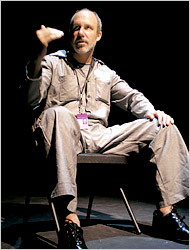
Photo by Paul AulgurAmi Dayan plays Michael,
whose sorrow transmutes
into anger.
Adjustments are not hard to make. Fanaticism is not, as recent history has made clear, alien to any nations or the exclusive province of any religion. As Mr. Drury and Mr. Dayan delicately but hauntingly illustrate in this hourlong show, it is a psychological state engendered all too easily when people are exposed to certain kinds of stress.
The setting in the version that opened last night at the 59E59 Theaters is Denver, a city bang in the middle of America, and the narrator is a functionary in an electrical supply warehouse named Michael. At first glance he is an eminently normal guy, average to the point of ponderousness, save for a few small psychological tics.
He definitely has a compulsive streak. He goes on a bit about his uniform and how he likes to wash it himself rather than let the company do it, as he’s supposed to. And his habit of lighting a cigarette, rolling it in his fingers and taking two long drags before suddenly stubbing it out on his shoe, is a little odd. But having a hard time quitting nicotine is hardly aberrant.
As the details of Michael’s prosaic history begin to sink in, almost despite their studious blandness, a portrait forms of a man weakening under the small bruisings of life. His obsessive respect for the rules at work — got to have the right signatures on the right forms before he’ll hand over that transformer — has made him something of an outcast. With little rancor, perhaps even with a tinge of pride, he describes the abuse he takes for being such a stickler.
Casual references to the breakdown of his marriage increase our sense of Michael’s spiritual isolation. A lifelong loner who still retains traces of a foreign accent from his European roots, he may have inherited a tendency toward rigidity from his mild crank of a father, who saw the world in black and white and fired off letters to the newspapers at the rate of two a week.
But marriages fall apart every day, and there are eccentricities in every family, aren’t there? The achievement of Mr. Drury’s play, and of Mr. Dayan’s restrained but compelling interpretation of it, is in how it exposes alienation as a commonplace state of mind.
There’s nothing overtly nutty about Michael. He has a few friends; he was happily married, at least for a while; he takes a measure of pride in holding down a steady if uninteresting job. But when his wife finally leaves him, with brutal parting words, and after a violent confrontation with a gang of hoodlums at a train station, Michael begins to look more closely at the literature being handed out by a new friend.
“Some of the things they said were a bit extreme,” he says, reasonably, about attending a meeting at his friend’s church, “but at least they are prepared to do something about things. These are good Christian folks with good Christian ideals, and they’re not ashamed of having answers. They’re trying to do what they think is right for people like me.”
Those last words — “people like me” — are telling. Stung by an accumulation of small personal sorrows, Michael cannot resist dissolving them into a collective sense of grievance. He trades his me-against-the-world view for an us-versus-them ideology that is both consoling and psychologically empowering.
Christians may question the subtle equation the play makes between a turn toward evangelism and psychological dysfunction. Michael is not by any means a flagrant kook, but he is clearly man with major “issues,” and the implicit suggestion that evangelical faith is born of spiritual or emotional poverty might seem to reduce religious devotion to a textbook pathology.
“The Man Himself” is not about religious faith; it’s about the seductions of collective movements. Mr. Drury and Mr. Dayan’s aim is to reveal how they exploit the loneliness and alienation that are symptomatic of modern civilization, and in some cases channel it into hostility and violence.
If this average American guy undergoing a series of unexceptional shocks can be persuaded to enlist in a small-scale holy war, after all, it is easy enough to understand how such movements take root in the world’s more impoverished, dehumanizing climates.
THE MAN HIMSELF
By Alan Drury; adapted, directed and performed by Ami Dayan;
co-adapted by Mark Williams; lighting, stage management and technical
operations, Michael Ou; film and graphic design by Benjamin Flaherty;
general manager, the Splinter Group: Seth A. Goldstein, Anne Love and
Elisabeth Bayer. Presented by Maya Productions at the 59E59 Theaters,
59 East 59th Street, Manhattan, (212) 279-4200. Through Oct. 1. Running
time: 1 hour.
Copyright 2006 The New York Times Company