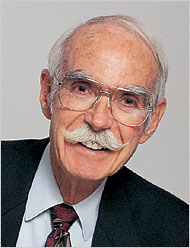
G. Robert Crowningshield, a gemologist who helped revolutionize methods for judging the quality of precious stones and for spotting fakes, died on Nov. 8 in Hightstown, N.J. He was 87.

He lived in the Upper West Side of Manhattan.
His death was confirmed by a spokesman from the Gemological Institute of America; Mr. Crowningshield had been a fixture in the institute’s Manhattan laboratory since 1949, introducing ever more exacting methods for defining the color, cut and clarity of gems.
In the 1950s, he helped introduce the use of a spectroscope, a powerful tool for jewelers and gemologists to assess the authenticity and color of a given diamond. At the time, a supply of relatively rare yellow diamonds had appeared on the gem market, leading to questions about the source of their color that could not be answered by examination under a microscope.
Using the spectroscope, Mr. Crowningshield conducted an extended study of yellow diamonds and was able to observe distinctions between more valuable natural stones and those whose color had been intentionally altered by exposure to radiation. He then drew the signature spectra revealed by the spectroscope for both authentic and artificially colored stones. His published illustrations became a standard resource in the field of gem identification.
With his colleagues at the institute, he developed a widely accepted system for grading polished diamonds and thereby helped introduce a phrase familiar to many bridegrooms — the need to determine the “cut, color, clarity and carat weight” of a diamond before buying it.
In other work, Mr. Crowningshield studied the characteristics of natural and cultured pearls, synthetic diamonds and dyed jade and lectured on these subjects. He was frequently called upon to examine large and unusual gems, and helped to grade the 45.5-carat Hope diamond for the Smithsonian Institution.
George Robert Crowningshield was born in Colorado Springs, Colo. He received an undergraduate degree in natural sciences from San Diego State University and later trained in gemology at the institute.
He joined the institute in 1947 and served as director of its Manhattan laboratory from 1952 to 1977. He formally retired as vice president of its laboratory in the 1990s.
Mr. Crowningshield never married.