Cached Feb. 16, 2007, from
http://www.lib.rochester.edu/Camelot/grlmenu.htm
Return to the Main Menu of The Camelot Project at the University of Rochester
THE HOLY GRAIL
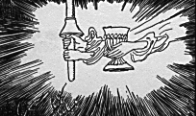
The Holy Grail is generally considered to be the cup from which Christ
drank at the Last Supper and the one used by Joseph of Arimathea to
catch his blood as he hung on the cross. This significance, however,
was introduced into the Arthurian legends by Robert de Boron in his
verse romance Joseph d'Arimathie (sometimes also called Le Roman de l'Estoire dou Graal),
which was probably written in the last decade of the twelfth century or
the first couple of years of the thirteenth. In earlier sources and in
some later ones, the grail is something very different. The term
"grail" comes from the Latin gradale, which meant a dish
brought to the table during various stages (Latin "gradus") or courses
of a meal. In Chrétien and other early writers, such a plate is
intended by the term "grail." Chrétien, for example, speaks of "un
graal," a grail or platter and thus not a unique item. Wolfram von
Eschenbach's Parzival presents the grail as a stone which
provides sustenance and prevents anyone who beholds it from dying
within the week. In medieval romance, the grail was said to have been
brought to Glastonbury in Britain by Joseph of Arimathea and his
followers. In the time of Arthur, the quest for the Grail was the
highest spiritual pursuit. For Chrétien, author of Perceval and
his continuators (four works take up the task of completing the work
that Chrétien left unfinished, two of which are anonymous, one is by
Mannesier, and a fourth is by Gerbert de Montreuil), Perceval is the
knight who must achieve the quest for the Grail. For other French
authors, as for Malory, Galahad is the chief Grail knight, though
others (Perceval and Bors in the Morte d'Arthur) do achieve the
quest. Tennyson is perhaps the author who has the greatest influence on
the conception of the Grail quest for the modern English-speaking world
through his Idylls and his short poem "Sir Galahad". However, James Russell Lowell's "The Vision of Sir Launfal",
one of the most popular of nineteenth-century American poems gave to
generations a democratized notion of the Grail quest as something
achievable by anyone who is truly charitable. The notion that the Grail
story originated in fertility myths was popularized by Jessie Weston in
her book From Ritual to Romance, which was used by T. S. Eliot in the writing of The Waste Land.
Eliot's poem, in turn, influenced many of the important novelists of
his and succeeding generations, including Hemingway and Fitzgerald.
TEXTS:
- Adams, Oscar Fay (1855-1919), "The Return from the Quest" (1886)
- Adams, Oscar Fay (1855-1919), "The Vision of Sir Lamoracke" (1886)
- Alford, Henry (1810-1871), "The Ballad of Glastonbury" (1853)
- Arthur's Knights: An Adventure from the Legend of the Sangrale (1859)
- Cawein, Madison J. (1865-1914), "Waste Land" (1913)
- Cooke, Rose Terry (1827-1892), "The New Sangreal" (1888)
- De Beverley (Pseudonym of George Newcomen), "The Achievement of the Sangraele and the Death of Sir Galahad" (1925)
- De Beverley, Thomas (Pseudonym of George Newcomen, "Sir Percival's Vision" (1925)
- Field, Eugene (1850-1895), "The Vision of The Holy Grail" (1905)
- Fowler Wright, S[ydney] (1874-1965) The Song of Arthur (Part 4: Carbonac) (from the S. Fowler Wright Website)
- Gareth, David (b. 1946), "Sir Mador Seeks the Grail" (1987)
- Hawker, Robert Stephen (1803?-1875), "The Quest of the Sangraal" (1864)
- The History of That Holy Disciple Joseph of Arimathea (?1770)
- Hylton, J. Dunbar (1837-1893), Arteloise: A Romance of King Arthur and Knights of the Round Table (1887)
- Jewett, Sophie (1861-1909), "The Dwarf's Quest: A Ballad" (1905)
- Larcom, Lucy (1824-1893), "The Cross and the Grail" (1887)
- Lowell, James Russell (1819-1891), "The Vision of Sir Launfal" (1848)
- Machen, Arthur (1863-1947), The Great Return (1915)
- Morris, William (1834-1896), "The Chapel in Lyoness" (1858)
- Morris, William (1834-1896), "Sir Galahad, A Christmas Mystery" (1858)
- Payne, John (1842-1916). "The Romaunt of Sir Floris" (1870)
- Rhys, Ernest (1859-1946), "The City of Sarras" (1905)
- Rhys, Ernest (1859-1946), "The Dolorous Stroke" (1905)
- Rhys, Ernest (1859-1946), "The Quest of the Grail: On the Eve" (1905)
- Rhys, Ernest (1859-1946), "Sir Launcelot and the Sancgreal" (1905)
- Rhys, Ernest (1859-1946), "Timor Mortis" (1905)
- Rossetti, Dante Gabriel (1828-1882), "God's Graal" (written 1858; published 1911)
- "The Sancgreal" (from Six Ballads about King Arthur) (1881)
- Tennyson, Alfred, Lord (1809-1892), "The Holy Grail" from The Idylls of the King
- Trask, Katrina (1853-1922), "Kathanal" (1892)
- Tennyson, Alfred Lord (1809-1892), "Sir Galahad" (1834)
- Underhill, Evelyn (1875-1941), The Column of Dust (1909)
- Weston, Jessie (1850-1928), "Knights of King Arthur's Court" (1896)
- Young, Ella (1867-1955), "The San-Grail" (1920)
IMAGES:
-
 Beardsley, Aubrey (1872-1898), "The Achieving of the Sangreal" (1894)
-
 Brown, Ian (b. 1962), "Percival Sets out for King Arthur's Court" (2002)
-
 Chapman, William Ernest, "The Departure of the Knights [on the Quest for the Grail]" (1908)
-
 Chapman, William Ernest, "The Golden Girdle" (1908)
-
 Chapman, William Ernest, "The Marvelous Appearance of the Sangreal at Camelot" (1908)
-
 Chapman, William Ernest, "Sir Galahad Beholds the Sangreal Uncovered" (1908)
-
 Dixon, Arthur (fl. 1893-1920), "The Holy Vessel Appeared in Their Midst" (1921)
-
 Flint, William Russell, Sir (1880-1969), "'Ah, Sir Bors, Gentle Knight Have Mercy on Us All'" (1927)
-
 Flint, William Russell, Sir (1880-1969), "And
Then They Put on Their Helms and Departed, and Recommended Them All
Wholly unto the Queen; and There Was Weeping and Great Sorrow" (1927)
Flint, William Russell, Sir (1880-1969), "And
Then They Put on Their Helms and Departed, and Recommended Them All
Wholly unto the Queen; and There Was Weeping and Great Sorrow" (1927)
-
 Flint, William Russell, Sir (1880-1969), "And Therewith on His Hands and on His Knees He Went so Nigh that He Touched the Holy Vessel" (1927)
-
 Flint, William Russell, Sir (1880-1969), "'As Soon as I Wist that This Adventure Was Ordained Me I Clipped off My Hair, and Made this Girdle in the Name of God'" (1927)
-
 Flint, William Russell, Sir (1880-1969), "'My
Knights, and My Servants, and My True Children, Which Be Come out of
Deadly Life into Spiritual Life, I Will Now No Longer Hide Me from You'" (1927)
Flint, William Russell, Sir (1880-1969), "'My
Knights, and My Servants, and My True Children, Which Be Come out of
Deadly Life into Spiritual Life, I Will Now No Longer Hide Me from You'" (1927)
-
 Garrett, Edmund H. (1853-1929), "Launcelot Beholds the Towers of Castle Carbonek" (1901)
-
 Garrett, Edmund H. (1853-1929), "Three Angels Bear the Holy Grail" (1901)
-
 Harrison, Florence (1884-19--), "TheGrail Maiden" (1912)
-
 Kappes, Alfred (1850-1894), "Sir Galahad Brought to the Siege Perilous" (1880)
-
 Kappes, Alfred (1850-1894), "Sir Launcelot at the Castle of the Holy Grail" (1880)
-
 Kirk, M[aria]. L[ouise]. (1860-193x), "'And Down the Long Beam Stole the Holy Grail'" (1912)
-
 Paul, Evelyn, "It Is Indeed the Cup" (1913)
-
 Rackham, Arthur (1867-1939), "How at the Castle of Corbin a Maiden Bare in the Sangreal and Foretold the Achievements of Galahad" (1917)
-
 Willy Pogŕny (1882-1955), Titurel and the Grail (1912)
-
 Pyle, Howard (1853-1911), The Grail Is Manifested, and Sir Lancleot Sleepeth (1910)
-
 Stassen, Franz (1869-1949), "The Communion of the Holy Grail" (1903)
-
 Stassen, Franz (1869-1949), "Montsalvat, the Castle of the Grail" (1903)
-
 Stassen, Franz (1869-1949), "Parsifal in Quest of the Holy Grail" (1903)
-
 Stassen, Franz (1869-1949), "Parsifal Healing King Amfortas" (1903)
-
 Stassen, Franz (1869-1949), "Parsifal Revealing the Holy Grail" (1903)
BIBLIOGRAPHY
Barber, Richard W. The Holy Grail: Imagination and Belief. Cambridge: Harvard University Press, 2004.
Jung, Emma and Marie-Louise von Franz. The Grail Legend. Trans. Andrea Dykes. 2d ed.; Boston: Sigo Press, 1986. (Originally published in 1960 as Die Graalslegend in psychologischer Sicht.)
Loomis, Roger Sherman. The Grail: From Celtic Myth to Christian Symbol. New York: Columbia University Press, 1963.
Owen, D. D. R. The Evolution of the Grail Legend. Edinburgh: Oliver and Boyd, 1968.
Waite, Arthur Edward. The Holy Grail: The Galahad Quest in the Arthurian Literature. New Hyde Park, NY: University Books, 1961.
Weston, Jessie L. The Quest of the Holy Grail. 1913; rpt. New York: Haskell House, 1965.