Cached on April 27, 2007, from
http://library.by/portalus/modules/warcraft/special/remember.ru/nagrady/o_slava.htm
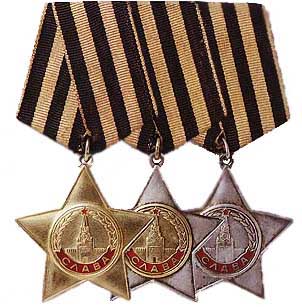
Order of Glory
|
| Order og Glory I, II and III degree |
Designed by N.I.Moskalev. This order was established on
8 November 1943. The order was intended for privates and NCOs, that's why it
was the most junior in the ranking system of orders. But despite such a modest
place in the order hierarchy and its short history -- it was given out for only
a year and half -- the Order of Glory quickly gained a huge popularity
among the fighters of the Red Army, and its holders -- a well-earned respect
among the people. The order had several peculiarities. First, it was the only
military decoration intended exclusively for privates and NCOs (in the Air Force,
for junior lieutenants as well). Second, the decoration was performed in ascending
order, starting with the most junior III degree. Third, the Order of Glory was
until 1974 the only USSR order awarded only for personal merit and never given
to military units, companies, or organizations. Fourth, the order's statute
stipulated the promotion of the holder of all three degrees in rank, which was
an exception for the Soviet system of decorations. The Statute of the order
reads: "The Order of Glory is awarded to privates and NCOs of the Red Army,
and also junior lieutenants in the Air Force, who exhibit glorious feats of
valour, courage, and fearlessness in combat for the Soviet Motherland."
the statute listed 32 combat merits for which the Order of Glory could be awarded.
The most significant of them are listed below: "The Order of Glory is awarded
for:
broke into the enemy disposition, furthered the success of the common cause
with personal valor; remained in a burning tank and carried on with the combat
mission;
... saved the unit's banner ... from capture by the enemy;
with the personal firearm killed from 10 to 50 enemy soldiers and officers ...
(or) shot down an enemy aircraft;
destroyed with an anti-tank rifle no less than two enemy tanks ... (or) with
hand grenades from one to three tanks;
destroyed with artillery or machine gun fire no less than three enemy aircraft;
... was first to break into an enemy pillbox (trench, fox hole, dug-out) ...
destroyed its garrison; personally captured
an enemy officer;
... removed an enemy outpost and captured it;
... in a night raid destroyed an enemy supply dump ..., risking own life, saved
the commander in combat...;
... captured an enemy banner in combat;
under enemy fire created a passage in enemy's barbed wire obstacles for the
attacking detachment;
risking own life, under enemy fire provided first aid to the wounded in the
course of several battles;
while in reconnaissance, brought back valuable information about the enemy;
a fighter pilot shot down from two ... to six, and a ground attack pilot ...
or a crew of a day bomber -- up to two enemy
aircraft...
ground attack pilot destroyed ... from two to five enemy tanks or from three
to six locomotives, or a train ... or
destroyed on the ground .. no less than two aircraft;
a crew of a day bomber destroyed a train, a bridge, an ammo stockpile, ... destroyed
a headquarters of a formation, a
station, sank a warship, a transport ...".
The right to award the Order of Glory III degre was given to formation
commanders of brigade and higher, Orders of Glory II
degree -- army (flotilla) commanders, and I degreee of the order could be awarded
only by the Presidium of the Supreme
Council of USSR.
The decoration with the Order of Glory continued from November
1943 to the summer of 1945. In this period 980 thousand
people became the holders of the III degree of the order, II degree -- 46 thousand,
and I degree, that is full cavaliers of
the order -- 2562 people.