From The New York Times of Monday, April 7, 2008:

Helen Yglesias, Who Wrote
of Women, Is Dead at 92

By DENNIS HEVESI
Published: April 7, 2008

http://www.log24.com/log/pix08/080410-Yglesias.jpg

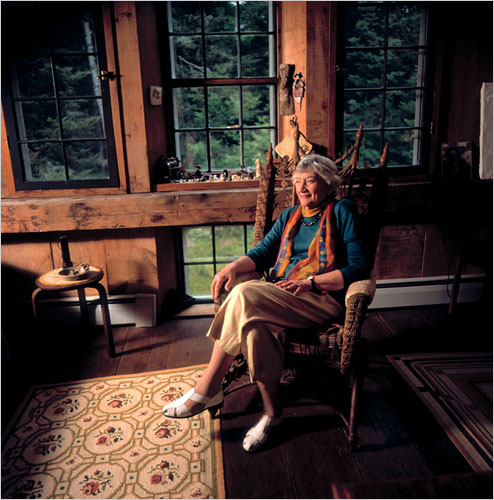
Photo by Michael York
from NY Times, 4/7/08.


Helen Yglesias
at her home in Brooklin, Me., in 2000.

Helen Yglesias, whose novels examined women’s lives in an array of settings and situations — small towns, radical urban politics, abusive relationships, illness and old age — died on [Friday] March 28 in Manhattan. She was 92 and had lived in Brooklin, Me., until several years ago.

She died of natural causes, her daughter, Tamar Cole, said.

Woven through much of Mrs. Yglesias’s work is the tension of women juggling the demands of career and family. Although she worked as an editor at The Nation magazine in the late 1960s, Mrs. Yglesias, a mother by then, did not write the first of her five published novels until she was 54.

That first work, “How She Died” (Houghton Mifflin, 1972), tells of Mary Moody Schwartz, the daughter of a Communist convicted of spying for the Soviets in the 1930s. Delving into the roots of American radicalism, the story evolves into an account of one woman’s struggle with cancer and the disorganized attempts of her family and friends to help her.

Mrs. Yglesias’s 1981 book, “Sweetsir ” (Simon & Schuster), is perhaps her best-known work. Set in a small New England town, the book takes its title from the name of the brutish Morgan Sweetsir, who enjoys beating his wives. When he strikes his fifth wife, Sally, once too often, she fatally wards him off with the plunge of a kitchen knife. After a trial she gains her freedom, but the question of liberation is not so simple.

Mrs. Yglesias’s other books are “Family Feeling” (Dial Press, 1976); “The Saviors” (Houghton Mifflin, 1987); and her last novel, “The Girls” (Delphinium Books, 1999), about four sisters living out their final years in “God’s waiting room,” Miami.

Born Helen Bassine on March 29, 1915, Mrs. Yglesias was the youngest of seven children of Solomon and Kate Bassine, Yiddish-speaking immigrants from the Russian-ruled portion of Poland who lived in a cold-water apartment in Fort Greene, Brooklyn. Her father owned several grocery stores that failed.

She wrote her first (unpublished) novel, about a teenage girl in a New York high school, in three notebooks on her kitchen table when she was a teenager herself. After high school she had jobs selling underwear, stuffing envelopes, teaching ballroom dancing, typing manuscripts and, eventually, editing. By 1965 she was an editor at The Nation and the mother of two.

Mrs. Yglesias’s first marriage, to Bernard Cole, ended in divorce. Her second husband, José Yglesias, died in 1995. Besides her daughter, of Sag Harbor, N.Y., Mrs. Yglesias is survived by a son from her first marriage, Lewis Cole of Manhattan; a son from her second marriage, the novelist and screenwriter Rafael Yglesias, also of Manhattan; and six grandchildren.

“She only received a high school education,” Mrs. Yglesias’s daughter said. “She managed to maintain a family and a career. She was an original feminist, before the road was paved.”

Copyright 2008 The New York Times Company


An Online Biography
of Helen Yglesias


Cached from
http://biography.jrank.org/pages/4853/Yglesias-Helen.html
--

Nationality:
American. Born: Helen Bassine in New York City, 1915. Career: Literary editor, the Nation, New York, 1965-69; Visiting Professor, Columbia University School of the Arts, New York, 1973, and University of Iowa Writers Workshop, Iowa City, 1980. Awards: Houghton Mifflin Literary fellowship, 1972. LHD: University of Maine, 1996.

PUBLICATIONS

Novels

How She Died. Boston, Houghton Mifflin, 1972; London, Heinemann, 1973.

Family Feeling. New York, Dial Press, 1976; London, Hodder and Stoughton, 1977.

Sweetsir. New York, Simon and Schuster, and London, Hodder and Stoughton, 1981.

The Saviors. Boston, Houghton Mifflin, 1987.

The Girls. Harrison, New York, Delphinium Books, 1999.

Uncollected Short Stories

"Semi-Private," in New Yorker, 5 February 1972.

"Kaddish and Other Matters," in New Yorker, 6 May 1974.

"Liar, Liar," in Seventeen (New York), February 1976.

Other

Starting: Early, Anew, Over, and Late. New York, Rawson Wade, 1978.

Isabel Bishop. New York, Rizzoli, 1989.

* * *

The novels of Helen Yglesias were written from her 54th year onwards. As she notes in her book of meditations, Starting: Early, Anew, Over, and Late, she had already had an active career of book reviewing and editorial work; she was for a time the literary editor of the Nation. Yglesias's account of her career and of the careers of other men and women in Starting shows that a recurrent pattern in her novels is an expression of her own sense of what a proper career for a person is. Each person has, as the many conversations with others in Starting shows, the opportunity to discover his or her "true self" and initiate actions that allow that self to unfold. Or, alternately, to turn aside and spend the years in conformity to the expectations of a group and thus court defeat and stultification. As Yglesias asks in the Introduction to Starting: "Is there 'a true self'? Does it indeed exist and does its existence matter? Is there measurable damage in human and social terms when an impostor inhabits the corner of space and time reserved for a unique self—whatever that is? To do what one has always wanted to do—to be what one has always wanted to be—what does that mean?"

In the body of her book Yglesias devotes space to her own life as a young Jewish intellectual bucking the waves of indifference she met in the 1930s; it is a story that is repeated in her second novel, Family Feeling. She also relates the "starting" of her son, the novelist Rafael Yglesias, who, in his mid-teens, withdrew from society to realize his artistic destiny. And Yglesias moves on to many others whose diverse destinies are marked by the urgent questioning she directed at her own life. With a sort of modesty she remarks of herself: "I admit to a vast general ignorance of things physical, technological, mythical, religious, and political-social." Such remarks indicate the drive behind the novels, and they also suggest the areas that are left for other novelists to handle. The Yglesias novels are tales of struggle: chiefly female struggle in a society that imposes on such struggle a terminology invented by males. Yglesias is a connoisseur of the successes and failures that women like her heroines—and one supposes, herself—meet. These struggles are often well realized and convince not so much by their general truth as by the mass of detail that is clustering at center-stage. This gives the novels an effect of conviction that cannot be overlooked. Occasionally Yglesias abandons this area for theoretical speculation; she endows a heroine with her own former or present political loyalties and her own esthetic preferences, and the novels become temporarily less vivid. But the textures that are impelling are soon re-established.

Family Feeling is the novel that is a rough equivalent (and a successful one) to the ry Yglesias tells in the opening section of Starting. Sweetsir is a negative version of the successful struggles in Family Feeling; the efforts of the heroine of Sweetsir commence and recommence but never move very far from the point where the repeated departures take place: the heroine's desire to be something, to realize in the relations of love some amorphous inner power that the heroine senses but cannot express. In contrast, the heroine of Family Feeling has an abundance of words to apply to each twist and turn of her journey. Yglesias's first novel, How She Died, is an account of a woman whose "starting" and its consequences lie somewhere between the distinct success and the grim failures related in the other two novels. The heroine of How She Died, Jean, devotes herself to a dying woman, has a love-affair with the woman's husband, neglects her own children, and realizes that her political ardor has brought her little reason for pride.

The other two novels, as suggested, are more decisive in their impact. Family Feeling reproduces the complex history of an immigrant Jewish family: a family that starts in poverty and that ends—for some of the members at least—in considerable prosperity and personal satisfaction. Barry Goddard is a son who ends as the owner of vast enterprises and an apartment that overlooks Central Park. Anne, whose intelligence is usually (but not always) the center of the story, follows a different course, one which leads her through social protest, literary projects that occasionally distract the reader, and finally to several years of a happy marriage with a WASP magazine editor who finds the Jewishness of Anne's family a constant diversion. The main concern of the moving narrative is not the social and personal goods that various characters grasp; it is the panorama of endless struggle—of "starting" and then achieving a continuation that is sometimes wasteful and sometimes admirable.

Such continuations do not appear in Sweetsir. This long and minutely executed novel, in which many pages are devoted to the details of legal procedures, begins with a domestic battle between Sally and Morgan Sweetsir, a battle that ends when Sally pushes a knife into the body of her brutal husband. Attention thus engages, the reader is conducted through the considerable number of years that brought Sally Sweetsir to her fatal confrontation. If one chooses to wonder why Sally's many "startings" go nowhere in particular, answers arise again and again. Sally comes from a lower-class milieu where there is no such tradition of struggle and survival as that which gave strength to Anne Goddard in Family Feeling. Sally has almost no words to put to her desires, the desires that take her through two marriages and into the law courts. And she lacks the intelligence to direct the sexuality and the ambition that come and go in her. And quite beyond her control are the crudity and insensitivity of the two males in her life. It is no surprise that in Sally's "world" (as assembled by Yglesias) Sally does not have to pay a social penalty for her "crime." Her long list of failures to "start" constitutes a sufficient punishment.

Yglesias describes her novel writing as "a happiness I could only liken to the happiness of love." Such happiness is open to the reader in long stretches of Family Feeling. And its absence is keenly felt elsewhere in the work of Yglesias.

—Harold H. Watts

Copyright © 2008 Net Industries