http://www.kingmixers.com/Glanvill.html.
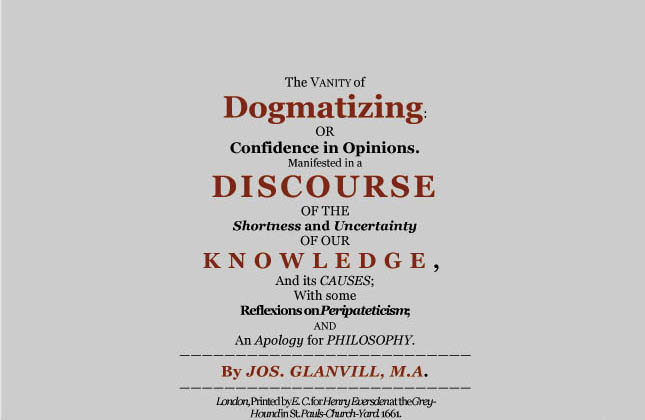
pp. 195-201
That one
man should be able to bind the thoughts of another, and determine them
to their particular objects; will be reckon’d in the first rank of
Impossibles: Yet by the power of advanc’d Imagination
it may very probably be effected; and story abounds with Instances.
I’le trouble the Reader but with one; and the hands from which I
had it, make me secure of the truth on’t. There was very lately a
Lad in the University of Oxford, who being of very pregnant and
ready parts, and yet wanting the encouragement of preferment; was by his
poverty forc’d to leave his studies there, and to cast himself upon
the wide world for a livelyhood. Now, his necessities growing dayly on
him, and wanting the help of friends to relieve him; he was at last forced
to joyn himself to a company of Vagabond Gypsies, whom occasionally
he met with, and to follow their Trade for a maintenance. Among these
extravagant people, and by the insinuating subtilty of his carriage, he
quickly got so much of their love, and esteem; as that they discover’d
to him their Mystery: in the practice of which, by the pregnancy
of his wit and parts he soon grew so good a proficient, as to be able
to out-do his Instructors. After he had been a pretty while exercis’d
in the Trade; there chanc’d to ride by a couple of Scholars
who had formerly bin of his acquaintance. The Scholars had quickly
spyed out their old friend, among the Gypsies; and their amazement
to see him among such society, had well-nigh discover’d him: but
by a sign he prevented their owning him before that Crew: and taking one
of them aside privately, desired him with his friend to go to an Inn,
not far distant thence, promising there to come to them. They accordingly
went thither, and he follows: after their first salutations, his friends
enquire how he came to lead so odd a life as that was, and to joyn himself
with such a cheating beggarly company. The Scholar-Gypsy having
given them an account of the necessity, which drove him to that kind of
life; told them, that the people he went with were not such Impostours
as they were taken for, but that they had a traditional kind of
learning among them, and could do wonders by the power of Imagination,
and that himself had learnt much of their Art, and improved in further
than themselves could. And to evince the truth of what he told them, he
said, he’d remove into another room, leaving them to discourse together;
and upon his return tell them the sum of what they had talked of: which
accordingly he perform’d, giving them a full acount of what had pass’d
between them in his absence. The Scholars being amaz’d at
so unexpected a discovery, ernestly desir’d him to unriddle the mystery.
In which he gave them satisfaction, by telling them, that what he did
was by the power of Imagination, his Phancy binding theirs;
and that himself had dictated to them the discourse, they held together,
while he was from them: That there were warrantable wayes of heightening
the Imagination to that pitch, as to bind anothers; and that when
he had compass’d the whole secret, some parts of which he
said he was yet ignorant of, he intended to give the world an account
of what he had learned.
Now that this strange power of the Imagination is no Impossibility; the wonderful signatures in the Foetus caus’d by the Imagination of the Mother, is no contemptible Item. The sympathies of laughing& gaping together, are resolv’d into thie Principle: and I see not why the phancy of one man may not determine the cogitation of another rightly qualified, as easily as his bodily motion. This influence seems to be no more unreasonable, then [sic] that of one string of a Lute upon another; when a stroak on it causeth a proportionablemotion in the sympathizing confort, which is distant from it and not sensibly touched. Now if this notion be strictly verifiable; ‘twill yeeld us a good account of how Angels inject thoughts into our minds, and know our cogitations: and here we may see the source of some kinds of fascination. If we are prejudic’d against the speculation, because we cannot conceive the manner of so strange an operation; we shall indeed receive no help from the common Philosophy: But yet the Hypothesis of a Mundane soul, lately reviv’d by that incomparable Platonist and Cartesian, Dr. H. More, will handsomely relieve us. Or if any would rather have a Mechanical account; I think it may probably be made out some such way as follow. Imagination is inward Sense. To Sense is required a motion of certain Filaments of the Brain; and consequently in Imagination there’s the like: they only differing in this, that the motion of the one proceeds immediately from external objects; but that of the other hath its immediate rise within us. Now then, when any part of the Brain is stringly agitated; that, which is next and most capable to receive the motive Impress, must in like manner be moved. Now we cannot conceive any thing more capable of motion, then the fluid matter, that’s interspers’d among all bodies, and contiguous to them. So then, the agitated parts of the Brain begetting a motion in the proxime Aether; it is propagated through the liquid medium, as we see the motion is which is caus’d by a stone thrown into the water. Now, when the thus moved matter meets with anything like that, from which it received its primary impress; it will proportionably move it, as it is in Musical strings tuned Unisons. And thus the motion being convey’d, from the Brain of one man to the Phancy of another; it is there receiv’d from the instrument of conveyance, the subtil matter; and the same kind of strings being moved, and much of whay after the same manner as in the first Imaginant; the Soul is awaken’d to the same apprehensions, as were they that caus’d them. I pretend not to any exactness or infallibility in this account, fore-seeing many scruples that must be removed to make it perfect: ‘Tis only a hint of the possibility of mechanically solving the Phaenomenon; though very likely it may require many other circumstances completely to make it out. But ‘tis not my business here to follow it: I leave it therefore to receive accomplishment from maturer Inventions.