A Synthetic Meditation on
Baseball, Racism, Closed Systems, and Spiritual Rigor Mortis
by
John R. Harris
Ού δεϊ
την πενίαν έκβάλλειν
Epictetus, 3.17.9
a)
Inflexible systems and racial bias
I began
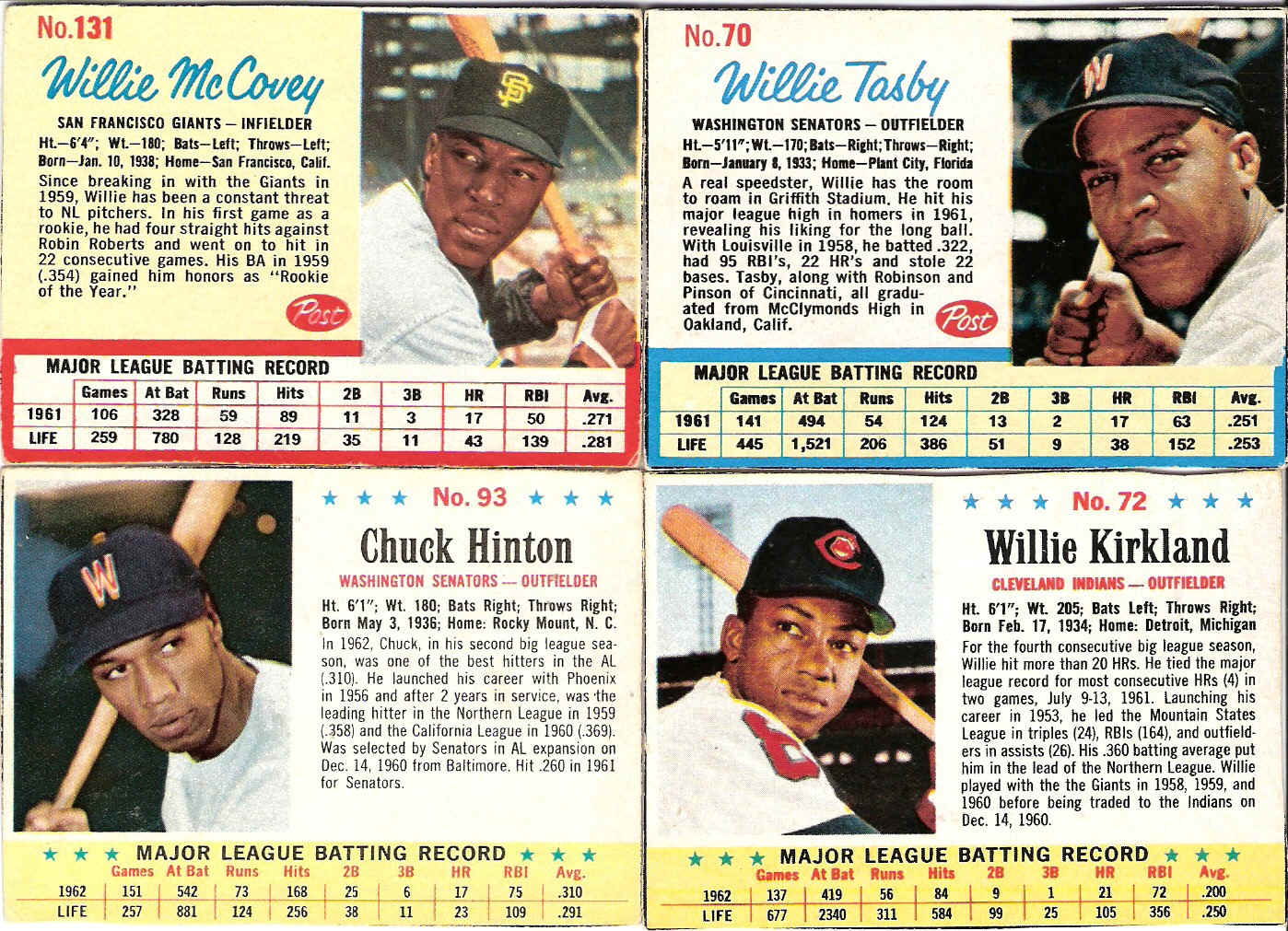
looking more closely at my old baseball cards to find out if black
players after Jackie Robinson were consistently short-changed in
seeking fair rewards for their abilities. They
were. I might now uncork
a sanctimonious diatribe against those of my own skin color who
are not as enlightened as I—the favorite liberal pastime of scourging
yourself and your entire community for a collective sin which (you make
sure to imply repeatedly) you personally have never committed. I don’t like such generous hypocrisy. What would be the good, in any case, of
apologizing for abuses half a century old, whose victims are either no
longer among us or else have created new lives in the meantime? Would Bill White get to be shuttled back in a
time machine for the few thousand at-bats of which he was robbed? Would Floyd Robinson, or Wes Covington? Can they be placed on a Hall of Fame ballot
for what they might well have done but never had the chance to do? Can Vada Pinson, even—who probably should
be in Cooperstown, probably would be if the forces
against which he struggled were as well publicized as they have become
in Orlando Cepeda’s case… can Vada Pinson, I ask, even be resurrected
from the huge bone pile of “also ran’s” whom the Veterans’ Committee
has long forgotten?
If this book does anything
of the sort, I should be more than delighted. As
for
the
broader social outrage of segregation, I do not have it within
me to masquerade as my grandfather’s ghost and repent of a crime which
someone of my generation can grasp neither with real profundity nor in
full context. Who can calculate the
tragedy of a ten-year-old artistic genius sent to work in a field or a
factory for the rest of his life? Which of
us can appreciate the pressure of familial and local attitudes in an
age when single parents are often the norm and when households move to
another neighborhood every five years? I
could express my deepest regrets—and I do—but not my artificial
contrition on behalf of those I never knew to those I can never know. Such treaties are hammered out in heaven and
in hell, not on keyboards like mine.
I suspect, besides, that
most people of darker skin recognize the white-man-in-sack-cloth for
the self-indulgent poseur that he is.
All sin, in fact, is personal—intensely personal: none is
collective. This is the most basic of
moral truths. The soldier who machine-guns
a bunch of civilians on his officer’s order is guilty of murder: personally guilty, because his finger pulled the trigger. The proud car-owner who takes unnecessary
joy-rides around town just to show off his sporty possession is guilty
of wanton pollution (not to mention silly vanity).
On the other hand, no soldier is guilty of a massacre just
because he happened to be in uniform on that dreadful day; and the man
who simply drives himself to work need not tear his hair about
participating in a wicked Western practice which is poisoning the air. As long as the soldier shares his food with a
street urchin, and as long as the driver resourcefully strives to
minimize his driving, they’re doing their bit. You
need
soldiers
if you don’t want other soldiers kicking your door in:
the world can be an ugly place, and the human heart a tangle of vipers. You have to pay your bills, and few of us can
walk to work in our sprawling urban society. I
tried
when
I was younger: it didn’t last very long.
We do what we can. Each of us does
what he can.
Enough of this non-apology. Frankly, as I have written more than once, I
received the distinct impression in putting this book together that the
men most victimized by the circumstances it describes are least
interested in dredging the whole thing up again after all these years. I have noticed, as well, that many white
people are as sensitive to being charged with racism as a recent bruise
is to a soft touch. They don’t want to
hear about it any more. They’ve heard
about it all their lives, even though most of them have tried to live
in a manner directly opposed to the past’s bigotry.
They would never deny a black person a fair crack at a job—and
they grow restless and fidgety when the suggestion is floated that the
past’s vices are not entirely buried. They
grow impatient, even… and even angry.
This often makes the
Caucasian-on-the-streets deaf to genuine cries of victimization raised
by genuine sufferers of prejudice. If you
beat a bruise long enough, it becomes a callus.1 On extraordinary occasions
such as the immersion of
But black kids without
fathers are still waiting, just on the other side of town, for someone
to show them how to throw a baseball. White
kids,
too—but
probably, in most towns, more black kids than white.
They don’t really need the money: they need
good neighbors. The readily bandied charge
of racism, it seems to me, makes everything too easy—and also too hard. Pay a few bucks and send your accuser on his
way. (Anyone who has ever been to a
country where beggars roam the streets knows this complex feeling of
guilt and resentment: “Okay, that’s all I’ve got—just go away!”) Our children don’t need handouts and
buy-offs—our neighbors’ children don’t need our checks, and our own
don’t need video games to keep them out of our hair.
They need our attention. We
need our attention: the state of our souls needs attending to.
So at last I’ve come to it:
the life of the spirit. As I look back
over all I have studied and written about struggling black ballplayers,
I see nothing so clearly as a classic case of the human
spirit being crushed within a system. Racism
was
part
of the system back then, yes; but the system created racial
prejudice every bit as much as prejudice created the system. More so, I believe: for bigotry was not nearly
well organized enough to launch a vast conspiracy throughout the whole
baseball establishment. On the contrary,
it is the essential nature of systems to become suspicious of intruders. In this case, the intruders happened to have
skin of a different color. Yet even when
insiders were able to overcome with reasonable effectiveness their
mistrust of dark skin, they remained leery of the “alien style”. They didn’t like new arrivals from the Negro
Leagues importing a more flamboyant kind of play—a more original kind
of play, consisting of unusual hitting techniques, audacious
base-running, and a lot of other things which they decided were
“clownish” or “childish”. They seemed to
be deeply convinced that their new black players just didn’t get it,
and probably couldn’t get it. The game was
sober and… well, systematic, like besieging a city.
You blasted away with heavy artillery and neutralized
counter-attacking sorties by falling back on prefabricated defensive
strongholds. (That this sketch also evokes
a football game is no accident: football is the system-adoring
society’s diversion of choice—about which, more anon.)
Blacks couldn’t understand the middle-infield positions (the
reasoning went), and they certainly couldn’t lead an entire team from
the dugout as managers—a type of prejudice which I have not much
discussed, but whose reality is self-evident. They
could
get
the “heavy artillery” part right, and they could run fast…
but their wild antics were otherwise more suggestive of an unruly child
than of a responsible adult. Stealing
home, indeed!
What I’m about to say is
rather complicated, and I despair of getting it all out in a coherent
manner. It has to do with what might be
called “primary racism” and “secondary racism”. The
most
elemental
racist baldly and stupidly dislikes or dreads someone
for his or her skin’s color (primary variety). Such
blunt
prejudice
may be contrasted with the secondary racist’s
discomfort around people of a physical appearance visibly different
from his group’s because those animals are suddenly
working what has always been his side of the street.
The secondary racist, to be sure, still notices the tint of the
epidermis and the profile of the nose. He
won’t dispute, however, that someone with such a complexion or such a
nose might be handsome or beautiful—he just doesn’t welcome the competition which has accompanied these exotic features
into a once-sealed community.
Even within secondary racism
(which I would guess is far the more abundant kind), there is the keen
hostility of those who directly stand to lose their jobs to the
newcomers… and then there is the passive but enduring suspicion of
well-heeled, heavily invested traditionalists who don’t want to rock a
profitable, comfortable boat. These
latter, of course, are the ones most involved in shaping and sustaining
the system. In all the accounts authored
by black ballplayers which have passed under my eye, the fat-cat
decision-maker is the villain hardest to forgive. The
sweat-soaked
rednecks
afraid of being sent to the soup kitchen are
relatively easy to understand and overlook. In
many
ways,
their angst about mere survival sounds a very sympathetic
note to the black teammates they shun.
The heart of racism as a
social and economic impediment, then, nestles among the second species
of the second variety: the successful lord-of-the-manor who doesn’t
want to jeopardize profits by discarding a tried-and-true formula. In baseball terms, we’re talking about owners
and general managers. Managers, too, had
much more power over their players’ careers in the fifties than they do
now;2 and though a manager of those days, as
a former player himself (more often than not), might well have harbored
a grudge against black “intruders” over having once competed with him
for a job, he might also have been a sincere “conservative”. Perhaps he really believed that the techniques
of the Negro Leagues would end up losing his team games.
After all, he himself was most certainly produced by a
different, somewhat rival system. The more
genuine this commitment to old techniques, the less severe the racism
from a purely visceral standpoint—which is ironic, because systematic
rigor screened far more blacks from success in baseball, I have
concluded, than hatred of dark skin ever did.
b) A parallel from the Ivory Tower
Let me try to illustrate my
intent by having recourse to a world I know far better than the
clubhouses and front offices of baseball: academe.
For the past half-century or so—throughout my adult life, at any
rate—the Ivory Tower has turned very competitive and cliquish in a very
topsy-turvy fashion. The Old Guard of the
fifties had been set in its ways. It had
honored time-worn theories and had taught about and from the same old
texts. (This was certainly so in the
humanities: the sciences were usually more creative.)
The New Guard which ushered in my generation during the late
sixties and imparted its free-floating values to the rest of the
century would have nothing to do with a literary canon of “classic”
works. The books you were “supposed” to
read merely reflected which group was holding the reins of power and
deviously trying to manipulate you through propaganda.
Professors started teaching movies, TV shows, comic books, and
even graffiti as “texts” instead of Dante and Shakespeare.
They started grinding out tomes and tomes of indecipherable
gibberish to explain their rebellion—and also, when rarely cornered by
some high-placed reactionary or other, to explain that no explanation
was really possible since all meaning is undergirded by prejudice,
leaving only honest gibberish (like theirs) and disguised gibberish
(like the classics) to compete for people’s attention.
The new professors wore their shoes without socks, preserved
their hair from combs, refused to give exams, slept openly with their
students, and assigned easy A’s to anyone who parroted their flaccid
ideas (preserving plenty of D’s and F’s, naturally, for those who
didn’t). How well I remember it all!
You wouldn’t think that a
bevy of anarchists like this would found a new system on the grave of
the one it had just so ostentatiously subverted. You
might
not
even think (if you are a naïve soul) that a collection
of such devout social liberals would be capable of replicating a
Klansman’s behavior. Yet it all came to
pass. By the time I entered the job market
as a professor, anti-systemic thinking had been rigidly systematized. With so much of my course work and scholarly
writing directed toward Homer, Virgil, Kant, and various other dead
white guys, I need not have applied for most openings.
When I did somehow manage to wrangle an appointment in an
English department (usually because the Old Guard had just barely
fought off the New Guard for the moment), I witnessed bizarre
happenings. I found that the generation
which had no use for socks craved feverishly—enough to lie, to steal,
and maybe to kill—the kind of achievement demarcated by promotion and
tenure. I observed that women, especially,
having been brainwashed by sixties cant that they were worth nothing
without a successful career, would not be denied success.
Some of them, when we would form “search committees” to fill new
positions, didn’t even want to hire another woman because
they saw in their exclusive claim to minority status an inside track to
the top. I’m sure no black player ever
wanted to be the only black on his team; but I wouldn’t be surprised,
based upon what I’ve learned of the human heart, to discover that some
minority employees enjoy being “one of the few” because the company
will almost necessarily advance them if it wishes to avoid
embarrassment.3
All these starry-eyed
revolutionaries, meanwhile, were busily shifting the theoretical jargon
of their unfathomable publications every year or two so as to make
their game less comprehensible to outsiders who wanted in—that is, so
as to limit the number of people who could compete for their jobs. The young bucks were becoming old boys. Many feminists even insisted that a writer
should be precluded from acceptance by any of their hermetic reviews if
she turned out to be a “he”. I’ve no doubt
that some of these “old girls” genuinely detested men; but I think it
likely that the majority simply wanted, once again, to narrow the field
of competitors. Like an aging second
baseman with a bad knee, they didn’t need a sudden flood of talent from
a totally new quarter. On the contrary,
they needed to throw up sandbags wherever possible.
So much for ideologues and
“idealists”. The very same kind of
behavior, I hasten to add, was fully evident on the most “conservative”
campuses ever to have their ivory thresholds darkened by my shadow. I saw it in how I was treated, and I saw it in
how others were treated: the reigning emotions were fear of being
ousted (on the part of junior professors with no real security) and
fear of innovation (on the part of senior scholars who had clambered to
the top by honoring certain “values”, such as teaching only British
works rather than admitting a French novel into the mix).
When you’re young, you
always consider that you have been hired fair and square to do the job
specified by your interview and your contract. (In
fact,
this
is seldom true: you’re hired because one campus coterie or
another sees you as a potential ally in some political tussle.) Being conscientious, you dedicate yourself to
doing the best job possible. You produce
extra work for yourself by assigning—and grading with ample
notations—essays which challenge the students at a high intellectual
level. You bring works into courses which
the weary anthologies have overlooked (and no anthology grows wearier
faster than the anything-goes generation’s, wherein stories and poems
appear just because their authors were not white
males). You refuse to curtail necessary
lectures and meaningful discussions for the sake of videos and
ignorance-sharing rap sessions. In a word,
you teach. You do your
damn job.
And how is your success
received by your compatriots? Well, let me
underscore the parallel with baseball as I answer.
Some colleagues are merely lazy, and the precedent set by your
labor-intensive assignments makes them nervous. These
were
the
“wits” who teased their new black teammates to the point of
harassment and spread stories about them behind their backs. Such rivalry does little observable damage to
a well-motivated worker, but it can grow quite demoralizing after a
while.
Some colleagues are more
malign. Aware that no administration likes
to tenure a large percentage of its faculty, they recognize you as a
life-or-death challenge and apply themselves to undercutting you subtly. I suppose the baseball equivalent would be a
player of real talent who was nonetheless insecure about his position
on the team when the first blacks arrived. He
didn’t
run
off at the mouth loosely: he just shook his head without a
word—but being certain that the manager saw him—when Jackie or Willie
ended a rally by being caught in an attempted steal.
When Billy homered, he pumped his fist with the rest of the
team; but he also sidled up to the skipper, pretending to go for a
drink of water, and muttered behind his smile, “Too bad he couldn’t
have done that when we had runners on base.”
Some of your Ivory Tower
“team”—especially the more powerful—are vain, and begrudge you your
long hours of paper-grading at home because you are less available to
grin and fawn at their innumerable endless soirées.
These, of course, correspond to the coaches and managers who
like to “hold court” after the game over a round of beers.
They egg on those of their black players who are more easily
finessed to drink a few too many a little too often.
Those who see through them are branded as “not team players”:
talented, yes—but obviously not happy here in
A few number-crunching
cynics in the front office (and academe has large front offices) may or
may not understand your professional ardor as sincere: they see only
the gripes on student evaluations about being bored and having to work
too hard. They begin to fret over
retention issues. In the baseball front
office, executives would carefully mull over the number of black
citizens attending games now that “one of their own” was wearing the
uniform, and counterpoise to this gratifying figure the distressing
outbreaks of violence and foul language among Caucasian fans. It’s a crying shame that certain members of
the lower class have to be so crude and retrograde, but… “But baseball
is a family event. We want our fans to
know that they can bring their kids to the ballpark.
Too many of these incidents spells big trouble.
We have to think of the women and children.”
c) The futility of specific corrections
I reiterate that I am not
trying to reduce the anguish of racial segregation to just one more
example of workplace bullying. I am
proposing an analogy, not an equivalence. The
plight
of
black players in the later fifties and early sixties resembled
that of other people caught within a vast
system’s cogs in two respects. First (as I
have said above), all such cases involve numerous insiders perceiving a
handful of outsiders as a threat—a threat to compete for and take away
jealously guarded employment, and also a threat to drag complacent
employers through a disruptive and unpredictable series of changes. In isolating the threat and holding it at bay,
the status quo may seize upon any irrelevant detail which seems to
characterize all the outsiders superficially. This
detail
may
be skin color, or gender, or age, or language, or place of
origin (and I might note that an aspiring professor from the northeast
or the West coast is much more likely to find work in academe than a
professor from Alabama or Oklahoma, all other factors being equal). To be sure, after the
harassed outsider leaves the workplace to take a walk in the park or
eat at a restaurant, he will probably not continue to face suspicion
and rejection as a black player would have done in 1954 after showering
and heading off into the streets of
The second way in which
baseball’s cold embrace of black players resembles the inertia of a
huge system exposed to change is that specific adjustments
almost always fail to have a significant long-term impact. If the boss circulates a memo demanding that
all nude photos and Playboy calendars be removed from
the office, then the photos and calendars will come down.
If the workplace environment is profoundly crude, however, the
same old atmosphere will cling in low-lying pockets.
Salacious jokes around the coffee machine will be theatrically
broken off when someone sees Julie, although Julie’s appearance within
earshot was the cue to begin the jokes. Julie
will
sit
down at her desk and find a porn site running on her computer,
though—of course—no bystander will admit to having seen any tampering. If the old boys can rattle Julie enough, she
may even fly into a rage or break into tears; and then the case can be
made that she was unhinged from the start. If,
on
the
other hand, Julie files a lawsuit, then the boss may actually
suspend or fire some trouble-makers as he fumes over paying the
settlement. Yet the next time he has a
choice between hiring a male or a female, enlightened though he is, he
will remember that fat settlement; and, unless required by some quota
system, he will avoid inviting the
trouble-makers to make trouble.
Quota systems: have they
ever worked? You might say that the
pressure to bring two blacks up to the big team by 1960 (and it was
always two or four: somebody had to room with the guy on road trips)
constituted a de facto quota for Major League baseball. It worked, yes… and then again, it didn’t. I have argued (as have others) that certain
particularly recalcitrant organizations added black players who were
not the best qualified of their race to receive the promotion, precisely so that integration might be discredited. Even when the new players were top-notch, they
could be handled so as to undermine their effectiveness.
They could be benched most of the week, so that their one start
or their two pinch-hit appearances would find them as stiff as the
boards they usually sat on. They could be
played out of position, or moved to relatively unimportant positions
which dozens of other qualified players stood ready to fill. In the event of success, their disposal in a
trade could be fully justified—with plenty of farewell praise for
public consumption—as necessary to get four or five younger players
(and one of these might well be black, just to put up a good front). In a bitterly cruel irony, quotas addressing
such superficial attributes as skin color or gender sometimes diminish the individual minority member’s chances of
success. The establishment can always
point to its satisfactory ratios, diverting attention from how each
human being composing the ratio has been treated personally.
The human spirit is as
resourceful as it is perverse. Tolstoy
said it about Napoleon and the Grande Armée: as
long as the French wanted to follow their emperor, they made him a
legendary conqueror. When they got tired
of following him, neither his orders nor his pleas could keep them from
turning back. People will find a way to do
what they’re inclined to do. Those
inclined to be bigots will find a way to slight their targets.
d) The Great War: a study in systematic rigor
Yet my major theme in this concluding chapter is that
people are inclined, above all else, to trudge around in the circle
which they have already worn. The spirit
is inclined to go to sleep—to turn away from its higher destiny and
embrace a lethal comfort. Writing about a
different war from Napoleon’s, Arnold Zweig made one of his characters
observe, “As water inevitably gathers at the deepest point, so the
human spirit will collectively find the shallowest place where it can
rest undisturbed.”4 Zweig was a veteran of
World War I, and his novel sees the fighting through German eyes. Abject obedience to a system was perpetually
tossing young men into the trenches like logs into a sawmill. Systems-within-the-system kept cropping up
along the Maginot Line’s moldy trenches and shell-blasted villages:
lieutenants intent upon feathering their own financial nest, soldiers
intent upon avoiding the front line’s risks, liaison officers intent
upon telling the high command what it wanted to hear.
Overtly criminal acts arose unquestioned from these strange
sodalities in modest extension of the reigning logic.
A group of officers in Zweig’s novel actually posts a young NCO
where he is certain to be killed so that he will not blow the whistle
on their cozy profiteering racket.
As in little things, so in
big things. The Great War was undoubtedly
a major catalyst of the West’s invincible demoralization throughout the
twentieth century. Cynicism, absurdism,
nihilism… death camps, ethnic cleansing, mutually assured destruction…
it all really got under way when the well-oiled socio-political machine
at the turn of the century demanded to be fed with millions of human
lives and limbs. In Zweig’s account, a
“closet” Marxist within the ranks reflects upon the situation’s
homicidal efficiency at handling what José Ortega y Gasset would
one day call the “rebellion of the masses”—and the assessment, let us
admit, is not devoid of accuracy:
In order to hold the masses in check, the very
coalescence of these masses became serviceable. Every
year
in
So well, indeed, did World
War I confirm the Marxist scenario of a privileged class eliminating
its roused proletarian rabble that the popularity of communism spread
through
Insane.
How could it all have happened? To
this day, European intellectuals remain in shell-shock.
Some of them are actually Bourbonists, hoping that the
restoration of the monarchy will turn the clock back, make the
nightmare go away, and burrow warmly into a paternal system which would
spare puny individuals the trauma of decision-making.
My purpose here is not to sort through any culture’s past
choices or to argue for or against the human right or obligation to
make choices. I seek to underscore,
rather, the present ineptitude for choosing in which a rigorous
adherence to system has left the cradle of human freedom, the
birthplace of constitutional republics and of individual conscience. The controls have frozen, and no corrective
procedure is advised by the repair manual.
French novelist Jules
Romains, in writing a classic account of the Battle of Verdun, stresses
The indeterminate, the unknown, and the accidental were
thus nestled into either end of the event: into the end where a
worldwide convulsion was taking place, and into that where tiny,
pitiful men were fighting in the smoke. On
the scale of the astronomical and of the molecular.
Nobody knew to any great extent the minute degree to which
ghastly acts composed the war; there were plenty of witnesses, but all
so embroiled in what was happening that they could scarcely draw back
and see it—and, in any case, the impression they received from twenty
paces was dulled like a lantern in a fog. Nobody,
on
the
other hand, knew that the event could assume the gigantic
face—like that of a planet on fire—which it would present to the Night
of Ages, that Night of Ages which includes not only the past, but is
also the eternal envelope of a medium wherein history floats like a
meteor.6
One
of
the
French officers whose activities Romains tracks briefly lulls
himself to sleep each night with “realistic” fantasies—scenarios
distinctly different, that is, from the hell he lives daily, and yet
still just hellish enough to justify his hoping in them.
He imagines himself, for instance, liberated from the trenches
with his company to wander among the mountain forests.
His men would establish some loose base of operations—a barn,
say—where they could receive orders; but they would otherwise be free
to forage for themselves. They would
become what we now call guerilla fighters. This
is
the
extent of one bright young man’s ability to foresee a future
beyond the system’s bounds: a salutary near-anarchy resulting from the
practical impossibility of keeping the troops stocked in food and
clothes.
I contend that “the
indeterminate, the unknown, and the accidental” are precisely what any
successful system must accommodate—by not trusting itself fully, by
remaining open to minority (even “crackpot”) opinion, by constantly
reconstructing its orderly conclusions to suit a less orderly world. The Great War was fought with tactics that
dated back to the days of cavalry charges and cannon balls. The geometric progression in destructive power
which modern weaponry had described failed to occasion a radical review
of strategy. Among the civilian
population, too, attitudes which had always been stirred before by
national struggle cheered on the effort without remotely divining an
imminent cultural catastrophe. “Nobody
knew….” The actors had rehearsed lines for
the wrong play, and nobody—no leading figure—could tap sufficient
spontaneity to improvise effectively from various fragments of
experience.
An entire generation of
young men was lost in the Great War—the “absent” to whom Edwin Muir
addressed the poem which gave me this book’s title.
Because treaties had been signed, national pride staked, hands
shaken, and honor pledged, two thousand years of civilization based on
energetic, creative sacrifice and belief in every person’s sacred spark
dissolved in smoldering ruins.
If men will thus fling their
own sons into the fiery furnace in an obsession with making the system
go, what hope is there that a mere game—a true game, a joyful
pastime—will liberate itself from systematic rigor to increase the
quality of play or to allow more players on the field?
e) The
Dr. Thomas Bertonneau
recently reflected in these pages NASA’s change-resistant, “circle the
wagons”.8 He concluded his thoughts
by directing them to the etiolated bureaucracies which run our public
schools. Another person might note how
reminiscent is such inflexibility, devoted first and last to preserving
the system rather than accomplishing what the system was created to do,
of certain church hierarchies confronted with such devastating scandals
as clergy-related child-abuse. Any
long-running, many-branched human organization is likely to illustrate
the same phenomenon. (If it doesn’t,
there’s something new under the sun.) This
institutional hardening of the arteries is one of the most frustrating
aspects of human society. Once in a while,
starry-eyed reformers attempt to rectify flaws by creating a board or
committee to review existing boards and committees.
The review board, in turn, generates a protocol which soon grows
rigid… and then we savor the unpleasant irony of an anti-bureaucracy
wrapping itself in red tape rather than making things honest and open.
Again, one has to wonder how
a silly little game of hitting a round ball with a round bat—a very difficult silly little game, where success is often
measured in small fractions—can hope to overcome the stifling effects
of dogmatism if the destiny of civilizations and the advance of pure
knowledge cannot crawl out from under the “old boy” shadow. Everything we think, do, and are seems to be
blunted, as if by a narcotic drug, somewhere along the orderly
corridors of the systems which have led us this far.
But maybe this is looking at
the problem upside-down. Maybe a mere game
is exactly the place where we should discover how to keep from becoming
enthralled to our well-functioning organizations the way a bricklayer
absorbed in his work might accidentally wall himself into a tomb. For that matter, baseball may be the one game
above all others which punishes inflexible thinking.
Ballplayers adjust, or they perish. A
pitcher
who
hurls bullets but has no change-up will eventually be
pounded. A hitter who can catch up to the
league’s best fastballs but can’t wait on a change-up will eventually
never see a fastball in the strike zone. Such
remarks
as
these are platitudes to baseball people.
In fact, one of the main qualities scouts look for in young
talent is a certain humility—an ability to listen to and profit from
suggestions. The game is humbling by
nature: failure is always sitting on your shoulder.
So why don’t more teams
value the dynamism of creativity? I use
the present tense, because, to this day, the dazzling style of play
which Jackie Robinson brought to the Major Leagues is highly suspect in
many organizations. For some reason,
coaches and managers often refuse to accept that the same inflexibility
so toxic to an individual can be just as lethal to an entire line-up. Teams like the Texas Rangers seem to believe
that socking home runs is the prescription for victory, even though
they complete season after season in the second division.
As I sit writing these words (at the end of the 2005 season),
the Rangers have just set an all-time record for the most solo homers
by a ball club in a year. Not
surprisingly, they have also failed to finish above .500, and they have
barely managed to stay out of the Western Division cellar.
The number of sacrifice bunts successfully executed by the
Ranger offense was dead last in all of baseball: nine, another all-time
record for inflexibility.
Is it an accident that the
Rangers ended the 2005 season carrying just one African-American player
on the roster (Gary Mathews, Jr.)? One-dimensional
slugging
preoccupies
the front office even as the pitching staff is
routinely reviled for failing to hold the other side down.
Within recent years, the franchise has had on board such
promising hurlers as Kevin Brown, Rick Helling, Aaron Sele, John
Thompson, Darrin Foster, and Brian Driese. Trade
bait,
every
one—and almost always for another slugger.
In the 2005 season, it was deemed necessary to acquire Phil
Nevin. In past seasons, the answer to
fans’ prayers was to be Alex Rodriguez. Before
him,
it
was José Canseco.
Why don’t the Rangers get it? Maybe it’s the name. Historically,
the
Rangers
were created by the young state of
In baseball, too, you don’t
want duplication: you don’t need heavy hitter upon heavy hitter. An 11-3 victory is just one more victory: you
don’t earn extra points for piling on runs. An
11-3
loss,
likewise, is just one loss—humiliating, but every team has
its share of them. Where baseball’s Texas
Rangers consistently fail to make up vital ground is in close games:
games, that is, which require a multi-pronged attack, a flexible
approach. The franchise’s 2-1 and 3-2
losses stack up, season after season… and the pitchers in these little
tragedies, of course, make easy targets for a shallow fandom and a
shallower press. But the cause lies just
as much with the offense’s “home run derby” mentality.
When you confront an adversary with good pitching, you usually
don’t prevail with power. It is reasonably
easy for skilled pitchers to work around free-swingers.
What you need in the bottom of the ninth when down a run is not
Mighty Casey, but Speedy Gonzalez: someone who knows how to draw a walk
and steal a base. And then you need two
guys behind him who know how to put the ball in play.
The Rangers lose nail-biter after nail-biter because they don’t
acquire such players, don’t coach their youth to turn into such
players, and unload any such player who happens to stumble into their
clubhouse.
The Willies (and a
Chuck). One sometimes gets the feeling
that white baseball wanted every black kid named Willie to become the
next Mays—and one of them did. In the
early sixties, it looked as if they all might.
f) The
black
ballplayer,
spontaneity, and neglect
Is it mere coincidence that
teams like the Texas Rangers (for there are others—just study the
second division) have so few black players? Is
there
not
for some reason a substantial connection between black
players and base-stealing, gap-hitting, using the whole field, taking
the extra base, and a whole range of razzle-dazzle offensive maneuvers
as bewildering to the observer as shadow ball? I
know
that
it’s politically incorrect to suggest that something like the
“African physique” might be responsible for such prowess—and I
certainly don’t know enough about physiology, in any case, to judge the
merits of the claim (assuming that the politically correct would allow
us to judge anything by merit). I suspect,
however that the underlying causes of baseball à la
Negro League are indeed more nurture than nature.
My evidence is as follows.
I have coached both black
kids and white kids, and I assert with some dismay that the white kids
have far more often been rigidly instructed rather than tossed a ball
and allowed to play. They have been
subjected to expensive machines of the most outlandish varieties for
teaching the fine arts of hitting, pitching, and fielding—but
especially hitting. Black kids, sadly,
tend to know the game of baseball less well by the age of ten, yet many
of them take to it gleefully if not at once overwhelmed with minute
instructions. Once upon a time, after a
single session of tutoring my ten-year-olds in how to beat a run-down
and advance to the next base, I found that my black kids wouldn’t stay
put during the next game. They were so
devil-may-care that my hands spent most of the evening in my hair. (Yet not a one of them was ever tagged out.) On the other hand, I had a couple of white
kids—fast runners, too—who wouldn’t even take off for second on a
passed ball. They were scared of failing,
or perhaps horrified at the sense that they were doing something beyond
the bounds of routine structure. I rather
doubt that they had much fun, on that night or any other, and I should
be surprised to see them playing ball five years from now.
Since black children, at
least in my part of the country, tend to live in less affluent
circumstances, they have less gear and equipment, fewer machines and
tutors. They improvise better. In a sense, they also tend to have less
supervision around the home, or to be supervised more often by siblings
than parents (though supervision for affluent white kids now consists
largely of enthrallment before video games). As
a
result,
perhaps, the black child may be more apt to try something new
or do something bold, while the white child is more likely to hang back
and think, “Are we really allowed to do that?” I
might
as
well say that I believe many children in my demographic
bracket (the Caucasian, professional, two-parent household) to be
excessively supervised, if by that may be understood rigid scheduling
of free time and even recurrence to Ritalin when the child seems to
rebel rather too often.
The factors I have just
described are all environmental. Anyone
who takes a casual drive through a predominantly white neighborhood and
a predominantly black neighborhood in a small southern city will
instantly see where more kids are outside riding bikes.
When the kids who stay inside—the white kids—are finally
released from their electronic cells, it is to fall in and drill at the
ball park under the dictatorial eye of half a dozen coaches. And the drilling has its effect, all the way
from the humblest Dixie League team to the exalted squadrons of
millionaires who appear on TV every summer evening.
The contempt for the unchoreographed move is apparent in
everything from the absence of drag bunting to the easy lope toward
second base on a “gapper”. Spontaneity is
not encouraged, nor are those who practice it best the most rewarded. Is the slight overtly racist?
No, of course not. But because
black and Latino players, for environmental reasons (let us stipulate),
are and have long been the masters of the unpredictable and the
unrehearsed, they suffer the most neglect in a milieu which begrudges
free-style performance. They suffered in
the fifties and sixties, years after Jackie Robinson had supposedly
broken down the color barrier; and, ironically, they suffer now, years
after patent prejudice on the field (if not in the organization’s
hierarchy) has been eradicated. They
suffered before because they were black, but also
because they constituted a threat to chess-match, station-to-station
baseball. They suffer now exclusively for
the latter cause, since kids in the Dominican Republic still grow up
using broomsticks for bats and black kids in Memphis or Akron import
their feints on the basketball court to base-running.
The phenomenon deserves to
be called discrimination, but not racial
discrimination: call it, rather, discrimination against the resourceful
individual who redirects the flow where nobody anticipated its going.
g) The incredible homering hulk
At this point, I cannot
avoid mentioning the home run again. Of
all the players I used to stop and watch on TV, no matter what I was
doing, the one who commanded my attention most imperiously was Tony
Gwynn. I would stand and gape at his every
move, even if a baby were screaming or the phone were ringing. Tim Raines and Wade Boggs were not far behind. I have realized painfully that the players who
inspire that same devotion in my son are the Sheffields and the Bondses. Now, Gary and Barry are both black, and many
of the game’s most exciting home-run hitters continue to be
dark-skinned, just as they were in the days of Aaron and Mays… but
Barry Bonds, especially, represents the game’s degeneration to me. As a youngster, Barry was the kind of
“five-tool” player who would frequently stroke doubles and sometimes
stretch them to triples. Now he is a
somber monument to home-run obsession. He
has dedicated himself, by fair means and foul, to doing one thing. His body has morphed physically, in the
process. Even if Bonds truly didn’t
understand just why it was doing so, he was clearly pleased with the
result. He transformed himself into a
mountain of muscle, a heavyweight machine which could no longer produce
bunts or triples. Henry Aaron, though age
thickened him as it does all of us, remained essentially lean and
svelte. Not Barry: no hammer, he, but a
pile-driver.
Something about the game of
baseball, and about our society more generally, has nursed this
monomaniacal commitment to bullying the ball out of the park. For the home run is the most systematic
of hits: its results are the most predictable and controlled. Once the ball sails over the fence, it’s out
of play, and the base-runner need merely trot. (Indeed,
contemporary
home-run
hitters like Bonds have signature trots as finely
tailored as Willie’s basket catch.) Organizations
like
home
runs, and always have. They are
decisive, final. They dispense with the
need for on-the-spot creativity. They can
be instantly entered into the ledger as assets. Far
be
it
from me to imply that Aaron and Mays were not exciting when they
clubbed a long one—but Aaron and Mays did a host of things
magnificently. The status quo awarded them
primarily (especially Aaron) for hitting home runs, and rewarded them
very well compared to the treatment given other black players who were
no more than potential base-stealers or batting champs.
Hank and Willie were not forged by The System, but one aspect of
their multi-faceted play particularly appealed to The System’s
obsession with regularity and reliability.
Now we are allowing the
system to make robots out of us in ways that are scarcely even
metaphorical. We allow technology to
sculpt our bodies into something no longer quit human, knowing all the
while (or maybe not knowing, in a few tragic cases) that, like
Achilles, we will die young in return for our day in the sun. Players use bats today which are no longer
remotely capable of a .400 season, should a throwback magically appear
who has the skill to achieve such a number. The
damn
things
snap in two unless you hit the ball squarely on the
oversized barrel—no one-and-two pitch has any chance of being fisted
over the infield. In any case, hitters
make no notable adjustment in their swing with two strikes: the third
swing is one last chance to go for the downs. Even
after
Ichiro
Suzuki comes into our midst from an entirely different
culture and shatters a season-hits record which none of our home-grown
talent could ever approach, we merely shrug and turn our attention back
to A-Rod or David Ortiz.
And that raises a question
about us who watch: the fans. As much as
the organization craves the money-in-the-bank solidity of the home run,
we fans seem to crave its majestic arc and foot-on-the-throat triumph
even more. Why is that, I have often
wondered? What role have fans played in
the rigidification of baseball around the long ball?
h) The home run’s past: a system-designer’s
systematic edge
I don’t think we spectators
were always the guilty party. Naturally,
fans thronged to see Mantle and Maris chase after Babe Ruth’s
single-season home-run record in 1961, both because of the record’s
seeming impregnability throughout baseball history and because the two
men seriously assailing it were on the same team. Yet
Yankee
games
were perennially well attended, and the crowds which
packed Yankee Stadium in the fall of ’61 often appeared more interested
in harassing Roger than admiring the arc of his long flies. During the years of my study, I do not believe
that fans were the driving force behind home-run mania.
The rate of home-run hitting had risen more-or-less steadily
throughout the fifties, and not just because of the influx of black
sluggers. Mantle, Mathews, Mize, Musial…
the letter “M” could already account for about 2000 home runs in this
era without Mays’s even being added to the tally. Kluszewski
reached
or
surpassed 40 home runs in each of the three seasons from
1953 to 1955. Roy Sievers hit a total of
81 during 1957 and 1958. Rocky Colavito
walloped an even 200 homers in the five years from 1958 to 1962… and so
it goes. Not since the 1930’s had so many
sluggers racked up so many “taters”.
I have argued that the
fifties and early sixties may have been big home-run years for
whites precisely because black ballplayers were steadily trickling
into the Major Leagues’ ranks. That is, I
suspect that management may have fallen back conservatively on the
Ruthian technique of cashing in lots of chips at once because this
formed a distinct contrast with Negro League baseball.
I am not insinuating that any concerted plot was hatched, and I
hope none of my earlier remarks has been read as implying anything so
absurd. I simply think that greater
emphasis of the home run was a natural way for white baseball to circle
the wagons. That Aaron and Banks and Mays
and Robinson ended up beating the white establishment at its own game
proves how little of the genuine conspiracy was behind this long-ball
fever; for black home-run kings were not only rewarded with salaries
and playing time approximate to a white slugger’s—they inspired many
organizations to give marginal stars like Willie Kirkland a good taste
of limelight in the hope that they, too, would start belting a shot
every other game.
As home-run champs, these
players did more than any others of their generation to carry Jackie
Robinson’s vision forward. White
management was only too happy to discover that blacks could indeed play
long-ball: what made it most nervous, I suspect, was that blacks might
capture the Majors with bunts and steals. Caucasian
players
must
have feared that they could not compete on such terms:
Caucasian owners probably feared that they could not win on those terms.
I’m going over old ground,
for clarity’s sake. I shall be adding no
great revelation to say that contact hitting and steals did at last
become central to the game in the latter sixties and throughout the
seventies and eighties. Home-run hitters
continued to serve their vital purpose, as they always have—but a
couple in the heart of the order sufficed. Bert
Campaneris
and
Billy North gave Sal Bando and Reggie Jackson runs to
bat in: Pete Rose and Joe Morgan did the same for Johnny Bench and Tony
Perez, as did Vince Coleman and Willie McGee for Jack Clarke. The offenses of these years were far more
balanced, more difficult for an overpowering pitcher to shut down
entirely. They produced fewer lopsided
games, but also fewer shut-outs. These
were the very years, of course, when the percentage of blacks in the
game was at its highest, and also when the variety of skills which
black players could bring to the game was most manifest.
With Carew and Gwynn came Stargell and Dick Allen; with Coleman
and Henderson came Winfield and Andre Dawson.
i) The “Home-Run
So what happened? Here, I believe, is where the fans came in—or
the television, to be precise. Brainwashing
by
TV. I wouldn’t be the first one to
point out that highlight reels always privilege the home run. ESPN SportsCenter’s capsulizations of ball
games seem to consist of little except sluggers “going yard” and
pitchers recording critical “K’s”… maybe a bench-clearing brawl tossed
in once a week. To the extent that such
quick takes are most of what the casual fan ever sees of any given ball
game, it’s small wonder if he considers such events to be, indeed, the
game’s greatest moments. Similarly, kids
who grow up feeding on home-run replays in our “instant gratification”
society naturally want to hit homers when they take the field at school
or in Little League. We imitate what we
observe: that’s how we learn.
Yet televised highlights are
actually not the medium’s most influential message, in my opinion. I believe the effect of television on how we
watch baseball has been far more subtle (just
as
the
enforced passivity of TV-watching has done more to make us a
violence-tolerant society than shot-’em-up cop shows).
Consider the camera man’s dilemma. If
you
try
to cover the whole field, the players become too small on the
viewer’s screen to be of any interest. If
you zoom in on just one or two players (and the center-field camera
allows you to zoom in on three, the maximum possible), then the flow of
play escapes your lens as soon as the ball is hit.
Contemporary broadcasting has been incredibly resourceful about
resolving the dilemma. With multiple
cameras rolling all the time, the director can switch instantly to the
shortstop once a ground ball is hit, then track the throw over to first. On a ball smacked into the gap, however, all
we see—all we can see—is a couple of outfielders
chasing the bounding dot to the wall. We
only pick up the runners circling the bases when a switch is made to
another camera, one of the outfielders having hurled the ball back in. Even then, we follow only the lead runner: we
can’t see for the moment how far the hitter has advanced behind him.
In a real ball game, a live
ball game, you see all of this going on as it goes on. Human peripheral vision is so superior to any
camera’s lens that you can actually follow the ball to the base of the
left-center field fence while being aware that the lead runner is going
to try for home and that the hitter will make second easily. To me, a double in the gap with several
runners on base is the most exciting play in the game—but it’s only so
if you are sitting in the stands and watching it. Television
is
forced
to leave far too much of the play out as it unfolds.
A televised home run is an entirely different
matter. You really don’t miss anything on
the screen; in fact, you see the home run infinitely better than you
would “in person” if, like me, you’re a little near-sighted. With the announcer’s voice rising to clue you
in that this one has a chance, you follow the left fielder to the wall…
and see a little white orb land five rows back. You
haven’t
really
missed a thing on the infield, because the runners had
to linger near their bases lest the left fielder make a sensational
leaping grab. The camera picks them up an
instant later as they plod home, then turn around to high-five the
conquering hero. The same scene beheld
live in the ballpark is often the least bit disappointing to me. I hear a crack of the bat, I see the
outfielder sprinting back… and then, everything decelerates into a kind
of slow-motion. The ball’s out of play: we
just sit and watch Casey circle the bags.
Of course, I can tell that
most of my fellow spectators are not in the least disappointed—not if
the home team has just racked up some more runs. I
look
at
them. A lot of the least attentive
are young, a lot are female (let’s face it: more men than women like
baseball), and a lot are important-seeming swells on cell phones. I doubt that most of them even knew what the
count was, let alone what kind of pitch was thrown.
And anyway, stands are arranged now for easy egress to
concession booth and restroom: unless you have expensive tickets, you
can’t see nearly as much of the fine maneuvering as you would have in
Ebbets Field. But they all appear very
happy, cradling corny dogs and nachos as a scoreboard reminiscent of
their TV blares in center field and squadrons of clowns and go-go girls
(or whatever you call them after the millennium) cavort on the dugout
roof between innings. Believe it or not,
these people have been so well conditioned by the television to cheer
the home run that they are virtually immune to the excitement of a
hit-and-run play or a double steal. They
aren’t really watching: they don’t know how to watch.
They’re grazing and swaying to rock music and taking toddlers to
the potty and, behind it all, waiting for that crack of the bat. Was it one of our guys? Yippee!
The casual fan’s inordinate
glee at watching balls sail over fences fed what I regard as the
dirtiest secret in baseball since the Black Sox Scandal—and I don’t
mean steroids, for this conspiracy subsumes the steroid disgrace, being
its direct cause. I have read or heard
nothing over the years which softens my conviction that the Major
League owners engineered a perennial home-run derby throughout the
latter nineties in order to recover financially from the decade’s
strike-harrowed early years. In 1991,
Howard Johnson led the National League comfortably with 38 home runs:
only four other players had 30 or more, and three of these logged under
33. Cecil Fielder, a bulging slugger of
the old school, kept putting up numbers at or around 50 in the late
’80s and early ’90s: no one else really matched him over this stretch.
Meanwhile, revenues declined
as labor disputes seethed just beneath the surface.
After storm clouds gathered and partially dispersed over and
over for several seasons, a deluge finally poured down in August of
1994, when a deadlock between owners and players resulted in a walk-out
that canceled the rest of the season, including the World Series. The public didn’t much care for either side. It perceived baseball ownership as stingy and
dictatorial, while the players’ union showed staunch unwillingness to
countenance the notion of salary caps accepted by every other major
sport. Even when the gates finally
re-opened the next spring, the man-in-the-streets was loath to spend
hard-earned money enriching either one of these unsavory parties.
How to get people back into
the seats? The home run, of course—the
single baseball event which, although in many ways utterly unlike other
baseball events, has come to be the game’s shorthand in the popular
mind. Little League trophies usually
feature a slugger with bat wrapped around forward shoulder, having just
executed a home-run cut: the typical baseball logo often represents the
same slugger in silhouette. Vox
populi,
vox
dei—which is to say (in free translation), if the fans
want it, the fans get it. We all know how
McGuire and Sosa heated up—and then, taking us somewhat by surprise,
that lanky Bonds kid (who suddenly didn’t look so lanky).
Bespectacled men in lab coats ran tests to assure us that the
juiced ball wasn’t juiced. Theories full
of techno-babble were floated to explain why the late-nineties player
was so much more home-run proficient than his predecessors. These guys hit the weights hard, and they
generated unprecedented levels of bat speed by using short sticks with
all of the meat in the barrel. (It was
considered irrelevant that, once upon a time, Ernie Banks picked
cotton, Reggie Jackson delivered ice with tongs, and Mickey Mantle
swung a coal pick—and also that yesteryear’s power hitters typically
choked up on their heavy bats. You want
theories, you’ve got theories!)
Change-ups awkwardly swept
at with one hand carried to the warning track—or beyond—to the
amazement of us older observers, who had been conditioned to record
such a swing as a “can of corn” long before an outfielder trotted in to
put it away. Lifetime “gap hitters” like
Brady Anderson and Luis González incredibly surmounted the
50-home-run mark, a plateau seen by all of eleven hitters throughout
baseball history before 1995 and visited by ten more in the ensuing
decade.
Even umpires had been coyly
recruited for the charade. They squeezed
the strike zone into a box about the size of a hitting tee, especially
for a franchise slugger; and if a maverick pitcher were so ill-advised
as to respond by brushing Mighty Mark back from the plate, the benches
cleared or—at the very least—the offender was threatened with ejection.
We now know, too, that the
lower levels of the front office—and most certainly the coaching
staff—must have been aware that banned substances were being employed
to enhance the effects of all that barbell-bouncing.
Yet nobody said anything. The
owners didn’t want to know, and the managers didn’t want to tell. Just tiptoe between photo ops and the daily
hit parade. Fave, as the
ancient Romans would have said: keep silent—favor the
emerging wonder by not asking or answering any sharp-edged questions.
I’ve heard it argued lately
that Rafael Palmeiro should be tried under a conspiracy statute, since
he was putting a phony product before the spectator/consumer by
imbibing steroids. If we should rise up
and demand that players who hoodwinked us be hauled off in cuffs, why, a fortiori, should we not demand the same thing of the
owners who staged the five-or-six year sham finishing out the twentieth
century?
For all of the reasons I
have just coursed through—at least half a dozen—the mini-era of McGuire
and Sosa and Bonds is highly suspect, and it indicts fraudulence at a
very high level. The single-season
home-run record is now a sloppy mess. For
my money, Roger Maris should be credited with owning it, and Bonds,
McGuire, and Sosa should all have asterisks placed after their names. Of the nineties generation, I nominate Ken
Griffey, Jr., as King of the Home Run.
j) Turning cowhide into pigskin: the
audience pursues its downward spiral
Yet the last few paragraphs
have, in a way, constituted a mere digression in the greater matter of
our cultural problem. For baseball
ownership would never have hatched The Great Home-Run Race if we fans
hadn’t been home-run crazy. Television got
to us, yes: it affected our ability simply to perceive
the game’s fine points, and hence to appreciate them.
Our pathological impatience with life is probably also
implicated. Suggestions for “speeding up”
baseball as preposterous as using a simple gesture from the umpire to
issue an intentional walk keep crawling out of the woodwork. (Not only do a few intentional walks per year
result in wild pitches: the four straight wide throws incur a
substantial risk of compromising the pitcher’s accuracy, so that the
next hitter is in a much more favorable position than if the umpire had
merely nodded his predecessor down to first.) We
want
our
runs quick—at one fell stroke.
I suspect, too, that the
image of the knock-out blow appeals to us. Our
society
has
grown alarmingly aggressive. We
want to see someone or something get creamed in our
sports nowadays. When a pitcher records a
strikeout, an announcer is likely to call it a “K” (for “knock-out”),
and a group of votaries at the upper deck’s rail will be sure to hang
out a “K” sign. I can’t recall when I
first heard the term “K” used of a strike-out, but I’m pretty sure the
date was in the 1980’s. By the way, this
gladiatorial mentality seems actually to have infected pitchers in some
cases. Those few like Greg Maddux who know
how to induce three easy ground balls on three pitches are true
masters, yet they seldom elicit much public enthusiasm.
We hunger and thirst for a dominant
performance—which Maddux’s is; but we don’t appreciate dominance when
we see it. We want to witness an open
humiliation which does not require of us any grasp of the game’s
subtleties.
As a result, football has
become our new national pastime—or watching football, anyway. The whole set-up fits readily into our TV’s
screen. The game’s purpose is to shove the
ball down the other team’s throat: every single play involves multiple high-impact collisions.
Though some of us may rumble around a vacant playground with our
buddies on Saturday afternoon (often twisting a knee or spraining a
finger) as we “psych up” for Sunday, our genuine heroes no more
resemble us—or normal members of our species—than Robo-Cop looks like
Officer Buckle. Whether by ingesting
contraband drugs or swallowing legendary servings of steak and eggs or
pumping iron like an Olympic weight-lifter, these monstrosities have
transformed themselves from human beings into weapons of mass
destruction. Barry Bonds would immediately
vanish in one of their crowds. They are
grotesque—and we love them.
The game is also supplied
with frequent lacunae of activity which flatter our cultural Attention
Deficit Disorder. This, after all, is why
we find baseball “boring”: not because too little happens too seldom,
but because something is always going on, and we just can’t keep up. Football gives us frenzied, life-threatening
bursts of energy followed by lulls which allow our giddy faculties to
focus on another handful of potato chips. If
the
players
are pistons in a mighty engine, we viewers are the
adolescent foot that revs the engine as we scream our throats raw—in a
rather contemptible irony, it seems to me: for our sedentary guzzling
and grazing actually turns us to pudgy cannon fodder even as the
cadenced mayhem before us incites our irresponsible dreams of payback
and autocracy.
I don’t like football. I haven’t liked it from the day when, as a bus
carried our high school team to face a particularly imposing adversary,
my best friend asked me in amazement, “Harris, what’s the matter with
you? You look like you’re about to kill
someone!” In my mind, I was doing
precisely that. I was getting “mentally
prepared”. But then, most Americans never
actually play football with pads on. And I
like the game even less, if possible, when I consider how it allows
them to handle a week’s load of suppressed aggression by watching other
people get pounded rather than by examining their souls and changing
their lives. (Will someone explain to me,
by the way, why certain denominations see an indissoluble link between
football and the life of Jesus Christ?)
These days, what I hate
about football most of all is that it seems to have invaded baseball. Home-run fever, the “K”, the diving catch (as
opposed to getting a good first read or positioning yourself well)… the
love of bench-clearing brawls, the joy of baiting umpires, the revived
pastime (once popular when fans were taking an afternoon off from the
sweatshop) of hurling racial slurs and blunt objects at players… I hate
what’s happening to our society, and in baseball I can see it happening
very clearly.
k) The Black Female Coroner: racism and
electronic brainwashing
And just what is
happening to our society—and what in the world does it have to do with
racism? System is
happening: a new kind of system with the same old suicidal effects of
all systems—a system for people who don’t know the difference between
freedom and irresponsibility, between individualism and narcissism. A system based upon private terminals and
capsules—on free-market technology. A
private automobile for every traveler, a personal computer for every
shopper, a television-and-dish for every thrill-seeker….
We are all being gratified
instantly these days, but we will all awaken one day (if we haven’t
already) to realize that we aren’t very gratified.
The higher pleasures cannot be instant. Playing
an
instrument,
or composing music for it, takes years of apprenticeship.
Designing a beautiful building requires years
of designing mediocre buildings, or elegant but structurally unviable
buildings. Being an All-Star hitter or
pitcher requires years and years of grinding practice.
In contrast, any tall kid can succeed as a wide-receiver on his
high school’s football team after a little coaching, and can extend his
triumph to the school’s basketball team after football season winds
down. I’m sure players in these sports
view success with satisfaction, just as I’m sure those of my students
who design Web sites are being honest when they claim that their work
is an artistic outlet. As a culture, we
sincerely do not suspect what deep, rich satisfactions we have given up
in order to have the instant kind: collectively, we have not
yet awakened.
The worst-case scenario is
that we may be growing incapable of awakening: our narcosis of quick,
shallow pleasures may be luring us into a coma. Just
as
our
athlete-heroes are looking more like invincible robots all the
time, so we may be altering our nature to suit the whimsy of our
machines. Have you noticed that the more
labor-saving devices we create, the more we clamor for something new to
save us more labor? Has it occurred to you
that the more time our sophisticated gadgetry spares us, the less time
we have? Our ready-made, easy-opening
amusements and accessories have convinced us that the only worthy work
is the elimination of work, and our lightning-quick marvels have
rendered all that is not quick insufferable to us. We are in danger of
incurring a fundamental moral ineptitude. A
little
farther
along this path, and we shall not be able to think up a
plan and then bring it to fruition. Halfway
through
the
endeavor, we’ll be looking for a channel-stick.
You can throw this book out
the window right now with my blessing… but I remain absolutely
convinced that a new racism is linked to the electronic
American. I have already argued that
racist conduct occurs when people outside the reigning system can be
plausibly associated with a readily observable set of superficial
characteristics. This is not a new
argument: historian C. Vann Woodward described racism in the South by
stressing that the freed slaves were, first and foremost, economic
competition for poor whites. When
outsiders want in, they constitute a threat for insiders who have
traditionally profited from the status quo. But
how
on
earth can today’s minorities—any of them—be said to remain
outside of our technological revolution? Poorer
households
can
afford less hardware, to be sure; but nothing really
prevents a determined kid from using the Internet at school or the
public library. Once online, his color or
ethnicity can hardly be given away by how he clicks the mouse.
The effect I have in mind,
now as before, is far more subtle. (If
these things weren’t subtle, they would have alarmed us a long time
ago.) I believe that life before a monitor
induces the “user” to think in stereotypes. Everything
about
electronic
communication is eventually centripetal.
By that I mean that we are all, sooner or later, force-fed the
same ideas out of the same cookie-cutters. We
are
continually
being sucked toward a central deposit of images, as if
we were circling a maelstrom. The Internet
has always had its libertarian defenders who assure us that the little
guy—the lonely blogger, for instance—can now reach the entire world. Television, too (since the advent of cable)
looks at first glance like a happy hunting ground for viewers with a
rainbow of tastes. Never have so many been
able to express themselves so freely.
There are two things fatally
erroneous about this idyllic picture, however. The
first
is
that any “scattering” of interests on an electronic medium is
immediately followed by a “regrouping” counter-movement, just as an
exploding star inevitably coalesces into smaller clouds of gas and
debris. I’m a blogger myself: I think my
weekly audience may run as high as two digits on occasion.
The bloggers who have achieved sufficiently broad dissemination
to render their “lonely voice” something more than a pebble on the
ocean bottom are those who, in fact, reflect the general interests of
vast movements. Their work is cited or
linked to dozens or hundreds of other Web sites: that’s how they pull
in readers and achieve the critical mass necessary to confer influence. As for TV, anyone
who thinks that owning a dish provides access to unlimited avenues of
entertainment hasn’t owned a dish. Out of
several hundred channels, one is able to strain a rather lean fare of
sporting events, newscasts, porn, talk shows, and Andy
Griffith reruns. Producers simply
cannot make money by targeting minute niche markets.
They well know that people who sit in front of the tube will at
last settle down to doze before the least objectionable show in the
absence of anything truly pleasant or intriguing. The
much-touted
tendency
toward the diverse ends up, sooner or later,
producing rivulets which lead right back into the mainstream.
In a society dominated by
such media, minorities will be stereotyped simply because
they are minorities. Movies and TV
shows will have “black” parts, just as they have young-and-blonde parts. The major networks have lately tried to resist
the tendency by casting black females as—of all things—coroners! Apparently, the intellectual demands of the
job defy the old “Amos and Andy” stereotype, the association with the
legal establishment nixes the “ghetto-kid outlaw” image, and the
handling of corpses belies the assumption that girls are squeamish. One of two things will happen here, though:
either black females will begin to be stereotyped as personalities fit
to be coroners, or else the coroner image’s distance from reality will
become so apparent that the connection will be dropped.
(I actually believe the former is more apt to occur, since
people reared before screens have no notion of reality beyond what the
screen reveals.)
Electronic life is severely
reductive. It is usually timed, and has a
window of only such-and-such proportions to communicate its message. It is also legion: there are so many shows and
sites riding the air waves and pulsing through the wires that an
offering must “type” itself to win a following. In
the
process,
its component parts are also typed. White
people
are typed, too: the young, the old, parents, teenagers,
“hotties” and “hunks”… the whole degrading and imbecilic panoply which
parades before our children. Don’t think
for a moment, either, that white kids abstain from trying to squeeze
themselves into these stereotypes. Peer
pressure, like the “K”, was something none of us had ever heard of
before about 1980. The television has
played nanny now to two generations—and counting—which consider
themselves obliged to “fit in” somewhere among commonly broadcast
expectations.
But minorities will always
have the worst of this cookie-cutter approach to humanity, because they
will always have fewer options. Their
appearance will always lead them to stick out more.
Black women will always (at least if current demographic trends
continue) be more observable as coroners than white women, let alone
white males. The stereotype, by the way,
need not send an overtly contemptuous message. My
son
told
me a year ago that he wished he were black, because
black guys are rappers and star athletes. I
tried
to
tell him that classical musician Wynton Marsalis is black,
too… but the broader implications of his error are irresistible. Until he becomes old enough to think for
himself, black people will be associated with a relatively narrow range
of possibilities in his mind, even though he may value
those possibilities. The true
objective of desegregation is not for minorities to be saddled with
“good” stereotypes, but for the saddle to be removed.
Electronic communication has pulled the cinch a little tighter,
because it must do so.
l) From the Red Sox to Dexter’s Laboratory:
six of one…
System.
Tecum non possum vivere nec sine te, quipped the
Roman wag Martial: “I can live neither with you nor without you.” It would be ridiculous to suggest that we
human beings could survive at all, let alone prosper and progress,
without organization. The most basic
functions must be rendered somewhat routine so that we may be freed to
think creatively about our higher ambitions: you can’t paint the
Sistine Chapel if you’re worrying about where your next meal will come
from. The objection I have lodged against
organizations is precisely that they tend eventually to sabotage their
healthy effects. They grow rigid to the
point that observing organizational order is more important than
accomplishing what that order was fashioned to do.
The first time external circumstances change from a predictable
range of forms and patterns, the system fails to respond sensibly, so
bound and gagged is it in procedural rigor. By
the
early
sixties, the Boston Red Sox had resisted integration and
clung to habit for so long, calling up the bare minimum of black
players and using them as seldom as possible, that even the expansion
Los Angeles Angels were out-performing them. The
Kansas
City
Athletics hadn’t been much more progressive
(quasi-superstar Vic Power was soon unloaded), and continued to hover
near the bottom along the way to losing their franchise.
Systems cannot afford to stifle creativity, even though the
admission of too much creativity undermines the system.
The contradiction must somehow be resolved into a paradox: the
healthy organization must find ways to keep changing as it remains the
same.
I have never seen a system
which subverts this quest for a healthy truce more effectively than
electronic communication. Messages move at
the speed of light and reach every plugged-in citizen: they must
therefore be responsive to individual inspiration, since any plugged-in
citizen may instantly fire back the most whimsical of reactions. Will we ever figure out, as a society, that
the means of the response already “systematizes” it to
the point where it can offer little resistance? Or
we
will
figure this out (I should have asked) before it’s too late? The objection to speed and ease is slowness
and difficulty. Speedy solutions are not
thoughtful, and easy solutions do not tap our deepest resources or
develop our endurance. The most
responsible answer to a talk-show host’s question would be, “I don’t
have enough time in this interview to respond as I should,” just as the
only responsible conclusion to any important call on a cell-phone must
be, “Come and see me, so that we can talk face to face—so that I can
look you in the eye and know that you’re speaking with undivided
attention.” The inescapable criticism of
our airy media is that they are unsuited to meaningful communication. Such a criticism, of course, is out of bounds
when the audience can only share in your words, to begin with, over the
TV or from the other side of town. Our
whole culture would have to slow down—our very communities would have
to be re-structured in favor of walking and visiting—before the critic could be taken seriously.
The shallowness of our lives
as we now lead them seems, then, to be irrevocable.
We are doomed to be “icons” to each other. “My
boyfriend”,
“my
teacher”, “my little sister”… I suspect fearfully that
each of these nouns evokes a two-dimensional stereotype in the young
people who use it. How many of them think
of a boyfriend or girlfriend as a complex human being whose
collaboration in a common future will require sacrifice as well as
bestow satisfaction? How many of them
simply see a face which dimly resembles a favorite movie star’s and a
set of behaviors endlessly modeled on soap operas and “reality shows”
(as those bizarre pantomimes are called where young people try to
replicate TV scripts off the cuff)? And if
we see the persons closest to our hearts (or who ought to be closest)
as mere “script-enablers”, bandying clichés with us and
responding on cue in formulaic dramas, how will we ever reach out
across racial boundaries to the common humanity of distant neighbors? What exactly is a “cool black guy” to my white
college students, I wonder? Is he cool
because he displays the requisite cool features—earring, high-top
sneakers, dreadlocks—or because he sits quiet and the least bit surly
in class, importing into the white man’s refuge a slight chip on the
shoulder? What if he were short, wore
thick glasses, excelled at math, and asked lots of questions? Would that turn them off?
Does a white lad of the same description also turn them off? Why is the white scholar a “nerd” or a “geek”,
like Dexter of cartoon fame (a pre-adolescent mad scientist), while the
black scholar emanates a vague odor of betrayal, as if it were his moral duty to be tall and free of myopia?
In my half-century of life,
I have never found the people around me to be so captivated by
unquestioned and shallow assumptions—so prejudiced. The prejudice is not usually full of spite. It more often smacks of the “black female
coroner” syndrome: generous but still block-headedly rigid. What do we do about this?
What can we do about it?
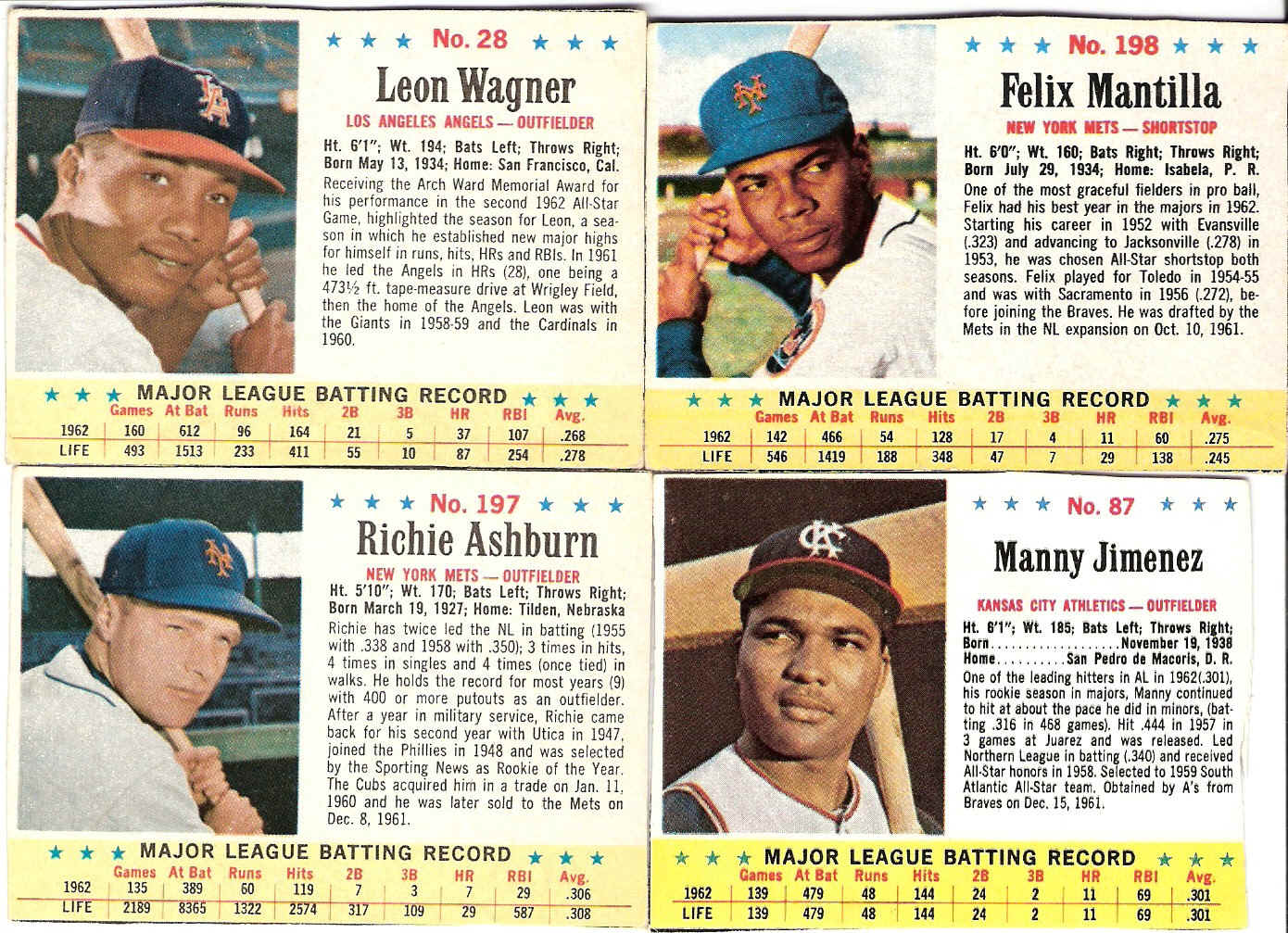
A contrast in employer
devotion: the oft-traded Wagner had a longest stint of four years in
Cleveland Mantilla warmed a Braves
bench for years, then played five seasons for three clubs.
Jiménezr received almost half his big-league at-bats in
1962. Ashburn’s tour of duty with the Mets
punctuated a long, distinguished career with Philadelphia
and the Cubs.
Note that the three players whose hands are visible have spaced
them apart on the handle—Wagner very dramatically, Ashburn by about a
quarter-inch. Leon and Felix hold the
bottom hand loose so as to turn fast on an inside pitch, while Richie’s
top hand is looser, allowing him to reach for the outside pitch: a
high-power versus a high-average strategy. Such
ingenious
eclecticism
of technique was common in the Negro Leagues, but
was often scoffed at by Major League hitting “experts”.
Negro League veterans often remarked that Ashburn played ball as
they were taught to play it.
p) On the vital importance of flowers and
balls
If the baseball
establishment is indeed precisely like every other, then there’s not
much hope of our seeing another Satchel Paige or Ricky Henderson or Rod
Carew in the near future—players who, one and all, used different moves
for different occasions, adjusted, disrupted, experimented, and (in a
word) created. On the
contrary, as the Age of Electronic Communication is busily programming
us to think in orderly channels, files, and icons, the developing
technical arms of the “sports instruction” industry are rehearsing
youngsters—hardware-savvy, affluent, mostly Caucasian youngsters—to do
things just thus-and-so. And as our
leisure increasingly becomes given to wild fantasies on disks or
websites, our “day jobs” grow ever more “goal-driven” and
“results-oriented” (and the English language ever less organic). There is no responsible, healthy symbiosis
between fantasy to reality: the two blur, instead, in the most cramped
and petulant ways, with the computer whiz hacking into a rival
company’s secret files on a lark and the porn addict setting up hidden
cameras in the ladies’ restroom. Our most
creative moments have the look of a compulsive pathology, as if we
cannot resist becoming the stereotypical characters in some stale soap
opera.
The best-educated are no
less susceptible than the exploited masses. The
politically
correct
among us scream and rave about “diversity” from
their ivory tower, but their multi-cultural
The essential spirit of
Western civilization—the voice which spoke through Socrates and
Boethius and Descartes and Kant (two of whom were executed, one of whom
fled his country, and one of whom had to write almost
hieroglyphically)—whispered to past generations beneath the steady
drone of a Pharisaical officialdom that it wasn’t culture or system or
burnt offerings which mattered, but Truth. Truth
with
a
capital T, enduring human verities, the Golden Rule, the
categorical imperative… the obligation imposed upon us by the eyes of a
child—any child—in need, the feeling of sublime transcendence inspired
in us—all of us—by a beautiful sunset. System
has
tried
over and over to throttle the humane impulse of our
civilization. At long last, now that our
words and very thoughts have become so systematized—now that we speak
in clichés drilled home by TV commercials and dream in images
designed by Hollywood technicians—our ability to pursue meaning beyond
system seems to have subsided. Even our
religion speaks in relativist language. The
example
of
Christ is no longer true because it unlocks the noblest,
most selfless ambitions which struggle for expression in every human
heart: it is true only and entirely because one finds it in our
culture’s historically preferred holy book.
I know how nutty it sounds
to connect electronic technology with this implosion of systematic
rigor, and for that reason I want to insist upon it one more time with
(I hope) greater clarity. Look at the
connection this way: never before in human history has wealth been so
culturally impoverishing. The new wealth
of the
Now what, I ask you, does
new wealth do in our culture? To be sure,
the Medicis and the Churchills were ostentatious on an extravagant
scale: our billionaire attorneys and CEO’s didn’t invent the
in-your-face, kiss-my-money palace on the hill. But
the
lavish
leisures in which yesteryear’s wealthy invested almost
possessed, of necessity, a public dimension. The
plays
which
they commissioned were witnessed by dozens, if not
thousands. The portraits for which they
sat pompously, though perhaps deposited in an intimate antechamber
throughout their lifetime, eventually reached public museums (the
masterpieces among them, at any rate). The
situation is entirely different with Sharon Jones, Bank President, or
Farley Smith, Director of Acme Security Systems. She
or
he
has a “home entertainment center” wired up in the mansion’s heart
of hearths—or maybe a small theater to accommodate dozens of
fair-weather friends and sycophantic minions; the big bucks, in any
case, have gone into the technology—the means
of
transmission—and not the “entertainment”. Jones
and
Smith
(and whatever appendages they may choose to invite) will sit
before the same Monday Night (or is it now Nite?) Football game or
Much of our economy—more all
the time—is dedicated to creating nothing, to toying
around with what was created long before we were caught in this
swirling funnel of seeing quicker and closer rather than seeing more
worthy sights. Active footage of James
Cagney and John Wayne is already being spliced into the trivial skits
of TV commercials. Soon feature-length
films will star long-dead actors revived via
computer—or perhaps super-beautiful humans digitally enhanced from the
raw clay of mere “supermodels”. But this
miracle race will utter no memorable lines, will enlighten no dark
corners of the human psyche: no Euripides or Shakespeare or Chekhov
will be writing the script. Culture is not
being enriched by our riches; creativity is not being tapped by what we
create. We are indeed trapped in a
maelstrom, and we have absolutely no idea—none of us—what cloaca
maxima we are likely to be spewed into once the spout finally
ejects us (if we may assume, that is, that we will retain enough pieces
to care by that time). We are enslaved to
a system which does no more than constantly re-program itself, at
exorbitant cost and with ever less sensitivity to what it was first
intended to broadcast. We cannot rear our
heads from the dials and buttons long enough to study—to sit
and study—how Delacroix used his reds or how Turner
used his rough brush strokes on a static piece of canvas.
We are barbarians. Attention
Deficit Disorder is just another way of describing a Visigoth.
The
pauper, as the Roman philosopher Seneca once wrote, is not he who has
little, but he who craves more. Poverty is
becoming power in our moribund culture—the privation, I mean, of
material things which we not only don’t need but which are making us
weak and dull. We don’t see it yet… but
those of us who will be best off will be those who have the least
disposable cash. Life doesn’t require much
as long as one has a roof over one’s head and three square meals a day. (Americans who do not have this much are
usually not pinching their pennies enough: when you’re poor, think poor.) I repeat that
we desperately need not to have most of what we
presently pant and pine after. We need not to have “entertainment centers”: a book is infinitely
better, if one can still be found. Canvas
and oil paints are a lot cheaper than a “
But, no, we are not yet to
the point where one may sing the praises of poverty and be understood
as a loyal American and a faithful Christian. To
argue
against
the acquisitive instinct—to argue, even, against
“developing” that instinct to ravenous proportions (otherwise known as
advertising)—is to subvert the basis of democratic capitalism. To insist that God is more palpable in deep
silences and vague feelings which disdain to be satisfied by tinsel
holidays is to deny the spirit as a “living” power.
The political forces which worry most about babies not allowed
to be born worry least about six-year-olds growing up around cell
phones and computers or about adolescents being propelled into a car
culture that claims a
In our vast cultural
debacle, we find ourselves sometimes playing a game with a ball, just
to recover a little sanity. In the same
way, a person who crawls safely from a plane’s wreckage might sit and
stare at an uncharred daisy. Is a daisy
really such an insignificant thing? Is a
game with a ball? I’ll bet that one of the
first free, spontaneous acts a survivor of a concentration camp might
perform would be to rub his hand along the bark of a healthy green
tree; and I’ll bet that one of the next would be to pick up an escaping
ball and toss it to an expectant child. As
long as a few trees and a few balls remain, we still have a chance. Some day, a baseball franchise may still go a
little bit “nutty”, throwing out the book and throwing into its arsenal
everything but the kitchen sink. (Henrik
Ibsen wrote somewhere that only lunatics are sane in a crazy world.) This off-the-wall franchise, if it ever comes
to exist, will win, almost of necessity; because the system has been
finely tuned to defeat play by the book, so “wrong” play is sure to
trip the system up completely.
This is poetry, as I said at
the beginning of what has become a rather long composition. Baseball, done right, is poetry.
It is the unpredictable leap in Heisenberg’s electron, the
unanticipated melody in the composer’s brain, the wholly improbable
emergence of a sapling from a pile of stones, the blossoming of a
flower from a crack in the sidewalk. Yes,
system is profitable in baseball, as in all human enterprises. Pitchers systematically analyze hitters and
succeed in neutralizing them: then hitters systematically analyze
pitchers and neutralize the neutralizing strategy—and so on ad
infinitum. But the most successful
player of all is the one who, for some reason, defies systematic
analysis; and the only reason any player ever does so (for nothing, in
baseball or in life, defies all analysis—even an
angelic visitor would have much of x and little of y) is that the player has exploited the system’s blind
side. Not “miracle wrists” or “superhuman
speed”, but creativity which—for the moment, anyway—is too much for the
professors and the gurus to handle… that’s what ultimately makes a
great ballplayer, just as it elevates an artistic genius from the
rigors of genre and “tasteful” expectation.
The greatest tragedy of
racism, perhaps, is that it deprives a culture of the “alien” element
necessary to vivify its own most beloved conventions.
Some people don’t like what Wynton Marsalis brings to Telemann
by way of jazz; the same people’s grandparents, I suppose, didn’t like
what Debussy imported from jazz to classical music.
But there isn’t a single example in human history of an art form
which did not change with time: for to be utterly contained within
forms—to satisfy expectation merely—spells death to the artistic
experience. An element of surprise, of
mystery—of chaos, even—must exist in the beautiful if it is to capture
the beholder. So for goodness: if we sense
no mystery in our pursuit of righteousness, but instead simply sit back
and check off the commandments we have fulfilled, then we are as far
from the good as any abject sinner.
I know now that baseball has
never escaped rigidity—that it was never the irrepressible burst of
creativity, perhaps the one such burst honored among us today, which I
naively took it to be in my youth. But I
think it has its moments; and if some bad boy keeps stirring the pot to
find an advantage in competition, then… well, then maybe we may some
day figure out that the more serious aspects of our lives do not have
to fit the mold, either.
NOTES
1 The ever
sagacious Shelby Steele dissects this type of response in an article
entitled “The Recoloring of Campus Life,” first published in Harper’s Magazine (February 1989) and reprinted in an
anthology often used in Freshman Composition classes like mine, The Norton Reader, 11th ed., eds. Linda
Peterson and John Brereton (New York: Norton, 2004), 372-382. Professor Steele concludes, “Young whites tell
themselves that they had nothing to do with the oppression of black
people. They have a stronger belief in
their racial innocence than any previous generation of whites, and a
natural hostility toward anyone who would challenge that innocence”
(381).
2 Cf. Joe
Morgan’s comments in Long Balls, No Strikes: What Baseball
Must Do to Keep the Good Times Rolling (New York: Random House,
1999), 76: “Filling out the lineup card gave every skipper tremendous
leverage over his team [before the era of million-dollar contracts]. Unless you were a superstar, he controlled
your playing time and, by extension, your compensation.
You had to remain in a manager’s good graces back then. If you didn’t he could sit you down, demote
you to the minors, or ship you to another team.”
3 I might note
here the mysterious case of Eileen Julien, an up-and-coming scholar of
African Studies who was young, brilliant, beautiful, female, and black. Professor Julien’s book African
Novels and the Question of Orality (Bloomington: Indiana UP, 1992)
was a definite tour de force. When
I
read
it, I immediately tracked her down to her elite East Coast
campus and offered my congratulations through e-mail.
By way of reply, I was informed by a helpful drudge that Julien
had “gotten married and moved to
4 This is my
rather liberal translation from Zweig’s novel, Erziehung
vor
5 Ibid.,
24;
my
translation. I am not a fan of Karl
Marx’s, by the way: if the murderous twentieth
century
accomplished
nothing else, it revealed that Marx’s extremely
reductive system supplies at least as many occasions to “trim away”
outsiders and misfits as does a monarchy or a capitalist republic. Indeed, Ortega y Gasset has astutely remarked
that progressivism stifles creative responses: “Liberal progressivism
and Marxist socialism both suppose that what they envision as the ideal
future will come to pass—inexorably, with the necessity of an
astronomical event. Protected from their conscience by this vision,
they leave history’s rudder untended, stand down from high alert, and
lose all their agility and efficacy” (my translation from La
Rebelión
de
las Masas [
6 My
translation from Romains’ Prélude à
7 Wilfrid Owen borrowed this line from the Roman elegist Horace to mock bitterly the European Old Guard’s staunch support of the War. The poem was one of Owen’s last: he was killed one week before the Armistice.
8 See “’I,
Martian’: The Autoscopy of a Science-Fiction Addict,” Praesidium
6.1-2, pp. 5-23.
***************************