Diamond Girl
Cached from http://oslopuls.aftenposten.no/?service=redirect&sourceid=1955287
Translated from Norwegian by Google
Translate
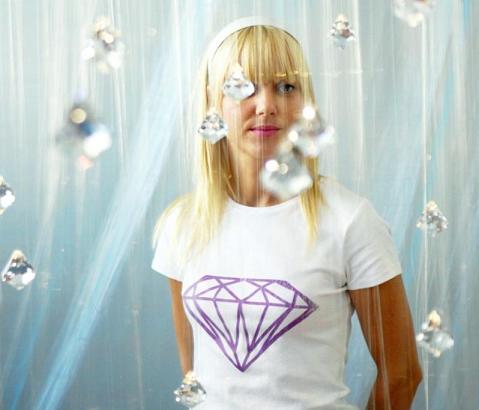
- I think it would be nice if the viewer
can get a glimpse of another
world,
a kind of beautiful dream, "says Josefine Lyche.
Photo: Tor G.
Stenersen
Krystallutopier
Josefine
Lyche has previously worked with the shiny knife paintings.
Now, she is
concerned with perception, with crystals and geometry.
ERIK BJORNSKAU
Published:
08/24/2007 10:16
Updated:
06/02/2008
"All seems
well that a crystal is beautiful, it reflects a utopian ideal state of
purity, and is built on a geometric, logical manner. The
exhibition refers to technology, science, progress and utopias," says
Josefine Lyche carefully.
The artist
has a few years established itself among the young artists who are
working spatially and in large formats, and was among last year
taken out of the prestigious Carnegie competition. She shows in
this new project center/gallery Schweigaardsgate five different
working with a common title "Cosmic Drop-outs."
"I suggest
probably titled something seems to have fallen out of the cosmos. But I also
take the basis of psychedelia and science fiction. It is
literature, texts and films that have influenced me," says Lyche.
"Diamonds"
There are
five separate works, different angles on this subject. In the
entrance two text works directly on a purple wall-- a sort of dry
version, the definitions of the structures surrounding geometry and
crystals-- texts borrowed from an anthroposophical book on geometry.
A single
plant is silver glitter scattered over the floor, which the viewer
"taking with them" and move on - a "tribute" and a direct quotation of
the artist Liam Gillick, who has made a similar work. On one wall
has Lyche mounted some large glass "diamonds" on the round base that
rotates slowly: "The Garden of Time." A type of
object you often see in science fiction movies, but also a humorous
reference to the glitter king Liberace and his giant diamond rings in
the show.
With closed
eyes
The fourth
single work is a kind of video work, inspired by a so-called "Dream
Machine," a device designed in the hippie times in the 1960s. The work
consists of multiple colors that flash in 21 Hz on three computer
screens, with frequencies corresponding to alpha waves in the brain
that are at a "resting level." When you look
at the screen with eyes closed, there is color and shows the inside of
the eyelids. But they stop
when you open your eyes, says Lyche, which ensures that it is not
dangerous-- but apparently not for epileptic patients.
The last
piece, "Noon Universe," is a cylindrical blanket or curtain of small
shiny crystals on strings, close to 500 in all, illuminated from above.
The title
refers to a fictional world with highly developed social and
technological development, from the Russian writer brothers Strugatskys'
books, the universe, "The World of Noon."
"Ideal
Universes"
All the works
refer to something utopian, something fascinating in a future with
highly developed technologies. Crystals, for
example, central to Superman's universe and history. Crystal is
beautiful in itself, but one can imagine that it also provides a
different experience here, as an image of something in an ideal
universe. And that
perhaps is important in crystal form, suggesting the artist.
"About the
audience here can get a glimpse of another world, get an experience
that gives a different view of everyday life, a kind of beautiful
dream, yes, I think would be great! Although it
probably sounds pretentious out. But I believe
that yes," laughs Josefine Lyche. "If my
references in these works can create a new benchmark and an experience,
it would be cool. . . .
"
Good to 21 September.
Wed .- Fri. 12 to 17,
Sat. &
Sun. 12 to 16