Fr. Robert Sokolowski, Ph.D.
Lecture
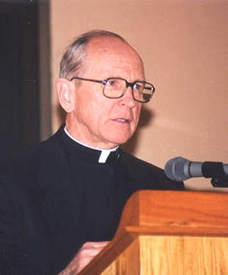 Fr.
Robert Sokolowski, Ph.D., is Professor of Philosophy at The
Catholic University of America in Washington, D.C. Ordained
a Roman Catholic priest in 1962, he is internationally recognized
and honored for his work in philosophy, particularly phenomenology.
In 1994, Catholic University sponsored a conference on his
work and published several papers and other essays under the
title, The Truthful and the Good, Essays In Honor of Robert
Sokolowski. Fr. Sokolowski came to the College as part of
the E.L. Wiegand Distinguished Visiting Lecturers Program,
which was established to bring distinguished educators to
Thomas Aquinas College and St. John's College. Following is
abridged from a lecture he gave at the College on March 26,
1999. Fr.
Robert Sokolowski, Ph.D., is Professor of Philosophy at The
Catholic University of America in Washington, D.C. Ordained
a Roman Catholic priest in 1962, he is internationally recognized
and honored for his work in philosophy, particularly phenomenology.
In 1994, Catholic University sponsored a conference on his
work and published several papers and other essays under the
title, The Truthful and the Good, Essays In Honor of Robert
Sokolowski. Fr. Sokolowski came to the College as part of
the E.L. Wiegand Distinguished Visiting Lecturers Program,
which was established to bring distinguished educators to
Thomas Aquinas College and St. John's College. Following is
abridged from a lecture he gave at the College on March 26,
1999.
I'd like to begin with a rather confrontational claim: That
phenomenology can help restore the understanding of being
and mind that was accepted in classical Greek philosophy and
medieval thought and can still take into account certain contributions
of modernity, especially those of science. Phenomenology,
in its classical form, understands the human mind as ordered
towards truth, and this is the understanding of the mind that
prevailed in classical thinking. Phenomenology develops this
understanding through its doctrines of intentionality and
evidence but with a consideration of modern problems.
This revival of classical thinking is both desirable and
important. In spite of the many advantages the modern age
has brought us over the past 500 years, it has also contributed
to a kind of undermining of our human self-understanding and
a skepticism about our ability to know both ourselves and
the world in which we live. I think phenomenology can provide
an alternative to both the modern and the post-modern predicament
because it provides a new understanding of mind as ordered
towards truth.
Phenomenology began with the work of Edmund Husserl, whose
first major work appeared about 100 years ago in Germany.
While other phenomenologists came along after him (such as
Heidegger, Scheler, and Sartre), I want to concentrate on
him because I think the strengths of phenomenology are found
more in him than in the others. He was able to overcome the
problem that has plagued philosophy throughout the modern
age: The isolation of thinking from being. Sometimes we call
that "the egocentric predicament" - the problem
of claiming to know only ourselves.
Husserl said that the discovery of intentionality is the
central move that establishes the phenomenological movement.
He claimed that consciousness is intentional, that is, it
is always conscious of something. When we know, we don't just
know our own ideas; we know something other than ourselves.
This looks like a trivial remark but it contradicts the modern
notion that the mind is immediately aware of only itself and
of events that occur in itself.
henomenology claims that consciousness and the mind are presentational
- they let things become present to us - and not just things
like chairs and tables and walls and ceilings, but things
like past memories and groups and art and judgments and numbers
and mathematical equations. These things are not simply constructs
that the mind builds up on the basis of impressions or ideas
given to it. The mind is made public; it is with other things
and not just with itself. Phenomenology describes these different
forms of presentation.
Perhaps Husserl's greatest contribution to philosophy is
his treatment of the theme of absence. He gives absence a
kind of reality. He shows that all presences are accompanied
by absences; all presentation is accompanied by intending
something that is not present. This counters the modernists
who assert that mind only knows itself.
Husserl says whenever we perceive an object there is a mix
in it of parts that are present and parts that are absent.
If one side is given to us, we always cointend the other sides.
The presence of an object involves both presence and absence.
It also involves sequence. As one aspect comes into presence,
the other one slides into absence.
Now there can be different kinds of absence. Consider how
when a sentence is beginning we already anticipate the end,
even though it's not there yet, and how we're all waiting
for the period of the sentence because the meaning isn't clear
until that period is reached. And when we come to the end,
the beginning has already been gone for some time. It is in
this unusual mixture of presence and absence which stretches
through time that the identity of the sentence is recognized.
Also, a sentence may be given to us even though its meaning
is absent, when we don't "get it." The same can
be true when we see a painting, say of Matisse. It is physically
present to us but it may be aesthetically absent. The painting
comes to life when we finally "get it." We see that
all of these distortions are actually a part of a pattern
that makes sense.
Consider situations where we can turn our minds to something
entirely absent to us. We can talk about the Empire State
Building and intend that building in its absence. We might
do this through words, but we might also do it through imagination
and memory. We can stretch our minds towards things that are
far away or past or future. What is absent is meant in its
absence. In fact, its absence can be palpable, indeed, even
sorrowful, if it is something we deeply regret, or is the
absence of someone we love, for example. And we do not have
to account for absence by appealing to a present representative
of the thing that we are aware of. The mind ranges over the
absent as well as the present. And "being" includes
absence as well as presence.
Consider how fiction is different as a kind of absence, even
from history. Fiction projects a world that never existed
at all. Or consider the definitive absence of someone who
has just died. This absence is conclusive; it is different
from someone going far away. Or consider the absence we have
in a picture. A man might have a picture of his wife and children
in his office. But it is not the same thing as just putting
their names there. Their names impose a different kind of
absence. The picture draws the presence of the person there
in a way the name does not. Finally, consider absence in theological
issues. The absence of God allows the Incarnation to take
place. Only because God is so different from the world can
He become man.
Another aspect of phenomenology is the theme of identity.
Normally in classical philosophy, identity was treated as
the permanence of an object through time or the permanence
of an object through changes. But there's another aspect to
identity that comes out in the presence and absence theme
because an object is the same in its absence and in its presence.
If we intend the Empire State Building and then go see it,
it has the same identity we intended, first absently and now
in its presence.
Once I went to see a golf tournament when Jack Nicklaus was
playing. I had never seen him play, but I had read about him.
That's one kind of absence. I saw his picture in the newspaper.
That's another kind of intending of Nicklaus. And then I went
to the tournament, and I saw leader boards with the names
of the players, including that of Nicklaus. So there I had
another intending of him. Then I saw his famous caddy, and
that was a kind of associative intending of him. Finally,
I saw Nicklaus. I identified him, but I had been intending
him in his same identity even when I didn't see him. I'm sure
I was the only guy at the tournament thinking of identity
this way!
Phenomenology also concerns personal identity - identification
of the self or the ego. Our own identity is especially involved
with presentation, since what lets us be human beings is most
fundamentally being rational animals. We are what we are because
things appear to us and because we can let them appear. We
identify things, but we are identified also; we are "identified
identifiers."
Now Husserl uses several very interesting techniques to bring
out what personal identity is. One such example is the theme
of memory and imagination which are similar to one another.
He argues strongly against the idea that in memory or imagination
what we have is an internal picture that tells us about something
past or something non-existent. We tend to think of memory
and imagination working like a little movie screen in which
we look at images of something past. But he rejects that understanding.
In memory or imagination we have a displacement of the self.
We double ourselves, as it were.
If I'm daydreaming about something I did yesterday, I am
now doubled into the one who was doing what I did yesterday.
My identity is not found primarily in my present self. It's
found in between myself now and myself then. We have this
duality within our own selves. We carry around our past and
our future. We live not only in our immediate surroundings,
but in the absence of the future and the past, and we see
ourselves in that future and past. Indeed, sometimes the memory
is so powerful and intrusive that it won't remain past. It
becomes present constantly, and that's known as a kind of
psychological difficulty. Overcoming that problem essentially
involves distinguishing between one's present self and one's
past self. And one's identity is the identity that occurs
between those two.
Following another level of personal identity, we can sympathize
with another person and yet know that the other person is
always irreducible to us. Wouldn't it be scary to have someone
else's memory come up inside of you? Isn't it odd how when
we see somebody we haven't seen for 10 or 15 years that we
think of them as somehow alien because we realize they have
so many memories that we never shared with them?
Also, the way we are in our body is distinctive. So are the
ways in which our various senses work - how touch is reciprocal.
When you use your hand to rub your elbow you sort of think
through your hand; but if your elbow started the rubbing,
then you sort of think through it instead. There's a kind
of reversibility of your own thinking within your own body
because of the extendedness of your own consciousness and
reason. Think about how reason is embodied in the human body
- how the self expresses itself through voice; how sign language
is conveyed and how it expresses emphasis in lieu of modulation.
Finally, there are many other ways in which phenomenology
can be fruitful. Consider the play of presence and absence
in friendship or hostility, or the patterns that occur in
gratitude and in envy. Consider the sequences that take place
when we redefine a personal relationship, when we are the
same and yet not the same, after a particularly disruptive
event in our lives. How is a writer present in the words written?
How is a footprint or a flag there for us except as still
new forms of presence and absence? These analyses will shed
light on what it is to be human and in doing so revive the
most classical form of philosophy.
Phenomenology is not just a local dialect in the human conversation,
nor a temporary amusement, but part of the philosophical conversation
that has been with us since reason first became aware of itself
in the great thinkers of ancient Greece.
-- Qtrly Newsletter, Spring 1999
|