 |
Although the Consul frequently sees the universe in Cabbalistic terms, the degree to which Under the Volcano is informed by the Cabbala is much debated. Lowry was evasive on the matter. In the ‘Letter to Jonathan Cape’ he stressed Cabbalistic elements and hinted at others, as if to prove "there are depths"; but to David Markson [20 June 1951; Woodcock, 114], he admitted to going on about the Cabbala in a way "quite misleading and probably not a little juvenile." Nevertheless, he stated quite definitely that he met a Cabbalist at a "critical and coincidental moment in the writing of the book." While the novel existed in substantially its present form before Lowry met Charles Stansfeld-Jones (Frater Achad) and before Cabbalistic details were inserted, it can be argued that such details are not superficial and that this element of the book (like the sign in the garden and the Spanish Civil War references), though late, retrospectively focused and clarified many previous details of Lowry's design.
As Frater Achad admits [QBL, xi], "Philosophically speaking a great deal of rubbish has accumulated around the roots of The Tree of Life", and it is not always easy to see the tree for the wood. The roots of the Cabbala go back to Old Testament times: Cabbalists claim that the word ‘Cabbala’ derives from the Hebrew root QBL, ‘to receive’, and that its mysteries were first taught by God to a select company of angels; after the Fall it was graciously communicated to Adam, to furnish the means of his posterity returning to their pristine nobility and felicity; and thence imparted to Noah and to Abraham, who revealed some of the mysterious doctrine to other men [MacGregor-Mathers, The Kabbalah Unveiled, 5]. The written Cabbala has two main sources:
(i) the Sephor Yetzirczh, the ‘Book of Formation’, probably written in Babylonia between the third and fourth centuries A.D.
(ii) the Zohar, or ‘Book of Splendour’, written about 1280 in Spain and attributed to Moses de Leon. In addition, there are many commentaries and explications, as well as esoteric matters rumoured to be too secret to be committed to print.
Andersen [64-66] describes the Cabbalistic principles that have most influenced Lowry:
The Cabala posits a universe unified and organized into a complex pattern of correspondences culminating in the idea that man is a microcosm of the universe and of God. The basic correspondences are expressed by a system of symbols based on the twenty-two letters of the Hebrew alphabet and the numbers from one to ten. In addition, there are, at each stage of the basic system, a corresponding color, divine name, angel, virtue, vice, Tarot card, body organ, heavenly body, jewel, and so on. Many cabalistic symbols are shared with the Tarot and alchemy, as well as with various forms of magic, Jungian psychology, and oriental religions and philosophies.
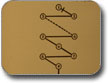
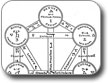
The cabalistic universe is expressed visually by a diagram ... called the Tree of Life. This diagram consists of ten spheres (Sephiroth) connected by twenty-two lines (paths). The Sephiroth are arranged in three vertical rows (pillars), the two outside ones consisting of pairs of opposites which are "reconciled," given balance or equilibrium, by the spheres in the middle column. At the top of the diagram is the sphere named Kether (light), which represents God (Ain Soph), the sum of all things, limitless, infinite, eternal, by definition unknowable. God makes himself known and in fact makes man and the universe possible by a succession of ten emanations, of which the spheres are the symbols. In one sense, these symbols are God and therefore constitute his sacred Name. The emanations progress in succession down the Tree of Life in a zigzag path resembling lightning. The Tree of Life is simultaneously visualized as a series of three triangles, arranged vertically, with a single sphere, Malkuth, at the bottom.
The aim of the serious cabalist is to develop from a spiritual neophyte into an adept by proceeding from Malkuth to Kether, retracing the "Path of God's Lightning" .... The first step is to tread the twenty-second path, to project his astral body into the lower of the three triangles, which has Yesod as its base .... Once the initial projection has been achieved, the signs and symbols of each sphere are mystically projected upward as the aspirant threads the paths by means of thoughts of wisdom, deeds of kindness, and meditation on the infinite. To a special few may be granted the ultimate, the crossing of the great Abyss which separates the two bottom triangles from the supernal triangle. "To walk in light"... is, in effect, to achieve union with God, an achievement equal in rarity and importance to achieving the Philosopher's Stone by an alchemist or to the breaking from the Cycle of Necessity by an oriental mystic. Those who fail even to start the journey or who backslide too far are said to be in the realm of evil, of "husks" and “shells," called the Qliphoth, which some say, is ruled by Beelzebub.
Chesed and Binah (Mercy and Understanding) are respectively the fourth and third emanations (Sephiroth) from Kether on the tree of life, and the movement from the fourth to the third Sephira as one progresses towards the light is fraught with spiritual danger, as Frater Achad makes clear in QBL [66-67; Kilgallin, 155]:
for there is indeed a Great Gulf Fixed between Chesed and Binah and this is called THE ABYSS. Strange as it may seem he must give up all he has attained, including himself, before he can pass this Abyss and be re-born of the Spirit into BINAH where he becomes known as NEMO or No-Man. He is now MASTER of THE TEMPLE for having given up "self" he is able to comprehend and Understand ALL.
In his Anatomy of the Body of God [42], Frater Achad talks of the "Horrors of 'the Abyss' between Chesed and Binah", but he states quite definitely that it is "bridgeable by Wisdom and Understanding". As Kilgallin notes [155-56], citing Achad's The Chalice of Ecstasy, man is given freedom of will to ally himself with the divine will, and should he make the mistake (as the Consul seems to have done) of attempting to turn the divine will to merely personal ends, he must fail, cut himself off from the universal current, and slowly and surely be lost in the abyss. The Consul’s point is that, according to the arcane wisdom, one ascending the Cabbalistic tree will find no direct "pathway" between the fourth and third Sephiroth, that is, between Chesed and Binah. The crossing of this abyss is reflected in Cortés's crossing the barranca using a fallen tree [see #100.2], and at the moment of Yvonne's death as she clambers over a fallen log in the "pathway".
As Frater Achad says in QBL [2], "Equilibrium is the basis of this work." The principle of equilibrium is absolutely central to Cabbalistic thinking. It is defined by MacGregor-Mathers [The Kabbalah Unveiled, 16] as "that harmony which results from the analogy of contraries" and by Swedenborg [Heaven and Hell, #293] as the precarious freedom man must hold between the influence of good and evil forces acting upon him. It is the great law of nature, which, if abused, may react terribly and inevitably against man: as Captain Nemo says in Twenty Thousand Leagues under the Sea [Pt.II, Ch.15], "we cannot prevent equilibrium from producing its effects. We may brave human laws, but we cannot resist natural ones." Having offended against the principle of equilibrium by abusing the mystical powers of alcohol, the Consul must pay the penalty; the Cabbalistic statement of precarious balance which is reflected in Yvonne's death, losing her balance, falling from a tree [Markson, 23], is closely related to the way that the Consul here sees himself falling from the tree of life into the abyss. The Consul's "equilibrium is all" echoes King Lear's "ripeness is all" [V.ii.11] and Hamlet's "the readiness is all" [V.ii.236], both phrases uttered shortly before their deaths.
(c) the all-but-unretraceable path of God's lightning.
As Frater Achad notes [QBL, Appendix 5], "The Qabalists tell us that the SEPHIROTH were emanated by means of the FLAMING SWORD, or LIGHTNING FLASH, which descended from Kether unto Malkuth." The lightning flash that connects the ten Sephira thus marks the path the adept must seek to retrace to achieve his spiritual ends. At the moment of his death [373], the Consul senses the presence of this lightning.
This term is not to be found in Frater Achad's writings, nor is it commonly used by other Cabbalistic writers, but Lowry discovered this word for "the world of shells and demons" [‘LJC’, 65] in MacGregor-Mathers's The Kabbalah Unveiled [30], where the world of matter, made up from the grosser elements of the other three worlds, is said to be the abode of evil spirits called Shells, Qliphoth. As Epstein says [25]: "the world of rinds and shells, being farthest from the creative force, is subject to the grossest impurities of matter. For matter is the utmost limit of spirit."