Cached on March 19, 2011, from http://www.beaugrande.com/STORY%20OF%20GRAMMARS.htm
Journal
of Pragmatics
6 (1982) 383-422. Smartly polished for upload, August 2005.
THE
STORY OF GRAMMARS AND THE GRAMMAR OF STORIES
Robert
de Beaugrande
[An
earlier version of this paper was delivered at an invited symposium on
discourse
processing at the American Educational Research Association convention,
Los
Angeles, 1981. I am indebted to Dr. Jim Coots of the Southwest Regional
Laboratory in Los Alamitos for organizing the symposium; to Robert
Calfee,
Charles Fillmore, Jean Mandler, and Robert Wilensky for appearing on
the panel;
and to Benjamin Colby, Jean Mandler, James Mehan, David Rumelhart, and
Nancy
Stein for further comments.]
Abstract
The
theoretical and practical development of story grammars is analysed
through a
detailed comparison of some influential proposals. Progress in research
suggests
a gradual trend away from strict formal grammars toward psychological
process
models. However, several issues remain unresolved, such as the
conceptions of
‘grammatical rule’ and ‘well-formed story’, and the requirements of
interest and surprise in the interaction between storyteller and
audience. Some
prospects are aired for broader research.
1.
The heritage of formal grammars
1.1.
When a new notion is introduced into a field, a primary goal of
research is to
render it plausible and well-known. After a period of adjustment, we
ought to
take stock, and probe whether and how far investigators are proceeding
in
consistent and productive ways. If the notion has been pursued in
different
directions by its various adherents, the accruing body of research
should
present some signs of tension, diversity, and controversy.
1.2.
Such is my assessment after a close reading of the literature on ‘story
grammars’ over some five years, which promised significant
contributions to
the study of discourse processing, and a rich domain of exploration for
psychologists, linguists, and educators alike. Yet in view of lively
controversy, I think it may be useful to trace the historical and
theoretical
evolution of story grammars lest the main issues of contention be
clouded over
by disparities among claims and terms.
1.3.
During the acceptance of formal grammars into linguistics and
psycholinguistics,
the general assumption prevailed that there was no significant level of
formal
organization higher than sentence structure. The sentence remained the
chief
object of inquiry and sustained widespread views about how grammars are
or
should be constructed (see now Beaugrande 1999). Thus, early attempts
to design
‘text grammars’ favoured some type of analysis was essentially
fashioned for
sentences, with fairly minor modifications (cf. van Dijk 1972; van Dijk
et al.
1972). Indeed, it was not clear at the time whether these modifications
were
sufficiently substantive to warrant setting up ‘text grammars’ as a
domain
independent of current or future sentence grammars (cf. Dascal and
Margalit
1974; Ballmer 1975).
1.4.
In this ambience, the proposals for a story grammar implied some
discourse
structure on a higher level than the sentence yet still analogous to it
(cf.
Rumelhart 1975: 211f). The question was how far the analogy would be
either
implicit or explicit, notably in regard to was the extensive borrowing
of
terminology (e.g. Mandler and Johnson 1977; Johnson and Mandler 1980).
Recent
controversies reflect the backlog of issues where stories do not seem
so readily
comparable to sentences. Moreover, the consensus has been gradually
emerging
that some seemingly secure categories of sentence grammars themselves
are not so
straightforward after all. We might therefore start off the present
discussion
with a brief look at the heritage of formal grammars in the study of
language
and communication.
1.5.
The central enterprise of modern linguistics, as derived from the
methods
proposed by Saussure (1916) and his admittedly diverse followers, has
been the
description of structures. These methods were not offered up as an
account of
the structure-building operations of language in use. A clear
demarcation was
drawn between the abstract language system (‘langue’) and the uses of
the
system (‘parole’). The categories and procedures developed were
accordingly
simple analytical techniques employed by the linguist as investigator.
The major
effort was directed toward isolating units and toward classifying those
units in
a taxonomy, so as to describe structures as relationships obtaining
between two
or more units within a system. Consequently, the approach was often
called
‘structuralism’ (surveys in Bierwisch 1966; Helbig 1974; Beaugrande
1984).
1.6.
Structuralism was adopted by some early studies of the organization of
prose
(e.g., Propp 1928; Sklovskij 1929). This research undertook to isolate
units
that figured as structural components of plot lines in many samples. So
Propp
(1928) justly called his method not a ‘grammar’ but a ‘morphology’,
i.e., a catalogue of meaningful forms. He only isolated the units which
his set
of folktales had in common, and did not offer much detail about the
creation of
the individual tale, nor about the role of the story-teller (cf. 3.17).
(compare
L�vi-Strauss 1960). He described ‘functions’ in terms of blocks of
content,
e.g. ‘villainy, departure, struggle, victory, and return’. Some of
these
units are by definition structural, i.e., determined by relations among
units.
For example, a departure would logically be stated before a return, and
a
struggle before a victory. Others are not so confined, e.g., ‘villainy’
could occur anywhere in a story, though as Benjam�n Colby (personal
communisation) points out, it most frequently appears near the
beginning of a
story to provide a clear motivation for the hero’s response (cf. Colby
1973;
Sutton-Smith et al. 1976).
1.7.
In retrospect, the limitations of structural description seem more
evident than
they did for quite some time. These limitations are part of the
historical
heritage of grammar-based approaches, and thus far bear on the current
controversy over stories. Some researchers even proposed that
structures could
and should be isolated and classified without taking account of content
(e.g.,
Harris 1951). Also, the analysis of structures was seen as an end in
itself,
divorced from the study of how structures get created or used. Taken
together,
these two tenets leave open the questions of what status the structures
have,
and how they may relate to the concerns of human communication.
1.8.
These questions can be illustrated with the ‘discourse analysis’
proposed by
Harris (1952) can illustrate these questions. Looking only at the
distribution
of formal units such as nouns and verbs, he suggested that discourse
can be
defined in terms of the ‘equivalences’ obtaining among its sentence
patterns. But he noticed that his samples, e.g., an advert printed on a
hair-tonic bottle, did not manifest very many such equivalences. He
therefore
introduced into linguistics the seminal idea of the transformation
—
not as a language processing mechanism, but merely as a technique for
formal
analysis. To get a match for (1), he ‘transformed’ (2) into (3) — a
commonplace operation in subsequent ‘formal linguistics’):
(1)
You will be satisfied.
(2)
Satisfied customers
(3)
Customers are satisfied.
This
method is an unintentional but striking demonstration of a major
problem
permeating all varieties of structuralism: the investigator is creating
the structures that are to be analysed and described. Martinet (1962:
58)
expressed the matter pointedly, though few seem willing to grasp it
then or now:
‘A structuralist is not one who discovers
structures, but one who makes
them’. When structuralists like Harris purported to ‘abstract away
from’
the use, meaning, and purpose of language in communication, their own
investigatory procedures were themselves an unacknowledged and rather
untypical
use of language. The formal analysis of sentences rest upon the
linguists’
knowledge of how sentences can be used. I have concluded that the
discourse of
linguists merits a detailed analysis in its own right (Beaugrande 1991).
1.9.
The prerogative to create structures
entrained linguistics in a strenuous enrichment of
the
‘well-structuredness’ of language by postulating theoretical substrata
of
structure, as when Chomsky (1957) took over Harris’s idea of the
‘transformation’ for a different purpose. Here, structural
relationships
among sentences were construed as defining not the discourse,
but the entire
language. One would set up a ‘grammar’ whose rules
would both describe
all the basic strings and transform those basic
strings into any more
complex structures (or back again). The grammar was thus a theory for
establishing the well-structuredness of every ‘grammatical’ or
‘well-formed’ sentence. Predictably, considerations of language use
were
again excluded, but the exclusion of meaning was soon abandoned in
favour of
assigning it an ‘interpretive component’ (Beaugrande 1998).
1.10.
Even in his early review of Skinner, Chomsky (1959) sounded ambivalent.
On the
one hand, he envisioned a ‘grammar’ as ‘a statement of the integrative
processes and generalized patterns imposed upon the specific acts that
constitute an utterance’; and ‘rules of the grammar’ as the ‘selective
mechanisms involved in the production of a particular utterance’ On the
other
hand, he warned that ‘the construction of a grammar which enumerates
sentences
in such a way that a meaningful structural description can be
determined for
each sentence does not in itself provide an account of this behavior’
(1959:
56). This ambivalence has run throughout the later history of formal
grammars:
on one side, they are a formalism that directly represents human
language; on
the other side, they are a purely analytic technique for linguists who
manipulate and classify data. Most researchers would favor the former
enterprise; but the methods themselves obdurately tended toward the
latter.
1.11.
Consequently, each central notion of transformational grammar was
routinely used
in diverging senses. First, there was the formal definition stipulated
during
the construction of the grammar; second, there was a commonsense
definition more
attuned to human activities. For example, ‘generate’ means, in the
formal
grammar, ‘assign a structural description to’; in normal usage, it
means
‘create’, ‘produce’. The ‘speaker-hearer’ was a formal device, a
kind of abstract automaton with ‘perfect’ knowledge of ‘well-formed
sentences’; in everyday parlance, it is a real human being using a
language to
communicate. Intriguingly, Chomsky (1965: 9) acknowledged that’ his
‘terminology’ had engendered ‘a continuing misunderstanding’, yet he
could ‘see no cause for a revision’. Presumably, the clarification of
the
misunderstanding could have engendered pressure to reconstitute the
whole
enterprise.
1.12.
I have briefly aired these difficulties to illustrate the principled
divergence
between formal grammars and human faculties. The grammar is set down
via
deduction (a priori stipulation) and centers upon formal definitions.
The study
of human faculties, in contrast, is set down by induction (conclusions
drawn
from experience) and centers upon empirical demonstrations. It seems
plain that
deduction and definition should be the second stage of research, not
the first.
Before we formalize a domain, we need empirical evidence about its
nature.
Reacting no doubt against the behaviorist emphasis on ‘observation’,
Chomsky
(1965: 19f., 15) dismissed ‘objective tests’ as a ‘matter of small
importance’, unfit to bring any ‘gain in insight and understanding’;
indeed, the discovery of ‘patterns’ in ‘observed speech’ was said to
‘preclude the development of a theory’.
1.13.
It is, I think, among the most important tenets shared by researchers
in
cognitive science that there should be no gap between a formal
representation
and its empirical domain. For example, Rumelhart advocates ‘a grammar
of the
language’ that ‘fits together with the rules for processing the
language’
(1977a: 12). If this kind of a grammar is to work, we will need closer
integration between the formal-deductive approach and the
empirical-inductive
one. The two issues raised in 1.7 must be placed in the center of our
deliberations. First, we must consider whether a grammar can and should
imply or
assert the independence of structure from content. To have a grammar at
all, one
must have both a set of categories for classifying elements, and a set
of rules
for arranging elements (Jean Mandler, personal communication). The
question is
then whether these categories and rules can be defined in terms of
content, and
if so, how far such a definition can be compatible with a definition in
terms of
structure. Second, we must consider whether formal rules are
justifiable only if
they claim to represent the structure-building operations carried out
by human
processors. If so, the design of grammars must be constantly updated as
experimental evidence accrues. In the next section, I undertake to
probe these
two issues within the recent evolution of the story grammars approach.
2.
The heritage of story grammars
2.1.
Against the background sketched above, the current debate over story
grammars
might well have been foreseen to trouble the critics of story grammars
(e.g.,
Black and Wilensky 1979; Black and Bower 1980): the separation of
structure from
content, and the empirical status of the grammars. Though I would
concur that
grammars with the limitations cited by the critics are problematic, I
am not
convinced that those deficiencies can properly be laid to the account
of the
story grammars under discussion.
2.2.
Inspired in part by transformational sentence grammars, recent grammars
went
beyond the isolation of units typical of the early studies (cited in
1.6) and
offered sequencing rules (e.g., Colby 1973: 645). Rumelhart’s (1975
[original
1973]) paper, following Colby’s approach, was among the most
influential for
the new trend in story grammars (e.g., acknowledged in Bower 1976:
Mandler and
Johnson 1977: 113; Thorndyke 1977: 19). He called his approach a
‘schema’ in
the paper’s title, but used the term ‘grammar’ throughout the paper
itself. Rumelhart (1975: 213) followed Chomskyan grammar in giving the
generative (productive) role to syntax
(structure) and the interpretive role to semantics
(content). He didn’t seem to consider the trenchant critiques that had
already
been advanced in linguistics against this assignment (e.g. McCawley
1968; Lakoff
1971; vgl. Pet�fi 1971). In psychology, Mandler and Johnson (1977: I
13f.)
rejected it as ‘unwieldy to work and frequently redundant’. Thorndyke
(1977:
78) introduced semantics into the syntactic domain by appealing to
Fillmore’s
(1968) ‘case grammar’, where structural categories are additionally
defined
by recourse to their content, e.g., the sentence slots reserved for
expressions
of location and time. And finally, Rumelhart himself later remodeled
his own
set-up by defining the schema in terms of both structure and content:
A
schema is an abstract representation of a generic concept for an
object, event,
or situation. Internally, a schema consists of a network of
interrelationships
among the major constituents of the situation represented by the
schema. (1977b:
267)
2.3.
Black and Wilensky (1979: 214) single out Thorndyke’s ‘grammar’ as
having
only syntactic relations (cf. Black and Bower 1980: 228). It is true
that
Thorndyke (1977: 77) talks about ‘inherent plot structure’ that is
‘independent of passage content’. But his rules signal the contrary,
e.g.
(1977: 79):
STORY
=> SETTING + THEME + PLOT + RESOLUTION
SETTING
=> CHARACTERS + LOCATION + TIME
Categories
like ‘setting’ ‘location’, and ‘time’ are semantically determined,
not syntactically. Thus, these structural rules can be applied only
with
constant recourse to passage content; at most, they are independent of
the
specific details of passage content (e.g., where the location is, and
what the
time is.) Moreover, these rules are not fully syntactic because they do
not all
have to do with sequencing. Thorndyke (1977: 80) follows Rumelhart’s
(1977:
213) use of the ‘+’ sign ‘to form two items in a sequence (cf.
2.7.5.1.).
But it is obviously not the case that a story must give the location
after the
characters and before the time. The beginning of a standard folktale
may have a
quite different order, as in the opening of Snow White
(Grimms’
version):
(4)
Once it was the middle of winter [time], and the snowflakes fell from
the sky
like feathers. At a window with a frame of ebony [location] sat a queen
[character] and sewed.
I
shall return to this matter of order in the discussion of ‘rewrite
rules’
(cf. 2.7.5.1, 2.14).
2.4.
Conversely, Black and Wilensky (1979: 227) would each view their own
story
research, which coincides mainly just in their reservations about story
grammars, as based entirely on content and ‘unguided by syntactic
considerations’. However, their key notion (and that of many story
grammars
too, e.g. Rumelhart 1977b) is problem-solving,
which is in fact a
structural category just as much as it is a content-based one. A problem
is at least a pair of states, an initial state and a goal state —
possibly
with intermediate states between them — where there is at least a
reasonable
probability that the attainment of the goal state will fail. The higher
that
probability, the more serious the problem, and hence the more
interesting
(Beaugrande 1980b: 27). Often, the problem-solver will have to set up
subgoals
because the main goal cannot be reached in a single push (cf. Meehan
1976).
Depending on the method, processing may focus on a single complete path
(depth-first search); or on the spread of alternatives for each phase
(breadth-first search); or on the differences between the initial state
and the
goal (means-end analysis). From all this, it follows that we identify
or
understand a problem by relating content to a structural configuration:
a
network of states and their transitions.
2.5.
It is therefore inappropriate to adopt an either/or stance on structure
versus
content, placing the story grammars on one side of the fence and the
problem-solving story schemas on the other. I think we can safely
concur with
Mandler and Johnson (1980: 311):
What
people within the story-grammar framework claim [...] is that in
addition to
content specifications, stories have specifiable structures and that
people have
knowledge about such structures which they use in the course of
comprehension
and retrieval.
This
‘claim’ may have been unclear in earlier work, where the analogy of
story
grammars to sentence grammars could still taken for granted without
explicit
critical evaluation. In formal linguistics, the sentence is a purely
structural
category, defined exclusively by reference to its format; but in actual
communication, meaning and purpose are always implicated in the
processing of
utterances (which may or may not have
precisely determinable sentence formats). The story, on the other hand,
cannot
be dually defined in this way. When Thorndyke (1977: 78) presents ‘the
rules
of the narrative syntax’ as ‘independent of the linguistic content of
the
story’, the distinction should be not between structure versus.
content, but
between higher-level versus lower-level categories in a hierarchy. The
‘linguistic content’ is then the detailed utterances of the story
itself, as
opposed to the organization shared by stories
in general.
2.6.
Johnson and Mandler (1980: 54ff.) soon qualified their analogy,
expressly noting
that ‘the semantic and syntactic aspects’ are more ‘intertwined’ in
stories than in sentences in that ‘story categories are more dependent
on
context for their assignment than are lexical or sentential
categories’; yet
remarking that this same intertwining may be far more important in
sentences
than the ‘standard theory’ suggests (1980: 57). The claim that ‘the
syntactic classes’ of sentence ‘units can be determined without
analyzing
the structure of the sentence in which they appear’ (1980: 56) is far
too
strong (especially for English); but, as I shall argue in 2.14, the
dependency
upon context is indeed different for story categories versus sentence
categories.�
2.7.
We might now inquire how the differences between sentences and stories
might be
reflected in all terms and notions of story grammars. For purposes of
discussion, shall enumerate six perspectives regarding the status of grammatical
rules..
2.7.1.
The rules are stipulated solely by the formal construction of the
grammar. This
perspective pervades most work on the strictly ‘formal grammars’ upon
which
such linguistic conceptions as Chomsky’s are based. Such rules would
have to
specify the formal structure of all ‘grammatical’ stories and exclude
all
non-stories; and this delineation would have to be done by a purely
mechanical
application of the rules for well-formedness. A serious weakness of
linguistic
grammars is that human language users are demon�strably not able to
determine
in any mechanical way which sentences their language allows (cf.
Greenbaum ed.
1977). The same empirical intracta�bility will almost certainly be
found for
stories. At most, people will be more or less confident about accepting
a given
story, or will rate samples as better or worse stories (Brewer and
Lichtenstein
1981; Stein and Policastro 1982); on this basis, we might be able to
assign a probability
for storyhood to any sample. But in doing so, we exchange the
purely
deductive, formal outlook on rules in favor of an inductive,
approximative
outlook (cf. 1.12; 3.15).
2.7.2.
The rules are analytic techniques to be applied by the investigator. In
1.8ff.,
I remarked that most of the early rules in grammar had precisely this
status.
For example, in Harris’s (1951) ‘discourse analysis’, transformations
were
carried out only by the linguist, and only to create equivalent
syntactical patterns. An enduring perplexities with Chomsky’s followers
is
that they were not content with this version of transformations and
tried to
upgrade them into psychological processes carried out by language users
(cf.
Clark and Clark. 1977). Perhaps it is not impossible
that real
language processes do resemble the analysis carried out by professional
linguists, and much psycholinguistic research has in fact assumed that
resemblance (cf. Clark and Clark 1977). But for that very reason, the
resemblance tended to be built into experimental designs rather than
treated as
a hypothesis to be tested.
2.7.2.1.
In story grammars, the rules have been frequent tools for the
investigator’s
analysis. However, the detailed procedures for the analysis are much
less
specific than in sentence grammars, because we can agree much more
easily on
entities like ‘noun phrase’ than on entities like ‘theme’. Thus,
although the value of rules as heuristics for story analysis seems
secure, I
doubt we can accept this as their only function. Surely, rules that
reflect
human processing should be considered more interesting than rules for
analysing
examples.
2.7.3.
The rules represent human operations carried out when
producing or
comprehending a story. Here, the rationale for the rules is
neither formal
deduction nor heuristic analysis. Immediately, the constraints upon the
creation
of rules, as well as the constraints embodied in the rules, are of a
wholly
different nature. The rules must not only stipulate what elements are
placed in
what sequences, but also what limits there are. A purely formal
rule-set might,
as Chomsky (1965: 10) argued, be stipulated without regard for
‘rapidity,
correctness, and uniformity of recall and recognition’; but a rule-set
for
human operations must be bounded by considerations of memory,
attention, motor
control, and so forth. It is no coincidence that story grammars have
been most
impressively supported by evidence of people’s story memory (e.g.,
Mandler and
Johnson 1977; Thorndyke 1977; Mandler 1978; Stein and Nezworski 1978;
Stein and
Glenn 1979). Obviously, this shift brings important restrictions on
such notions
as recursion and embedding (to which I return in 2.17ff.). In effect,
the
‘infinite’ set of strings which formal grammars could describe (e.g.,
Chomsky 1957) becomes the finite set of story structures which people
will be
likely to produce and understand, given the limitations upon processing
capacities (cf. Beaugrande 1984a, 1984b, 1987).
2.7.3.1.
The most alluring aspect of this perspective is that it is empirically
testable
in a manner that the perspectives depicted in 2.7.1 and 2.7.2 are not.
As
Johnson and Mandler (1980: 78f.) suggest,
Each
model has been used to predict that departures from canonical form will
make
comprehension more difficult and that given a less than well-formed
story to
remember, subjects will tend to recall the story in a more canonical
form than
that which was presented. For the most part, tests of these predictions
have
involved generating a story which a given grammar predicts is
well-formed,
generating an alternative version of the ‘same’ story that violates the
rules in some way (e.g., by deleting constituents or moving
constituents out of
order), and comparing performance for the two forms.
The
loyal following that story grammars have attracted may be due to the
success in
such experiments (cf. Kintsch et al. 1977; Thorndyke 1977; Mandler
1978; Stein
and Nezworski 1978; Stein and Glenn 1979). Johnson and Mandler (1980:
79) are
not entirely happy with these confirmations, because the latter
‘involve
assessments of relative, rather than absolute,
grammaticality’
(emphasis added). This discontent hardly seems just. Even Chomsky
(1965: 11) was
ready to admit that ‘grammaticalness is, no doubt, a matter of degree’.
2.7.3.2.
Consider in this connection the notion of the canonical form
invoked in
the quote from Johnson and Mandler. In formal grammars, the canonical
form is
plainly an idealization, independent of any realization. This should
hold
especially for stories (cf. Smith 1980: 216ff). We can refer to different
versions of Snow White, but we can’t single out any
one of them as the canonical
version; at most, we could accept the oldest
version, as was the tendency
in nineteenth-century folklore research (but compare the protest in
Housman
1911); or build a fictional version from the
elements common to all known
versions (L�vi-Strauss 1955). In any case, we are depending upon our
powers of
reconstruction, historical or ethnographic; and the ‘canonical’ version
so
obtained is always tentative, pending further evidence.
2.7.3.3.
As representations of human processes, the rules proposed so far have
some grave
drawbacks. As Thorndyke and Yekovich (1980: 41) point out, as long as
the
detailed processing involved in using story grammars had not been
specified in
terms of rules, such grammars are ‘relatively impervious to
disconfirming data
while remaining capable of explaining post hoc most empirical results’.
Another drawback is that so far, researchers appear to suppose that a
theory of comprehension
can be worked out and tested without a theory of production.
Nearly all
studies of story structure in period I surveyed work at the
comprehension end,
even though much of the data in recall is the result of story
production carried
out by the test subjects. The retelling of a story you have has
received is by
no means trivial, given the exigencies of text production (Smith 1980:
230; cf.
Beaugrande 1984). Thus, many changes that the story undergoes when
recalled by
audiences may be due not just to ‘encoding’ and ‘retrieval’ of ‘story
propositions’ (Thorndyke and Yekovich 1980: 35). Propositions must be
reprocessed to meet exigencies of the linear media of a surface text
(cf.
Beaugrande 1984a, b, c). Moreover, as we saw in the quote from Johnson
and
Mandler (1980: 78f., cf. 2.7.3.1), many of the test stories have been
written
(‘generated’) by the investigators themselves — a practice with
implications for the objectivity and generality being claimed for test
results.
2.7.3.4.
Finally, I see the drawback that story processing is probably not
uniform in its
details: different people (or the same person at different times) may
do quite
different things with one and the same story. There can be fluctuations
of
attention, interest, motivation, or background knowledge that
materially alter
the scheduling and thoroughness of processing — precisely in the
domains of
evidence we would want to seek out, e.g., reading times (cf. Haberlandt
1980;
Uyl and Oostendorp 1980). In terms of design criteria (set down in
Beaugrande
1981): how much freedom can a story grammar allow among different
people and
still count as a grammar?
2.7.4.
The rules stipulate not all human
processes, but only those dealing with the order of story constituents.
We
could evade some of the drawbacks enumerated above by limiting the
rules only to
sequencing procedures. We would for the time being disregard such
matters as how
words activate concepts, how story grammars are ‘instantiated’ during
the
act of comprehending, and so on. We do indeed find such a perspective,
e.g.,
when Thorndyke and Yekovich (1980: 29) aver that ‘these schemata
describe the
syntax of narrative organization just as earlier phrase structure
grammars
describe the syntax of sentences’; and that ‘a schema provides
expectations
about the order of events in the story, and influences the encoding of
events
into their ideal order’ (1980: 37). Also, several of the recall tests
involved
disordered stories (e.g. Stein and Glenn 1979).
2.7.4.1.
The drawback here is that numerous rules proposed so far would not work
as
sequencing rules. Thorndyke (1977: 80) expressly presents his rules
with a
‘+’ symbol to ‘indicate the combination of elements in sequential
order’
(cf. 2.3). But consider his very first rule:
STORY
=> SETTING + THEME + PLOT + RESOLUTION
Now
‘setting’ and ‘resolution’ are clearly in sequential order, appearing
most often at the beginning and ending of a story, respectively. But
‘theme’
is defined as ‘the general focus to which the subsequent plot adheres’,
and
‘plot’ as ‘an indefinite number of episodes’ (1977: 20). Obviously, it
makes little sense to suppose that the theme and plot are ordered as
sequential
constituents; instead, both of them should pervade the entire story,
including
the setting and resolution (cf. 2.3). Similarly, I already remarked
that the
rule
SETTING
=> CHARACTERS + LOCATION + TIME
is
not an ordering rule, and provided a counter-example. At most, we could
have an
unordered set, e.g.:
SETTING
=> {CHARACTERS, LOCATION, TIME}
On
the other hand, Rumelhart’s (1975: 219) rules such as
EPISODE
=> EVENT + REACTION
ATTEMPT
=> PLAN + APPLICATION
APPLICATION
=> PREACTION + ACTION + CONSEQUENCE
would
seem to be valid sequencing rules for a typical story: an event should precede the
reaction, a plan should
precede its application, and so on. The different story grammars, as we
see, are
making ‘rewrite rule’ do different things even though the rules look
much
the same (cf. 2. 14ff.). Note also that the time sequence of events in
a story
line need not be the sequence in which the events are narrated via the
surface
text (Conrad’s Lord Jim is an extreme example).
And, time sequence
often correlates with causality. (Stein and Glenn 1979). Hence, if we
accept the
restriction of the rules to sequencing, we need to reconsider the
various
dimensions implied in the ordering of constituents: temporal,
narrative, and
causal.
2.7.5.
The rules do not account for the processing of stories, nor for the
sequencing
of stories, but only for abstract expectations about stories. In
this
perspective, the incompleteness and inconsistency of the rules as noted
above
seem less damaging. It is no longer claimed that story-tellers or their
audiences must behave according to the rules, but only that they can
use rules
as a means of general orientation in dealing with stories. The grammar
need not
represent in detail what every audience does with the story under all
circumstances; the grammar would only predict tendencies, such as the defaults
and preferences, that people use for
stories. For example, a story
would normally be told with the events in their original time sequence,
but the
story-teller could do otherwise, provided appropriate signals were
included in
the text. The empirical studies on recall of disordered stories (cf.
2.7.4),
where people put events back in order, could render such a perspective
attractive.
2.7.5.1.
However, this perspective weakens the predictive power and testabil�ity
of the
grammar. Since the rules need not be manifested in the surface text, a
given
test failing to reveal their effects need not constitute a refutation.
We have
no exact criteria for recognizing an application of the rules in actual
recall
protocols, aside from the highest-level categories such as the main
constituents
of episodes being present or being in a certain order (ef. 2.7.4).
Thus, the
relationship of the surface text to the underlying mental
representation we are
postulating for the whole story becomes flexible, if not vague.
2.7.6.
The rules stipulate the ideal toward which stories evolve in repeated retellings.
This
perspective should follow logically from that depicted in 2.7.5 �— the rules as a point of
orientation. Mandler and
Johnson (1977: 113) argue as follows:
An
orally transmitted story will survive only if it conforms to an ideal
schema in
the first place or has gradually attained such a structure through
repeated
retellings.
The
grammar would not stipulate which stories can or cannot be told, but
only which
stories are likely to be retold. The difficulty now is the historical
dimension
involved in ‘repeated retellings’. Empirical demonstrations could
ultimately
be done only over long periods of time, e.g., by comparing earlier and
later
versions of a folktale from different centuries. An experiment would be
one tiny
step in the long-range evolution of a story form: test subjects would
presumably
be ironing out structural difficulties (e.g., missing or disordered
constituents) in much the same way as traditional story-tellers should
do
throughout the ages. But a particular subject (or group of subjects)
might
contribute very little to the overall evolution of a story without
thereby
proving that the rules don’t work in a gradual fashion. Or, we might
want to
do experiments in which a story is passed on from one test subject to
the next
in an extended series (compare Bartlett 1932), rather than having all
the
subjects read or hear the original story and produce a recall protocol.
This
procedure could rely entirely on oral transmission, provided reliable
transcripts were made from recordings.
2.7.6.1.
However, we would also need to find out why — if the rules have this
evolutionary effect — all stories do not end up with the same
structure. The steady migration toward a ‘canonical form’ (2.7.3.1) or
an
‘ideal schema’ (2.7.6) should gradually level all stories into one
basic
pattern. What we actually find, however, is a startling diversity of
story
patterns, even within a single culture. One explanation would be that
memory is
too unreliable to keep the ideal (or canonical) format firmly in mind
at all
times; differences would then be due to memory lapses. This explanation
seems
unattractive, since studies such as Lord’s (1960) show that
story-tellers,
especially in pre-literate, oral cultures, command imposingly large and
accurate
memories. I would argue instead that story-telling depends vitally on
variety as
a means to maintain interest (cf. 3.5ff.; 3.24ff.). The ideal version —
the
single story that might be expected to arise from evolution — would not
be
interesting, or not for long. Story-telling is always situated in a
dynamic
context of social interaction (cf. Chafe 1980), and these dynamics
mediate
against the imposition of a static, ideal version (cf. Beaugrande and
Colby
1979).
2.8.
I have now enumerated six perspectives that might be adopted regarding
the
‘rules’ of story grammars. I have tried to show how each one entails
certain
drawbacks, especially in regard to the rules proposed by the usual
story
grammars. In early research, it was unclear which perspective was being
adopted.
In consequence, there were no unifying principles for constructing a
story
grammar, nor for controlling the creation of grammatical rules. Yet if
story
grammars are to have psychological reality — and I believe few
researchers
would want to abandon the claim that they should (cf. 3.23) — there
must be
empirical arguments that determine how a grammar is set up. For
instance,
Johnson and Mandler (1980) had to decide between proliferating the
rules for
‘base structures’ or else introducing transformational rules that can
account for story variants upon the same limited range of base
structures; they
took the latter alternative in hopes of containing rule proliferation
and
thereby upholding what they called ‘descriptive adequacy’. But the
ultimate
arbiter should be the degree of cognitive, rather than formal, economy.
2.9.
Anyone who works with formal grammars as linguistic and psychological
models
will soon incur the dangers inherent in the freedom to create rules.
Formal
grammars are decidedly too powerful wherever they take no account of
limitations
imposed by human processing capacities. For example, I can see nothing
in the
story grammars that would prevent the generating of stories whose
length,
recursion, and embedding are infinite; yet we would all agree that
human
restrictions would never tolerate an infinite story. Thus, we must
build in
limitations not only on the number of rules, but also on the extent to
which the
rules should be applicable.
2.10.
Rewrite rules are, I fear, hard to control on both counts. The
constructor of a
grammar can equate any category on the left with any other category (or
set of
categories) on the right. Taken as a formalism, the grammar sets no
limits upon
what can be ‘rewritten’. Psychologically, however, a rewrite rule is a
claim
that two categories (or sets of categories) are, under given
conditions,
equivalent enough to be substituted for each other. This claim must
seem very
strong in view of the difficulties of defining conceptual categories
(cf. Rosch
and Mervis 1975), and in view of the intricate, changeable associative
capabilities of memory (cf. Loftus 1980). Thus, the equivalence claim
inherent
in rewrite rules needs to be both supported and constrained by
empirical
evidence.
2.11.
The same challenge can be raised about transformational rules (see now
Beaugrande 1998). As a formalism, these rules (often notated as rewrite
rules)
allow the conversion of one structure into another. Psychologically,
these rules
imply that there is some sense in which processing actually takes the
one
structure and ‘transforms’ it into the other. This too must seem a
strong
claim, and one for which empirical support in studies of syntax has not
been
forthcoming, despite the best efforts of ‘psycholinguistics’. If
Johnson and
Mandler (1980) wish to create transformational rules for deleting or
moving
story constituents, they should make it clear who uses the rules —
besides of
course, the investigators making up the stories. A line of argument
such as:
The
conditions for deletion depend upon the principles of inferability
which govern
the ability of a listener to recover the complete underlying structure.
(Johnson
and Mandler 1980: 71)
clearly
goes beyond the interpretation of the deletion transformation as a pure
formalism by appealing to something that a listener does
(on deletion
rules, see 2.20).
2.12.
The whole question of using transformations in a well-formedness
grammar has, I
think, been inadequately resolved, whether in linguistics and in
psychology. On
the one hand, demands are advanced that every sentence (or story) be
well-formed. On the other hand, the transformational rules permit
virtually
endless tinkering with the forms of the data, so that the demand is
implicitly
vacuous, and the theory circular, creating the very well-formedness
that it has
postulated as its foundation. If the data do not fit the grammar, rules
can
always be added or manipulated to impose conformity. The
transformations
foreseen by the rules don’t actually explain the
data so much as get
rid of them. Only if there were a complete, definitive rule
set that did not
allow this freedom to add and manipulate could the basic
well-formedness claim
be strictly tested. Until then, it remains a circular assumption
arising from
the design of the approach and bears no principled responsibility
toward any one
corpus of obtainable data.
2.13.
Another way to interpret a ‘transformational’ grammar is as a claim
that any
pattern for a sentence or story is reducible to one of a small set of
basic
structures. Thus claim is also vacuous and circular as long as there
are no
principled limits on the number and extent of rules that can be
created. The
grammar itself stipulates that all sentences must contain the same
categories
(e.g. ‘noun phrase’, ‘verb phrase’). Once that stipulation is accepted,
it is immediately obvious that conversions from any sentence to any
other can be
carried out. It is not obvious, however, that a single, consistent rule
set for
doing so will also satisfy the well-formedness criterion. On the
contrary, the
ad-hoc rules that manage a desired conversion might also allow many
undesirable
ones. It is also questionable whether the relationship between
sentences claimed
to share the same base structure is syntactic. In my view, the relation
between,
say, an active sentence and its corresponding passive or interrogative
is
syntactic only in the trivial sense that they all contain the same
structural
categories; but in communication, the decision to use a passive or
interrogative
is always semantically or pragmatically motivated. Thus, if the
transformations
are to be psychologically relevant, we must build these motivations
into the
apparatus of rules.
2.14.
I would argue that these principled objections to formal grammars are
more
pressing than the details of the rules themselves. The current debate
has, for
instance, revolved on the various kinds of rewrite rules, which critics
of story
grammars use to classify current them as ‘finite state’, ‘context free’
and so on (cf. Black and Wilensky 1979: 215ff.; Black and Bower 1980:
229f.).
Their classifications would be entirely correct if the rewrite rules of
story
grammars contained only formal symbols. But instead we encounter fuzzy,
content-based categories on both sides of the rules. Thus, categories
like
‘setting’, ‘theme’, and ‘plot’ (cited in 2.7.4.1) are in no way
formal symbols, but at most entities we can define or recognize only
because
they occur in something we already know to be a story. No story grammar
proposed
today can be ‘context-free’, even though the rewrite rules have only
one
category on the left, as long as that left-hand category is
determinable only in
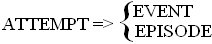
its context. Consider here Thorndyke’s (1977: 79) rule:
where
‘attempt’ is indeterminate except in the context of a plan and goal for
some
agent. Thus, context is omnipresent, but hidden away in the
interpretation of
the symbols (cf. Johnson and Mandler 1980: 56) — a recourse disallowed
for a
formal context-free grammar (cf. Ginsburg 1966).
2.15.
Not only do the symbols designate fuzzy content-based categories, but
so do
their junctions. As I remarked in 2.7.4.1, the ‘+’ symbol is being made
to
do too much and too varied work. In a formal grammar, it could only
signify that
two symbols appear adjacently. In a story grammar, this junction
depends upon at
least three kinds of linkage: (a) the sequence of mention in the
surface text;
(b) the temporal progression of story events (whether or not they are
mentioned
in temporal order); and (e) the causality whereby events and actions
depend upon
each other (again, whether or not this is reflected in the order of
mention)
(cf. 2.7.4.1). Several story grammars have clarified this matter by
labeling the
links between constituents, e.g. Johnson and Mandler’s (1980: 60)
‘and’,
‘then’, and ‘cause’; or Stein and Glenn’s (1979: 59ff.) ‘allow’,
‘initiate’, ‘motivate’, ‘result’, ‘and’, ‘then’, and
‘cause’ (cf. 2.24). Beaugrande and Colby (1979: 48) further proposed to
distinguish causality according to the type of implication: cause
(first
event creates necessary conditions for a second); enablement
(first event
creates sufficient, but not necessary conditions for a second); reason
(an event motivates a rational human reaction); and purpose
(some event
is the motivation for someone’s prior actions).
2.16.
As the nature of the categories and junctions in the rules becomes
better
defined, a purely formal representation seems more and more
impoverished.
Neither finite state grammars nor context-free grammars would allow us
to define
junctions in terms of temporality and causality. For this reason, the
criticisms
of Black et al., though just in themselves, do not apply to the story
grammars I
am reviewing. Perhaps the whole controversy would be assuaged if we
could phase
out rewrite rules altogether, and state the rules in plain English, as
in
Beaugrande and Colby (1979: 54f.):
Notice
the main CHARACTERS, and their PROBLEMS and GOALS.
Relate
ACTIONS and STATES to PROBLEM-SOLVING and to GOAL-directed PLANS
Such
a method would at least make it clearer what the rules require.
2.17.
The difficulties I have raised can be further illustrated with the
notion of recursion,
a common feature of formal grammars. The ‘infinite’ set of strings a
formal
grammar can supposedly enumerate (cf. Chomsky 1957) hinges
on infinite recursion of a finite set of categories. There could be no
‘longest sentence of English’ in any such grammar because some
prankster
could always come along and dob in another modifier, embed another
clause, or
whatever. But for a realistic grammar based on human capacities, we
don’t want
this much ‘power’. I have found that a recursion containing more than
three
members is comparatively rare in naturally occurring clauses or
sentences (if
you aren’t Spenser, Faulkner, Tom Wolfe, or the like). Each recursion
makes
the next one steadily less probable —
a kind of
‘self-destruct’ mechanism that normally terminates recursion fairly
soon.
2.18.
A recursive story plot is also limited. A case in point is the quaint
tale of
the Old Farmer and His Stubborn Animals (used in
Mandler and Johnson
1977: 127; Rumelhart 1977b: 273; Thorndyke 1977: 105f.; etc., etc.).
(The
original bard of this momentous tale was apparently Rumelhart, who
trans-gendered and trans-animaled Ye
Olde Englisshe
folktale, The Old Woman and Her Pig; see Rumelhart
1977: 273.). A superannuated
agrarian deploys
one tactic after another to impel his contumacious donkey into a
‘shed’.
Some of his sallies are pure recursions, where two
actions are unrelated
and could readily be moved without trouble, e.g., pushing the
unmannerly
quadruped from behind (a parlous act, I grant you) versus beseeching
the dog to
bark discordantly and affright it into locomotion. Other attempts
are embedded
recursions, where one action is initiated in order to enable
another, e.g.,
bribing the cat with milk to scratch the dog so that the latter will bark
with alacrity; or bribing
the cow with hay
to give the milk; luckily, no need to bribe the haystack.
All these recursions are unlike those in a formal grammar for at least
two
reasons. First, we have not mere repetition, but linkages of
temporality and
causality among the individual recursions. Second, there is always a goal
waiting
to terminate the recursions as soon as it is attained — such this is the recursion of general
problem solving (GPS), to
wit:
Difficulties
lead to goals to overcome them. This device accounts for
much of the recursive flavor of GPS, since its reaction to being unable
to apply
a goal is to set up the goal of applying it. (Newell and Simon 1972:
447).
A
third reason is not found in the Old
Farmer Story, but in many stories studied by Schank’s merry
consortium (cf. Schank
and Abelson 1977; Wilensky 1980a). Here, each action is a little more
drastic
than the one before it, e.g., when Bill first ‘asks’ John for the latter’s
bicycle, then
‘bargains’ with cash, and finally ‘threatens’ to ‘break his arm’, which last
eventuates
in the donation (Wilensky 1980a: 28). This mode of progression was dubbed
planbox
escalation by
Beaugrande and Dressler (1981: 170ff.). For a clearer example, our old farmer
might first conjure the obdurate
donkey in language courtly and melodious, then in language menacing and
obscene;
then proffer a bouquet of the most delectable carrots that ever mammal
munched;
next administer an unceremonious poke in the wotsit with a pike-pronged
pitchfork; all these no whit availing, he could secure an iron ring
around the
donkey’s neck
and hook up with a thick chain to a powerful windlass inside the shed
and, hey
presto! Success at last! In this progression, each method is more
forceful and
likely to work until the last one is guaranteed to convey the
stubbornest donkey
into its foredestined shed (and probably for good).
2.19.
A fourth reason why story recursion is not comparable to recursion in a
formal
grammar is that audiences’ attention span is limited. If a spotted and
inconstant farmer launches too many sallies and comes a cropper alway,
audiences
get jaded and yearn to the see old codger give up or get kicked into
oblivion,
and their minds (or their whole selves) will wander off. So there must
be a
limit to the number of times either the dogged farmer or the surfeited
audience
can endure sundry dickerings with unfeeling dogs and cats; frankly, I
find the
story already a wee bit tiresome. And my head positively swims over a
Russian
version where a harried peasant, in quest of a humble drink of water to
keep her
husband alive, is required to bribe a river with a lime-tree leaf, and
the lime
tree with some thread (Johnson and Mandler 1980: 64ff.). Whether the
senselessness of these bribes would astound those hapless peasants
doomed to
make requests of the Russian bureaucracy, I cannot say; I myself was
courteously
showered with libations in Russia, and the Moscow River is not
drinkable for
grisly reasons, God knows. But clearly, the actions in the story become
correspondingly interchangeable, and their order immaterial, which is
not true
for the story of the old farmer and his
ingratitudinous menagerie, nor in my escalating version
thereof. One
should always essay honeyed words before
the steely pitchfork.
2.20.
Just as recursion rules may allow too many additions, deletion rules
may allow
too many removals (cf. 2.11). In formal grammars, deletion rules are
occasionally needed to amend ungrammatical sequences created as a
side-effect of
other rules. Also, deletion can show the grammatical equivalences
between
outwardly diverse (though equally inane) sequences like Clark’s and
Clark’s
(1977: 61):
(5a)
The pen which the author whom the editor liked used was new.
(5b)
The pen the author the editor liked used was new.
However,
deletion is too powerful to the extent that it encourages not the
proliferation
of invisible data: an absent category would be
present, had deletion not
excised it. I recall a bold proposal to incorporate all sentences into
speech
act theory by arguing that there is a deleted ‘performative’ (e.g., ‘I
assert’) in front of every sentence (assessment in Lyons 1976: 778ff.).
The
founding of a general theory almost exclusively on invisible data
proved
unconvincing, and the project was not pursued beyond the proposal
stage.
Similarly, if any category in a story grammar were deletable, it would
be hard
to justify calling it a ‘grammar’ at all. This issue has colored the
recent
controversy, insofar as story lines are closely knit in temporal and
causal
connections that can be left implicit, but left up to the audiences’
powers of
inferencing (cf. Black and Wilensky 1979: 221; Johnson and Mandler
1980: 70ff.).
For instance, many folktale protagonists have a homey ‘stay-alive’ goal
which few story-tellers would bother to mention; (6) is certainly odd:
(6)
Jack heard the army of giants clumping back and decided
he would
like to stay
alive, so he hid inside a colossal and
odoriferous shoe.
Similarly,
if we hear that there is a beauteous princess to be rescued from a
maleficent
sorcerer, or a cankered hoard of strange-achiev�d gold to be freed from
a
fire-tonselled dragon, we can safely assume by default that the
protagonist hero
will have a go. The goal need not be expressed in the story, whereas
the attempt
for the goal may not be deleted (Mandler and Johnson 1980: 308). I
shall venture
an account for this constraint later on (3.8).
2.21.
The story tree, a popular schematic diagram for
story structure, is also
derived from the ambience of formal grammar. This formalism, like the
rewrite
rules (2.10), is being made to stand for several different things at
once,
especially when the tree is merely a graphic equivalent of the rewrite
rules,
which is the case for example in Thorndyke (1977) and Stein and Glenn
(1979).
Thorndyke’s (1977: 81) own rendition of the Old Farmer
story, blown in
every eye, shows a high level whose branchings are neither distinct
from each
other, nor ordered within the story sequence (cf. 2.7.5.1): the ‘theme’
probably includes the ‘setting’, and the ‘plot’ certainly contains the
‘resolution’. Further down, the branchings for ‘episodes’ are in a
logical sequence (‘subgoal’, ‘attempt’, ‘outcome’), whilst those for
‘characters’ are not. On the lowest level are propositions, or, more
accurately, clauses or sentences mechanically numbered just by their
position in
the story text. What all this succeeds in explaining is out of my
welkin.
2.22.
Rumelhart (1977b: 272) treed his more recent favorite, Mary
and the Ice-Cream
Man. In this suspenseful epos, the pristine heroine Mary,
hearing the
jingle-jangle approach of that many-flavored huckster, is stricken with
desire
for his confections; she dredges up from the floors of memory the funds
wherewith she had been endowed on a recent birthday and hies into her
abode with
all the single-minded impetuosity of the sugar-addicted poppet.
Unhappily, the
story breaks off, leaving the denouement enshrouded in mystery (aptly
symbolized
by question marks in the tree), because Rumelhart wished to test
audiences’
expectations about the (seemingly obvious) future actions of the
cone-crossing
pair. (In another, more terrible, version, she finds no funds and
fetches a
‘revolver’ to secure the delectable ices [Rumelhart and Ortony 1977:
115]).
The tree is decked out with general nodes like ‘cause’, ‘select’ and
‘try’ but also with specific ones like ‘rush’, ‘spend’, and
‘buy’, all strewn across vertical branches like so much tinsel at
Yuletide.
In contrast to Thorndyke’s tree, Rumelhart’s represents the
protagonist’s
planning, such as mediates between ‘hearing the ice-cream man’ and
‘rushing into the house’. No account is tendered of whether this
mediation
devolves upon a story-teller whose rendition were less infused with the
poignant
simplicity of Rumelhart (1977b: 265): ‘Mary heard the ice-cream man
coming
down the street. She remembered her birthday money and rushed into the
house...’
2.23.
Mandler and Johnson (1977: 120) propose to unveil the ‘underlying
structure of
the Dog story’. This canine object lesson (from
Aesop) recounts the
woe-begotten wages of greed and could thus edify any experimental
subjects left
unmoved by the Old Farmer and the youthful Mary. As you doubtless
recall, a
ravening dog carries a piece of (stolen?) meat across a bridge; seeing
its
reflection in the stream, opes its jaws to seize the meat of that same
glassy
essence and loses all — the importunate victim of optics and gravity in
malignant collusion. Yet none of this gripping, insensate drama shines
through
in a tree made of arid nodes like ‘beginning’, ‘development’, and
‘ending’; not Aesop himself would recognise his fable so filtered.
2.24.
Stein and Glenn (1979: 61) in turn would enchant their test subjects
with Melvin
the Skinny Mouse. Here was in sooth a sobering chronicle,
recounting the
misdeeds of a mouse who falls from righteousness upon encountering ‘a
box of
Rice Crispies’ unaccountably ensconced ‘underneath a stack of hay’. In
a
trice, the box is despoiled, and the erstwhile ‘skinny’ mammal, now
‘very
fat’, lies engulfed in darksome contemplation of his pitfall: ‘Melvin
knew
he had eaten too much and felt very sad’. (Why this mouse should fall
prey to
pangs of guilt is also out of my welkin; any other would be chuffed to
be
stuffed.) Yet any embarrassment to us ourselves is spared by a tree
with nothing
more sorrow-laden than ‘initiate’, ‘motivate’, and ‘result’ — as
compared, say, to ‘junk food’ or ‘pig out’.
2.25.
Merely for the sake of discussion, I make bold to display a transition
network drawn up by Beaugrande and Colby (1979: 60) for the Tom
Tit Tot
story, an eponymous ‘Suffolk tale’ dating from 1878 and recounting the
Rumpelstiltskin name-guessing bargain. We wanted a formalism that
stresses the
continuity of event and state sequences in a story as viewed not just
from
temporal and causal sequences, but also from the perspectives of the
characters.
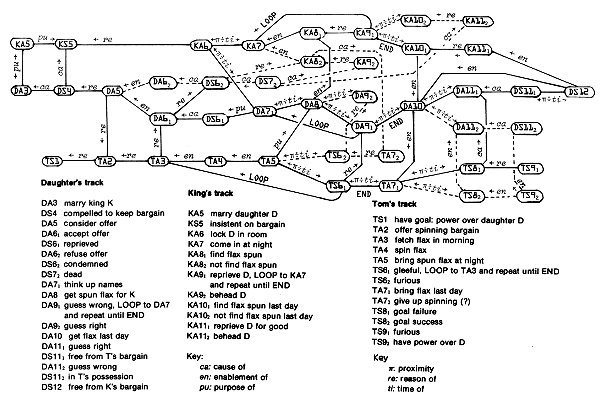
In
addition, we included events that were anticipated, but not realized,
on the
grounds that what happens at one point in a story is most richly
comprehended in
terms of what might have happened, but didn’t. We need to grasp the
importance
of interest and surprise value in the telling and hearing of stories,
which slip
through the rough fronds of story grammars (cf. 3.24). Since every
‘attempt’
has at least the two outcomes of failure or success, both might
reasonably
appear in a model dealing with comprehension and recall of plot lines.
To
appreciate this Rumpelstiltskin legend, an audience must know what
would (but
doesn’t) befall the ‘gatless’ (shiftless) and gutless ‘gal’ if an
intolerable deal of ‘flax’ is not ‘spun’ every day for a month (the
flax-mad king will ‘behead’ her); or if the name of the ‘black impet’
who does the job is not guessed (he will carry her off for a fate much worse than death). More worrisome
yet, if she guesses the name
before the month is out, she will lose both his aid and her noddle
regardless.
So, the most contrived coincidences must be fabricated. Whilst on the
final eve
she sits upon her stool, sullen and discombobulated, His Highness just
happens
upon Tom who is spinning lustily and lustfully in ‘an
old chalk-pit’ in the
forest and just happens to be singing a ditty with his own name, which
the royal
flax-collector then innocently repeats to the girl...and the Happy End
crashes
down like a whole ton of flax. Only a sour-pussed spoilsport would
point out
that the same mad marathon is due again in eleven months, during which
she would
be wise to take some serious spinning lessons.
2.26.
The issues reviewed in this section should illustrate the enduringly
uncertain
sense in which ‘story grammar’ relates to formal grammar. I suggested
that
the separation of structure from content is not feasible (2.1-6). I
noted that
the notion of ‘grammatical rule’ can be seen in a different
perspectives,
each involving its own difficulties (2.7.1-2.7.6.1). The unduly great
‘power’ built into formal grammars was compared to the important
limitations
upon human processing capacities, as illustrated by the concerns of
rewrite
rules (2.10), transformations (2.11-13), recursion (2.17-19), and
deletion
(2.20). The categories of a story grammar will necessarily remain fuzzy
and
content-based, quite unlike arbitrary formal symbols. Finally, the
construction of graphic representations as trees or networks should
follow from
clear decisions about how the structure of the story is built up in
real time,
however many ways it might be analysed after the fact (2.21-25).
3.
Future scope and
ecological value of story grammars
3.1.
Having reviewed a range of issues raised by past story grammars, we
might now
weigh the outlook for the future. The ultimate merits of a story
grammar might
be sought in two criteria. The scope would be the
number and range of
stories the grammar covers. The ecological value would
be the grammar’s
contribution to our knowledge about how stories are told and understood
by human
beings. We saw in section 2 that, from a purely formal standpoint,
there can be
a substantial variety of possible grammars or grammatical constructs.
Thus, we
need to step outside the grammar itself to judge its merits.
3.2.
The question of scope defines what counts as an
example or counter-example
for any theoretical construct. A grammar that could ‘generate’ only
the sagas of the foiled farmer, the sweet-toothed Mary, the rapacious
dog, and
the gourmandising mouse, for all their stark grandeur of ‘events’,
‘causes’, ‘motivations’, and so on, would not be satisfying. Mandler
and
Johnson (1977: 113; 1980: 306; Johnson and Mandler 1980: 84) aim to
encompass all
folktales in the oral tradition — ‘oral’ because, as the quote in 2.7.6
reveals, they relate the need for a stable structural pattern to the
limitations
of memory. I would note here that, although some story grammarians
addressed
oral presentation and retelling (Mandler and Johnson 1977: 142; also,
Stein and
Glenn 1979: 75), others addressed either oral or written (Thorndyke
1977: 86),
oral accompanied by written (Stein and Policastro 1982: msp. 46) (6),
or
exclusively written (Rumelhart 1977b: 283). This matter should be
controlled,
since the processing of oral and written discourse is obviously subject
to
differing conditions and limitations (Beaugrande 1984). Besides, the
texts may
have been ‘traditional’ but they were at best condensations and
manipulations. Whether such alterations might affect the processing of
the
stories is another matter for closer scrutiny.
3.3.
Rumelhart (1975: 213) first offered a grammar for ‘the structure of a
wide
range of simple stories’, and deployed both a made-up story of the
‘Mary’
type and an Aesop’s fable. Later, he added the basic notion of
‘problem-solving behavior’ as ‘a surprisingly simple motif underlying a
remarkable number of stories’ (1977b: 269). However, his categories
‘plan’, ‘preaction’, ‘attempt’, and ‘application’ in the early
paper (1975: 222) provide the essentials of problem-solving before the
term
itself appeared. Then, Rumelhart (1980a: 315) expressly limited his
grammar to
problem-solving stories as opposed to both (a) problem-solving texts
that
aren’t stories, and (b) stories that have some other basic organization.
3.4.
An optimal story grammar should have in its scope all those texts which
a given
culture regards as stories. Cultural consensus rather than the story
grammar
would properly be the final arbiter (cf. 3.8). Unlike Mandler and
Johnson (1980:
307), I would prefer to include novels and literary short stories,
because these
forms evolved ultimately from the oral tradition and thus should bear
structural
similarities to folktales, despite. Distinctions in the detailed
execution of
the text in tribute to literary conventions.
3.5.
What then might all stories have in common? First, they must have at
least two
states, plus an event that leads from the first to the second (cf.
Labov and
Waletzky 1967; Prince 1973). A single state cannot be a story (Carroll
1960:
126:
(7)
‘Once’, said the Mock Turtle at last, with a deep sigh, ‘I was a real
Turtle’. These words were followed by a very long silence [...] Alice
was very
nearly getting up and saying. ‘Thank you, Sir, for your interesting
story’,
but she could not help thinking that there must be more to come. (Alice
in
Wonderland)
Moreover,
the transition event from the first to the last state should not be a
matter of
course. These samples would hardly be acceptable:
(8)
It was autumn. Then the season changed, and it was winter. And spring
was far
behind.
(9)
Socrates was born. He lived and died.
There
must be at least two alternatives (and often, there are a great many)
for the
story plot, defined as a succession of states and events or actions
(cf. 2.25).
A dynamic way for story audiences to interact with a story-teller is by
identifying with a story character and wondering how they would react
to his or
her choices and circumstances. They would favour stories with the
formal
character of problem-solving, a problem being defined as two states
whose
intermediate transition uncertain (2.4). It might not be a problem the
protagonist explicitly sets out to solve, however; it might arise and
be solved
by the intervention of natural forces or fate (as frequently in the Arabian
Nights). However, a protagonist who must actively solve the
problem should
elicit more active audience participation, as envisioned by some story
grammarians (cf. Rumelhart 1977b: 269; Rumelhart and Ortony 1977: 113).
3.6.
The requirement that stories have either implicit or explicit problem
structure
seems rooted in the very nature of information,
which requires at least
two possible transitions from one state to the next (cf. Shannon and
Weaver
1949). Samples (8) and (9) violate this requirement and so are utterly
devoid of
interest. I have elsewhere suggested that informativity
is a necessary
condition of textuality which all actually occurring texts meet in some
degree
(Beaugrande 1980a). It could be argued that the temporal and causal
connections
in story lines are derivative from the dual need for coherence and
informativity. The two states of the minimal story must be related in
time,
usually as earlier versus later; and a causal relationship strengthens
coherence, even when the effect is not anticipated or desired. An
unexpected
causality brings a rise in information, as when magical events create
novel
causalities. In one Native American tale, a bridegroom drank rather
more river
water than was entirely prudent and got transformed into an enormous
fish —
the all-time best alibi for missing your own wedding. It blocked the
passage,
and his grumbling confreres had to portage their canoes around, until
it was
moved to retire by the bride’s well-meant if hardly fish-fitting gifts
of
moccasins and tobacco.
3.7.
If all texts possess informativity, a problem-solving structure will
not
uniquely identify stories, and further criteria must be sought. One
such
criterion would be the presence of at least one animate agent — not
necessarily a person, but some force-possessing entity that can act and
react
with the world (Prince 1973; Stein and Policastro 1982). Since the
audience must
understand the problem in terms of a recoverable goal, the agent is
usually
human or quasi-human enough to entertain human-like goals, as in the
tales used
by the story grammarians (cf. 2.21ff.). Animals may have character
traits that
fit their popular reputation (smart fox, greedy wolf, stupid cow), but
the
representation of the character will still be in human terms (e.,
thinking and
speaking. The ability to recover causalities and to identify with an
agent and
with his or her goals presupposes a cultural consensus whereby the
story
audience is knowledgeable and can participates (cf. Johnson and Mandler
1980:
80). In contrast, the Native American tale War of the Ghosts
used in
Bartlett’s research was poorly comprehended by Anglo-American readers,
especially the death of the protagonist who has been shot by ghosts on
the
warpath but drops dead only back home at sunrise (cf. Bartlett 1932;
Kintsch and
Greene 1978). I also noted in 2.19 the special inferencing needed for
the
recursive story where animals demand senseless bribes. Conversely,
an appealing story has goals that people easily recognize as highly
desirable.
Indeed, the mentioning of the goal might be omitted precisely because
of this
easy recognition; such is true of all three characters in Tom
Tit Tot,
e.g., why in earth the king wanted all that flax. The attempt cannot be
deleted,
though, because it sets in motion the goal-path and injects the
uncertainty and
interest. This account agrees with the constraints on deletion cited in
2.20
3.9.
Further constraints on the event configurations that qualify as stories
are
needed in regard to the identity of agents and the
mood of verbs. To
devise a text type that fits the grammar and yet remains a non-story,
Black and
Bower (1980: 231) made up a set of instructions on ‘how to catch a
fish’.
Before launching into the steps to follow, they provide a setting and
initiating
event:
(10)
It is fishing season in Illinois and a friend asks you to go fishing,
but you do
not know how. Well, I am going to tell you how to catch a fish. First
you need
to get some fishing equipment. [etc.]
‘This
text’, they remark, ‘contains a setting,
theme, plot, and resolution as demanded by Thorndyke’s or Rumelhart’s
story
grammars’ (1980: 23 1). Stein and Policastro (1982: msp. 19) object
that this
‘text’ cannot be a story, lacking a ‘specific protagonist’, as well as
‘an overt attempt, consequence, and reaction’. More precisely, to
preclude
sets of instructions as stories, the grammar would
have to be tightened
up to disallow both possibilities: (a) protagonist agents whose
identity is
neither determinate nor relevant, such that processing cannot recover
the plans,
goals, and attempts needed for audience participation (cf. 3.5); and
(b) the
conditional and imperative mood in verbs expressing the main events,
such that
temporal and causal relationships remain hypothetical
(cf. Freedle and Hale 1979: 124ff.). Here, we may see some grammatical
constraints of linguistic nature, though their underlying motivation
stems from
world-knowledge about events and actions.
3.10.
As the grammars evolve, the extent to which they are or should be
formal and
specific may prove a decisive issue. This point is illustrated by the
relationship between research on story grammars as compared with that
on story
schemas. In previous research, the two areas were not sharply
differentiated.
Rumelhart’s (1975) paper has ‘schema’ in the title, but ‘grammar’ from
then on (2.2). Notice also the similarity of these definitions:
We
will use the term ‘story schema’ to refer to a set of expectations
about the
internal structure of stories which serves to facilitate both encoding
and
retrieval. (Mandler and Johnson 1977: 112)
‘Story
grammars’ [...] describe the types of information that listeners expect
to
encounter in a story and the organization they tend to impose on that
information. (Johnson and Mandler 1980: 51)
Perhaps
we might clarify the respective domains by carefully assessing the
differences
between the grammar approach and the schema approach. A comparison of
the
literature indicates that a story grammar can be viewed as a rule-set
for
relating the ordering of surface-text categories to the underlying
schema (cf.
1.13). Thus, the grammar is a theoretical formalization that operates
upon the
knowledge organized within the schema, with major focus on the
arrangement of
categories in sequences. Prince (1973) and Thorndyke (1977), among
others,
assume that a story text must be composed of sentences, though this
requirement
is not met in many oral samples I have collected. No doubt influenced
by
sentence grammars, this assumption adds an well-formedness constraint
which
cannot be essential to the notion of a story grammar as such — an
ordering of
categories, not of sentences. This matter is not just a ‘subtle
distinction in
usage’ between ‘proposition’ and ‘syntactic clause’ (Thorndyke and
Yekovich 1980: 29). Even my fairly authentic ‘Suffolk tale’ is not just
sentences, viz.
(11)
Well, once upon a time there were a woman and she baked five pies. And
when they
come out of the oven, they was that overbaked, the crust were too hard
to eat.
So she says to her darter: ‘put you them there pies on the shelf an’
leave
‘em there a little, an’ they’ll come agin’ — she meant, you know, the
crust’d get soft. But the gal, she says to herself, ‘Well, if they’ll
come
agin, I’ll ate ‘em now’. And she set to work and ate ‘em all, first and
last. Well, come supper time the woman she said: ‘Go you and git one o’
them
there pies. I dare say they’ve came agin now.’ The gal she went an’ she
looked, and there weren’t nothin’ but the dishes. So back she come and
says
she, ‘Noo, they ain’t come agin.’ ‘Not none on ‘em?’ says the
mother. ‘Not none on ‘em’, says she. [etc.]
Grammar
or no, the ill-fated bakeress and her strong-jawed offspring could
hardly day:
‘not none on
‘em ain’t came agin’.
3.11.
The literature also reveals what we saw in section 2: that numerous
grammars can
be proposed for the essentially same schema. The outcome is not only a
variation
in rule sets, but also a variation in the text sets that are to count
as
stories. Unlike studies of the schema, the literature on grammar is
highly
preoccupied with the distinction between stories and non-stories. It is
questionable whether the schema itself is (or can be) defined precisely
enough
to carry this distinction. We would need to decide what the status of a
non-story might be:
3.12.1.
In purely formal terms, a non-story would violate the rules
of the
grammar. However, no grammar proposed so far claims to be either
explicit or
complete enough to provide such a test. Nevertheless, some artificial
counterexamples have been constructed whose status as non-stories seems
intuitively clear, even without consulting a grammar, e.g.:
(12)
The ball was red and white. The ball was stored in the gym. The ball
had a small
hole in it. The ball was used for volleyball. The ball could fit into a
person’s hand. The ball was dirty on one side. The ball was three
inches
around. (Stein and Policastro 1982: msp. 37)
Still,
the Black and Bower example in 3.9 showed that the decisive criteria
for
excluding non-stories (e.g., sets of instructions) are not well defined
in
current grammars. Interminable revisions might be needed before the
grammar is
robust enough to exclude all non-stories.
3.12.2.
A non-story might be incomprehensible, because its
constituents were out
of reasonable order or were lacking in �my temporal and causal
relatedness.
This measure is also not likely to be exact, because different
audiences possess
their own capacities and dispositions for making sense out of a
presented text,
for example, performing inferences to offset discrepancies or
discontinuities.
One variant of Wilensky’s (1980a: 29) gripping narrative about John
lusting
for Bill’s bicycle (cf. 2.18) takes a strangely fruity turn:
(13)
John told Bill he would break his arm if he didn’t let him have it.
Bill ate a
banana.
In
Wilensky’s vision, an audience might infer that eating bananas makes
Bill
preternaturally strong (like Popeye with his spinach); or that Bill
plans to run
and have John skid on the banana peel and land on his asphalt. When
confronted
with apparent incoherence, people are more likely to seek a solution
than to
output a message ‘ungrammatical’ and abandon all hope of understanding.
Hence, whether a sample is a non-story could depend on the audience’s
disposition, not just on the surface text. After all, I suppose somebody
must read Finnegan’s Wake.
3.12.3.
A non-story might be comprehensible, but only with substantial
cognitive strain. This measure escapes the quandary raised in
3.12.2. We can
test reading time and recall accuracy to estimate difficulty of
comprehension.
The lower performance on ‘less than well-formed stories’ (Johnson and
Mandler 1980: 79) would be one effect of this strain. Nothing prevents
anyone
from telling or understanding such stories, though there is more effort
demanded. But we should bear in mind that many people enjoy a story
precisely
because it challenges their understanding, witness the popularity of
intricate
detective stories told with omissions and displacements (e.g., Conan
Doyle’s Valley
of Fear). Thus, we might obtain the paradox that many
celebrated, enduring
stories get a marginal rating from the grammar.
3.12.4.
A non-story might be comprehensible, but only if the audience performed
substantial rearranging and inferencing. This definition supplies the
reason for
the ‘strain’ suggested in 3.12.3. The experiments showing that
disordered
stories had been reordered in recall to fit the grammar more closely
(Stein and
Nezworski 1978: 187) provide good evidence to support this view. A
study of mine
where tenth-graders heard an O. Henry story with its typical
flashbacks,
omissions, and surprise ending, and then had to retell it yielded
similar
results. However, the tenth-graders normalised their versions and thus
unravelled the intricate texture of the story that made the surprise
ending
possible and effective. Again,
there is a contradiction: tension between the patterning suggested by
the
grammar and the entertainment value of the story (cf. 3.12.3).
3.12.5.
A non-story might be comprehensible, but devoid
of all interest, so
that nobody could endure it and would forcibly eject the story-teller.
The
audience might have no trouble understand�ing such a story, but would
forcibly
eject the story-teller or run madly to the back of beyond to avoid
suffering
through it. This possibility has not been addressed openly in any story
grammar
— a good thing, considering the lethally unprepossessing pallor of
their
‘stories’ about characters who, not coincidentally, resemble the ‘John’
and ‘Mary’ of untold linguist’s examples, whiling away their
‘grammatical’. lives A grammar might specify that a ‘well-formed’ story
should contain challenging problems, violent conflicts, grave dangers,
high
suspense, and so on. Propp’s (1928) approach stressed elements such as
‘struggle’ and ‘victory’; Colby’s (1973: 646) included elements like
‘betrayal, challenge, con�frontation, provocation, attack, and escape’;
the
users of Meehan’s (1977: 96) story program enjoyed ‘making the problem
very
hard’; Bruce (1978) pointed up the importance of ‘conflict’; and Brewer
and Lichtenstein (1981) found that the degree of suspense influenced
audiences’ ratings of sample stories. These criteria entail values
judgment
about story quality, not just about story form;
and
well-formedness correlates with, rather than collides with, interest
and
entertainment (cf. 3.12.3-4).
3.13.
A suitably adjusted outlook on non-stories would affect not only the
scope of
story grammars, but also their ecological value (cf. 3.1). Several
investigators
outside the story-grammar approach have recently objected to the latter
on the
grounds that a story must have some element of surprise, a building and
release
of expectations (Beaugrande and Colby 1979; Kintsch 1980; Morgan and
Sellner
1980; Brewer and Lichtenstein 1981). Stein and Policastro (1982: msp.
15) retort
that ‘the notion of an unexpected event, even though not explicitly
stated in
the definition of the story, is implied by the inclusion of an
emotional
response on the part of the protagonist’. This argument will not
hold up,
however, even if we accept its doubtful premise that ‘emotional reactions to events occur
primarily’ when ‘the
event has violated the pro�tagonist’s expectations’ (1982:
msp. 15) — certainly, emotions can accompany expected
events as well, such as the sugar-caked weddings which wind up
uncountable
stories as if the plot had succumbed to an overdose of sanctified
domestic joy.
Besides, the story grammarians themselves assume that this response of
the
protagonist can be (and often is) deleted from the
story (Mandler and
Johnson 1977: 121; Johnson and Mandler 1980: 72); and Stein and
Policastro’s
(1982: msp. 68) own findings with adult judges confirm the assumption.
Of
course, those who stress the role of surprise would insist that the
unexpected
event is precisely what must not be deleted.
3.14.
The very inception of story grammars makes it unsuited for dealing with
surprise. First, a theory which posits ‘well-formedness’ as a
‘precondition for all members of a category would naturally incline to
view a
violation of expectations as an ungrammatical occurrence, and hence
outside the
domain of concern.
Second, the grammars attempted to formalize only the given events of
the story
and their impact on a character; except for Rumelhart’s fragments (cf.
2.22),
they were not concerned with hypothetical events in whose context the
given
events seem more or less surprising. Third, a categorical grammar is
unlikely to
exploit the concept of probability. On the contrary, by emphasizing
direct
causality, the story grammars make the event chain seem logically
inevitable.
But an audience will participate in a story most intensely if the goal
is very
difficult and the desire to attain it is very strong, e.g., winning the
lily-like hand of the matchless daughter of a legendary sultan only
after
performing spectacular feats of strength and endurance that kick the
stuffing
out of classroom physics.
3.15.
The question is now, what might be done in future research? One
alternative
would be to incorporate the interest factor not as
a required definition
in the basic definition of a story, but as a determining scale for the
quality
of a story. The more informative and interesting the plot line is, the
more
likely audiences will be to accept and esteem a text as a good story
(cf. Brewer
and Lichtenstein 1981). Price (1973: 9) suggests that telling stories
apart from
non-stories is independent of ‘knowing how to tell good stories’. Stein
and
Policastro used an experimental design with a ‘yes/no’ condition (‘Is
this
sample a story?’); one finding, which would amaze no parents, was ‘that
children judge and can generate stories which are not considered to be
“good” stories but do fulfil the requirements for the story concept’
(1982: msp. 76). Thus, the separation of storyhood from story quality
might be
provisionally justified.
3.16.
Though helpful for the issue of scope, this solution is ecologically
unsatisfying. Even if the ability to recognize a story is distinct from
the
ability to judge a good or bad story, the two can hardly be unrelated.
Moreover,
it is difficult to see why such wodges of research should be lavished
on the
former distinction, when the latter one, as Stein and Policastro (1982:
msp.
76f.) remark, is the relevant one for human development. Nor do I see
how these coruscating
lucubrations
on story grammars can shed light on the spiralling problems of basic
literacy,
any more than the sentence grammars bestowed on the word by Chomsky,
who himself
averred that ‘your
professional training as a linguist’ ‘just doesn’t help you to be
useful
to other people’ (1991: 88). Speak
for yourself, old boy.
3.17.
The study of story-telling as a mode of social and cultural
interaction
is another ecologically valid domain the grammars have neglected.
Grammars that
merely describe the mapping of a story schema onto the text downplay
the
story-teller as an agent with plans and goals. But surely stories own
their
forms partly to the social setting where they are created (Labov and
Waletzky
1967; Beaugrande and Colby 1979; Black and Bower 1980; Bruce 1981). The
story-
teller has the goal of keeping an audience interested, and possibly
also the
goal of presenting social messages, e.g., the ‘moral’ of Aesopian
fables
(cf. 2.24). The interest factor is the more crucial: audiences will
accept an
entertaining story without a message, whereas a dull story may probably
put them
to sleep before any message can be delivered. Interest is generated by
uncertain
t y, which is why I highlighted the alternatives in a story line (3.5).
The
story-teller must anticipate how the audience will reconstruct and
predict the
story line, and must surprise them at least some of the time with
unexpected
events. The audience can take as frames of orientation story characters
whose
plans and goals are either plainly stated or readily inferable. Each
story
should center on a turning point where the protagonist’s main goal
becomes
decisively attainable or unattainable. In a good story, the contrast is
drastic:
a highly negative track (e.g., death and destruction) versus a highly
positive
one (e.g., bountiful rewards). Identifying with the protagonist’s
problem, the
audience will experience great tension and suspense. Plainly, such
research must
explore cultural knowledge about what is desirable and undesirable.
3.18.
These considerations point us back to the significance of creativity
in
story-telling. I remarked in 3.12.2 that audiences enjoy a challenging
story
line, even if it forces them to carry out considerable rearranging and
inferencing (cf. 3.12.4). Hence, creativity could exert an opposite
pull from
whatever well-formedness is anchored in everyday expectations about
stories. For
example, many of the odd events in Alice
in Wonderland are entertaining because they caricature (and
hence expose)
the absurdities of Victorian society and its treatment of children: the
creativity carries along both interest and message (cf. 3.17). However,
cultural
factors may restrict or channel creativity. For instance, Grimes (1975:
34, 42)
points out that ‘many languages’, such as Ayor� of Bolivia, have ‘a
strict requirement for all narration’ that ‘the sequence in which
events are
told matches the sequence in which the events actually happened’. A
striking
counter-example was recorded in Saramaccan, a creole of Surinam:
A
story that deals with a canoe trip that ended when the canoe capsized
in the
rapids goes back at the very point of the disaster to a series of
events that
took place before the trip started. […] The reason this sequence of
events is
put into the story is not because those events should have been told
before as
part of the main sequence and were overlooked or played down, but
rather because
the speaker wanted the hearer to understand the magnitude of the loss
when the
canoe overturned. So he gives details on the labor that went into
producing the
load (Grimes 1975: 58f.).
3.19.
Another issue that has surfaced in recent controversy, is the discontinuous
constituent, which, Black and Wilensky state (1979: 218), is
unaccountable
in current story grammars: an episode and goal are set up, but the goal
path is
interrupted with an irrelevant episode. Mandler and Johnson (1980: 307)
surmise
that folk tales from the oral tradition do not contain such cases; and
Mandler’s (1978) earlier study indicated that memory organization
should
discourage discontinuous episodes. Her test subject listened to an
interleaving
of two episodes and then, when recalling them, tended to separate them
out into
two continuous episodes. All the same, folktales do contain
discontinuous
constituents, though they are, I think, quite easily explainable in
terms of
interest and of narrator-audience interaction. In Mandler’s (1978)
story, on
the other hand, the discontinuities were arbitrary and served no such
motives..
In the fifth book of the Iliad,
whose
oral roots have been ably assessed by Miller (1981), a goal is set up
when the
sagacious goddess Athena commands the Greek warrior Diomedes to wound
her rival,
the bodacious goddess Aphrodite. Diomedes rages off into battle, more
intent on
being revenged on Pandarus, who had wounded him, than on serving the
goal of the
envious Athena; he’s not big on wisdom anyway. The plot pauses for a
‘Homeric simile’ likening him to a lion falling upon a shepherd’s fold.
Hardly have, the Trojan heroes Aeneas and Pandarus decided to confront
Diomedes
when, the episode is again interrupted, leaving the goals of all the
agents
wafted in the windy air, for an episode recounting how Pandarus
inspected his
ten magnificent chariots and then left them at home because he feared
the horses
would lack fodder in besieged Troy; likewise the heavy weaponry was
left behind
in favor of the bow and arrow. This episode leads back to a current
problem that
is solved after Aeneas lends his weapons to Pandarus and agrees to
drive his own
chariot while Pandarus attacks Diomedes. The resolution of the inserted
episode
paves the way for the resolution of the interrupted episode: Diomedes
can be
revenged on Pandarus and serendipitously wound Aphrodite when she
materialises
to succour her son Aeneas. The story-teller has manifestly generated a
discontinuous constituent to construct a complex resolution which the
story
characters themselves do not envisage, except perhaps the know-it-all
Athena.
3.21.
The Arabian Nights are notoriously prodigal
discontinuous episodes, as
when one story is properly embedded into another (in the sense of
Mandler and
Johnson 1980: 307) and told by a story character deliberately in order
to obtain
a goal. For example, a merchant was tamely waiting to be killed by a
baleful
genie when three strangers enter the genie’s oasis. The genie is
dissuaded
from his fell purpose by each of three strangers telling him a
‘wonderful
story’ in exchange for sparing the merchant bit by bit, like some
ambulant
blood-bank (Payne 1901: 20-30). The genie’s bargain runs:
(14)
If thou tell me thy story and I find it wonderful, I will remit to thee
a third
of his blood’ (1901: 20).
Tales
this fabulous tales need not fuss over patent absurdities, such as
quandary of
what to do with so gruesome and coagulatory a
‘remittance’.
3.22
The interest value of a story as such becomes goal and decides the
turning point
of the interrupted story. By a similar device, some character confronts
a tough
decision and is told a story intended to illustrate an edifying precept
such as
forgiving those who envy or harm you (Payne 1901: 107-110). The
Arabian
Nights contrive to weave stories inside stories inside
stories — a narrative counterpart of the
embedded visuals known
as ‘Arabesque’. The key here is not whether the unity of an episode is
violated by insertion, but whether the inserted episode holds its own
interesting and prolongs suspense about the outcome of the inter�rupted
episode
(e.g. will the genie kill the merchant or at least one-third of him?).
And of
course the whole shebang is the confabulation of Sheherazade to
distract and
delay her uxoricidal sultan.
3.23.
Recently, Mandler (1983: msp. 4f.) distinguishes between psychological
reality of a story schema (as when audiences can report
their knowledge of
story structure) and its psychological
validity (as when audiences actually utilize structural
knowledge to process
the story). She cautions against conflating the two factors:
‘reportable
knowledge is undoubtedly linked in complex and indirect ways to the
mechanisms
that control processing’ (1983: msp. 14). The grammar is intended as
neither
real nor valid in these senses, but only as formalization of certain
structures
that regularly result from the operations (stipulated in the ‘valid’
schema)
under the influence of structural knowledge about stories (contained in
the
‘real’ schema). The reality of the categories and formats envisioned
by the grammar (not of the grammar itself) might be shown in people’s
intuitive judgments of a sample (e.g., Stein and Policastro 1982), or
by their
sorting of story statements into related groups (e.g., Pollard-Gott et
al.
1979). Validity could be demonstrated in studies of reading time (e.g.,
Haber�landt
1980), or of rearranged stories in recall (e.g., Mandler 1978). Both
reality and
validity might be probed by having readers predict the continuation of
a story
(Rumelhart 1977c).
3.24.
Comparable findings might be adduced for the role of interest
and surprise. Reality is suggested by the
activities
of Meehan’s story-program users and by Brewer and Lichtenstein’s (1981)
informants, all of whom preferred story versions with difficult
problems and
high suspense (cf. 3.13; 3.I7). Validity may help explain why
interesting
stories survive in the oral tradition, while others do not —
apparently,
interest is crucial for both
motivation and memorability. Or again, escalation
as cited in 2.18
renders each problem is harder to solve than the previous one, and the
dangers
attending on failure more drastic. In the Arabian Nights,
a fisherman
hoping to resolve his hunger problem nets instead a brass jar that
releases a
genie vowing to visit his gratitude by killing his piscatorial saviour
in a
release of bottled-up rage; of course he must be deflected with a
cunctatory
story (cf. Payne 1901: 30-51). Suspense stirs up
expectations of imminent
disaster, and then lets the story take its course. In Brewer and
Lichtenstein’s (1981) sample, a man in blissful ignorance that a
short-fused
time bomb is hidden in his car is contemplating the weighty matter of
‘spinach
crepes’ for dinner when he might be turned to crepe suzette himself at
any
moment. Exaggeration is prized in traditions like
the Paul Bunyan
stories, as they were passed along (cf. Weinrich 1966). Imbalance
of
power is crucial when the antagonist (say, the terrifying
Darth Vader)
vastly outranks the protagonist (e.g. the gormless Luke Skywalker) with
whom the
audience will identify. Reversal of social
values drives stories in the picaresque tradition with its
scapegrace
protagonists (e.g. the rascally Brer Rabbit) whose conceited and
successful
self-indulgences audiences can admire. All these elements implicate
interest and
surprise as ‘both ‘real’ and ‘valid’ components of the story schema.
3.25.
All these factors just bring us back to the ways in which real
story-telling is
situated in a context of interaction. If we try to abstract the grammar
away
from interest, suspense, surprise, creativity, culture, and society,
our
results, no matter how redoubtably formalized, will remain inconclusive
at best,
and irrelevant at worst. The final arbiter of what is or is not a
story, and
what makes a good story, must be the story-teller and the audience in
their
interaction.
3.26.
Moreover, the stories reviewed here betray an Anglocentric bias which
needs to
be alleviated by available research on decidedly different languages,
such as
the already cited Ayor� and Saramaccan (cf. 3.18) (see especially Longacre
et al. 1990).
In Halia of New Guinea, the past tense is reserved for all times up to
and
including the day before just before the story is told, whereas verb
forms in
the present tense are marked as being earlier on that day, or at the
time of
telling, or still contemplated; in Bahinemo, also of New Guinea, a
dependent
clause at the beginning of each story paragraph signals its relation to
the time
of the narrating, and all other verbs are tenseless (Grimes 1975:
76f.). In Godi�
of the Ivory Coast, stories have one set of particles linking sentences
and
paragraphs, and another set appearing in noun phrases to indicate the
degree of
intensity or explicitness judged necessary by the story-teller (Gratrix
1978).
In Jirel of eastern Nepal, each sentence in a story begins with a
linkage clause
repeating part of the previous sentence; these clauses show either a
simultaneous or a sequential relationship among events expressed in the
previous
sentence and those expressed in the current one (Strahm 1978). Stories
in
Sherpa, also eastern Nepal, use special markers in noun phrases when a
character
is introduced for the first time or placed in focus for the upcoming
passage
(Schoettelndreyer 1978). Waorani
of eastern Ecuador uses
Morpheme markers for ‘assertive’ to indicate an independent clause in
the
declarative, and for ‘inference’ to indicate what is known only by
hearsay
from a story once told by the ancestors (Pike
and Saint eds. 1988).
3.27.
All these usages definitely grammatical phenomena whose subtlety
fascinates me
in themselves and elicits admiration for the linguistic fieldworkers
who
arduously teased them out of previously remote if not inaccessible
data. To my
mind, they also instil reservations about the spiral-staircased
abstractions and
formalisms that hover above the human affection for stories, which is
more
engaging and universal than any of the putative ‘universals’ invoked —
and
more to the point, created — by linguists, psychologists, philosophers,
and
anthropologists as academic fashions fan them.
References
Ballmer,
Thomas. 1975. Sprachrekonstruktionssysteme.
Kronberg: Scriptor.
Bartlett,
Frederick. 1932. Remembering. Cambridge: Cambridge
University Press.
Beaugrande,
Robert de. 1979. Toward a general theory of creativity. Poetics
8:
269-306.
Beaugrande,
Robert de. 1980a. Text, Discourse,
and Process. Norwood, NJ: Ablex.
Beaugrande,
Robert de. 1980b. The pragmatics of discourse planning. Journal
of
Pragmatics 4, 15-42.
Beaugrande,
Robert de. 1981. Design criteria for process models of reading. Reading
Research
Quarterly 16: 261-315.
Beaugrande,
Robert de. 1984a. Text Production:
Toward a Science of
Composition. Norwood, NJ: Ablex.
Beaugrande,
Robert de. 1984b. Learning to read and
reading to learn in the cognitive science
approach. In Heinz Mandl, Nancy Stein, & Tom Trabasso (eds.), Learning
from Text. Hillsdale, N.J.: Erlbaum, 159-191.
Beaugrande,
Robert de. 1984c. The linearity of reading: fact, fiction, frontier? In
James
Flood ed., Issues in Reading Comprehension. Newark,
NJ: IRA, 45-74.
Beaugrande,
Robert de. 1987. ‘Text, attention, and memory in reading research’. In
Rob Tierney, Patricia Anders, & Judy Mitchell (eds.),
Understanding Readers’ Understanding. Hillsdale, New Jersey:
Erlbaum,
15-58.
Beaugrande,
Robert de. 1991. Linguistic
Theory: The Discourse of Fundamental Works.
London: Longman.
Beaugrande,
Robert de. 1998. Performative
speech acts in linguistic theory: The rationality of Noam Chomsky. Journal of Pragmatics 29, 765-803.
Beaugrande,
Robert de. 1999. Sentence
first, verdict afterwards: On the long career of the sentence. WORD
50, 1-31.
Beaugrande,
Robert de and Benjamin Colby. 1979. Narrative models of action and
interaction. Cognitive
Science 3: 43-66.
Beaugrande,
Robert de and Wolfgang Dressler. 1981. Introduction to Text
Linguistics.
London: ‘Longman.
Bierwisch,
Manfred. 1965. Review of Z.S. Harris, ‘Discourse analysis’. Linguistics
13: 61-73.
Bierwisch,
Manfred. 1966. Strukturalismus. Kursbuch
5: 77-152.
Black,
John and Gordon Bower. 1980. Story understanding as problem solving. Poetics
9, 223-250.
Black,
John and Robert Wilensky. 1979. An evaluation of story grammars. Cognitive
Science 3, 213-230.
Bower,
Gordon. 1976. Experiments on story understanding and recall. Quarterly
Journal
of Experimental Psychology 28:
511-534..
Brewer,
William and Edward Lichtenstein. 1981. Event schemas, story schemas,
and story
grammars. In: John Long and Alan Baddeley eds., Attention
and Performance
IX. HiIIsdale, NJ: Erlbaum, 363-379.
Bruce,
Bertram. 1978. What makes a good story? Language Arts
55: 460-466.
Bruce,
Bertram. 1981. A Social Interaction Model of Reading.
Urbana, IL: Center
for the Study of Reading.
Carroll,
Lewis. 1960. The Annotated Alice. New York: Potter.
Chafe,
Wallace, ed. 1980. The Pear Stories. Norwood, NJ:
Ablex.
Chatman,
Seymour. 1978. Story and Discourse. Ithaca, NY:
Cornell University Press.
Chomsky,
Noam. 1957. Syntactic Structures. The Hague: Mouton.
Chomsky,
Noam. 1959. Review of Verbal Behavior, by B.F.
Skinner. Language
35: 28-58.
Chomsky,
Noam. 1965. Aspects of the Theory of Syntax.
Cambridge, MA: MIT Press.
Chomsky,
Noam. 1991. Language, politics, and
composition. In: Gary Olsen and Irene Gales eds., Interviews:
Cross-Disciplinary Perspectives on Rhetoric and Literacy.
Carbondale:
Southern Illinois UP, 61-95.
Clark,
Herbert and Eve Clark. 1977. Psychology and Language.
New York: Harcourt,
Brace and Jovanovich.
Colby,
Benjamin. 1973. A partial grammar of Eskimo folktales. American
Anthropologist
75, 645-662.
Dascal,
Marcelo, and Avishai Margalit. 1974. A new revolution in linguistics:
text
grammars versus sentence grammars. Theoretical Linguistics
1: 195-213.
Dijk,
Teun van. 1972. Some aspects of Text Grammars. The
Hague: Mouton.
Dijk,
Teun van, Jens Ihwe, J�nos Pet�fi and Hannes Rieser. 1972. Zur
Bestimmung
narrativer Strukturen auf der Grundlage von Textgrammatiken.
Hamburg: Buske.
Fillmore,
Charles. 1968. The case for case. In: Emmon Bach and Robert Harms,
eds., Universals
in Linguistic Theory. New York: Holt, Rinehart, and Winston,
1-88.
Freedle,
Roy and Gordon Hale. 1979. Acquisition of new composition schemata for
expository prose by a transfer of a narrative schema. In: Roy Freedle,
ed., New
Directions in Discourse Processing. Norwood, NJ:
Ablex,12l-136.
Ginsburg,
Seymour. 1966. The Mathematical Theory of Context-Free
Languages. New
York: McGraw-HilI.
Gratrix,
Carol. 1978. Godi� narrative. In: Joseph Grimes, ed., Papers
on Discourse. Dalias, TX: SIL,. 311-323.
Greenbaum,
Sidney, ed. 1977. Language and
Acceptability. The Hague: Mouton.
Grimes,
Joseph. 1975. The Thread of Discourse. The Hague:
Mouton.
Haberlandt,
Karl. 1980. Story grammar and reading time of
story constituents. Poetics 9,
99-118.
Harris,
Zellig. 1951. Methods in Structural
Linguistics. Chicago: University of Chicago Press.
Harris,
Zellig. 1952. Discourse analysis. Language 28: l-30
and 474-494.
Helbig,
Gerhard. 1974. Geschichte der neueren Sprachwissenschaft.
Hamburg:
Rowohlt.
Housman,
A.E. 1911. Inaugural lecture at Cambridge University- Reprinted in his Selected
Prose. Cambridge; Cambridge University Press, 1962.
Johnson,
Nancy and Jean Mandler. 1980. A tale of two structures: underlying and
surface
forms in stories. Poetics 9: 51-86.
Kintsch,
Walter. 1974. The Representation of Meaning in Memory.
Hillsdale, NJ:
Erlbaum.
Kintsch,
Walter and Edith Greene. 1978. The role of culture-specific schemata in
the
comprehension and recall of stories. Discourse Processes
1: 1-13.
Kintsch,
Walter, Theodore Mandel and Ely Kozminsky. 1977. Summarizing scrambled
stories. Memory
and Cognition 5, 547-552.
Labov,
William and Joshua Waletzky. 1967. Narrative analysis: Oral versions of
personal
experience. In: June Helm, ed., Essays on the Verbal and
Visual Arts.
Seattle University of Washington Press, 12-44.
Lakoff,
George. 1971. On generative semantics. In: Danny Steinberg and Leon
Jakobovits,
eds., Semantics. London: Cambridge, 232-296.
L�vi-Strauss,
Claude. 1955. The structural study of myth. Journal of
American Folklore
78, 428-444.
L�vi-Strauss,
Claude. 1960. La structure et la forme. Cahiers de l’Institut
de Science �conomique
Appliqu�e 99, 3-36..
Loftus,
Elizabeth. 1980. Memory. Reading, MA:
Addison-Wesley.
Longacre,
Robert E. et al. 1990. Storyline Concerns and
Word
Order Typology
in East
and
West Africa.
Los Angeles: UCLA Dept. of Linguistics.
Lord,
Albert. 1960. The Singer of Tales. Cambridge:
Harvard.
Lyons,
John. 1976. Semantics. London: Cambridge.
Mandler,
Jean. 1978. A code in the node: the use of story schema in retrieval. Discourse
Processes 1, 4-35.
Mandler,
Jean. 1983. An analysis of story grammars. In: Friedrich Klix et al.,
eds., Processes
and Structures in Human Memory. Hillsdale, NJ: Erlbaum. (In
press.).
Mandler,
Jean and Marsha Goodman. 1980. On the psychological validity of story
structure.
La Jolla: Univ. of California technical report. Presented at the
Psychonomic
Society Meeting, St. Louis.
Mandler,
Jean and Nancy Johnson. 1977. Remembrance of things parsed: story
structure and
recall. Cognitive Psychology 9,
111-151.
Mandler,
Jean and Nancy Johnson. 1980. On throwing out the baby with the
bathwater: a
reply to Black and Wilensky’s evaluation of story grammars. Cognitive
Science
4, 305-312.
Martinet,
Andr�. 1962. A Functional View of Language. Oxford:
Clarendon.
McCawley,
James. 1968. Concerning the base component of
a transformational grammar. Foundations
of Language
4, 243-269.
Meehan,
James. 1976. The Metanovel: Writing Stories by Computer.
New Haven: Yale
Computer Sciences Research Report 74:
Meehan,
James. 1977. TALE-SPIN, an interactive program that writes stories. Fifth
IJCAI, 91-98.
Miller,
Gary. 1981. How oral was Homer? Washington, DC:
University Press of
America.
Morgan,
Jerry and Manfred Sellner. 1980. Discourse and linguistic theory. In:
Rand
Spiro, Bertram Bruce and William Brewer, eds., Theoretical
Issues in Reading
Comprehension. Hillsdale, NJ:
Erlbaum, 165-200.
Newell,
Allan and Herbert Simon. 1972. Problem Solving.
Englewood Cliffs,
NJ: Prentice-Hall.
Payne,
John, ed. 1901. The Book of the Thousand Nights and One Night.
London.
Pet�fi,
J�nos. 1971. Transformationsgrammatiken und eine ko-textuelle
Texttheorie.
Frankfurt: Athen�um.
Pike,
Evelyn and Rachael Saint (eds.). 1988. Workpapers Concerning
Waorani
Discourse Features. Dallas: SIL.
Pollard-Gott,
Lucy, Michael McCloskey and Amy Todres. 1979. Subjective story
structure. Discourse
Processes 2, 252-281.
Prince,
Gerald. 1973. A Grammar for Stories. The Hague:
Mouton.
Propp,
Vladimir. 1928. Morfologia skazki. Leningrad:
Akademia.
Rosch,
Eleanor and Carolyn Mervis. 1975. Family resemblances: studies in the
internal
structure of categories.
Cognitive
Psychology 7: 573-605.
Rumelhart,
David. 1975. Notes on a schema for
stories. In: Daniel Bobrow and Allan Collins,
eds., Representation
and understanding. New York: Academic Press, 211-236.
Rumelhart,
David. 1977a. Introduction to human
information processing. New York: Wiley.
Rumelhart,
David. 1977b. Understanding and summarizing
brief stories. In: David LaBerge and Jay Samuels, eds., Basic
Processes in
Reading: Perception and Comprehension. Hillsdale, NJ:
Erlbaum, 265-303.
Rumelhart,
David. 1977c. Toward an interactive model of reading. In: S. Dornič
ed., Attention
and Performance VI. Hillsdale, NJ: Erlbaum. 573-603
Rumelhart,
David. 1980. On evaluating story grammars. Cognitive
Science 4:
313-316.
Rumelhart,
David. 1980b. Schemata: the building blocks
of cognition. In: Rand Spiro, Bertram Bruce and William Brewer, eds., Theoretical
Issues in Reading Comprehension.
Hillsdale, NJ: Erlbaum, 33-58.
Rumelhart,
David and Andrew Ortony. 1977. The
representation of knowledge in memory. In: Richard Anderson, Rand Spiro
and
William Montague, eds., Schooling and the Acquisition of
Knowledge.
Hillsdale, NJ: Erlbaum, 99-135.
Saussure,
Ferdinand de. 1916. Cours de linguistique
g�n�rale. Lausanne: Payot.
Schank,
Roger and Robert Abelson. 1977. Scripts,
Plans, Goals, and Understanding. Hillsdale, NJ: Erlbaum.
Sch�ttelndreyer,
Burkhard. 1978. Narrative discourse in Sherpa. In: Joseph Grimes, ed., Papers
on Discourse. Arlingon, VA: SIL, 248-266.
Shannon,
Claude and Warren Weaver. 1949. The
Mathematical Theory of communication. Urbana, IL: University
of Illinois
Press.
Sklovskij,
Viktor. 1929. O teorii prozy.
Moscow: Federatsija.
Smith,
Barbara Herrnstein. 1978. On the Margins of
Discourse: The Relation of Literature to Language. Chicago:
University of
Chicago Press.
Smith.
Barbara Herrnstein. 1980. Narrative versions,
narrative theories. Critical Inquiry
7, 213-236.
Stein,
Nancy and Christine Glenn. 1979. An analysis of story comprehension in
elementary school children. In: Roy Freedle, ed., New
Directions in Discourse
Processing. Norwood, NJ: Ablex. 53-120.
Stein,
Nancy and Teresa Nezworski. 1978. The effects of organization and
instructional
set on story memory. Discourse Processes
1, 177-193.
Stein,
Nancy and Margaret Policastro. 1982. The concept of a story: a
comparison
between children’s and teachers viewpoints. In: Heinz Mandl, Nancy
Stein and
Tom Trabasso, eds., Learning and Comprehending Text.
Hillsdale, NJ:
Erlbaum.
Strahm,
Ester. 1978. Cohesion markers in Jirel narrative. In: Joseph Grimes,
ed., Papers
on Discourse. Arlington, VA: SIL. 342-348.
Sutton-Smith,
Brian, Gilbert Botvin and Daniel Mahoney. 1976. Developmental
structures in
fantasy narratives. Human Development
19, 1-13.
Thorndyke,
Perry. 1977. Cognitive structures in comprehension and memory of
narrative
discourse. Cognitive Psychology
9, 77-110.
Thorndyke,
Perry and Frank Yekovich. 1980. A critique of schema-based theories of
human
story memory. Poetics 9, 23-50.
Uyl,
Martin den and Herre van Oostendorp. 1980. The use of scripts in text
comprehension. Poetics 9, 275-294.
Weinrich,
Harald. 1966. Das Zeichen des Jonas: �ber das sehr Grosse und das sehr
Kleine
in der Literatur. Merkur 20, 737-747.
Wilensky,
Robert. 1980a. Understanding Goal-Based Stories.
New York: Garland.
Wilensky,
Robert. 1980b. Points: A Theory of Story Content.
Berkeley, CA:
Electronics Research Laboratory memorandum M80l17.