Beyond the Third Dimension:
Geometry, Computer Graphics, and Higher Dimensions
(Scientific American Library Series), by Thomas F. Banchoff --
http://www.math.brown.edu/~banchoff/Beyond3d/chapter6/section06.html
http://www.math.brown.edu/~banchoff/Beyond3d/chapter6/section05.html
http://www.math.brown.edu/~banchoff/STG/ma8/papers/lglee/w9.html
Comments on Beyond 3d
Laura Gigi Lee
Response to Chapter 6:
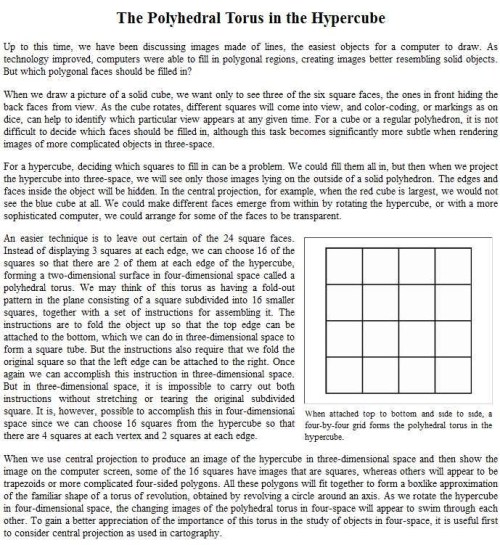
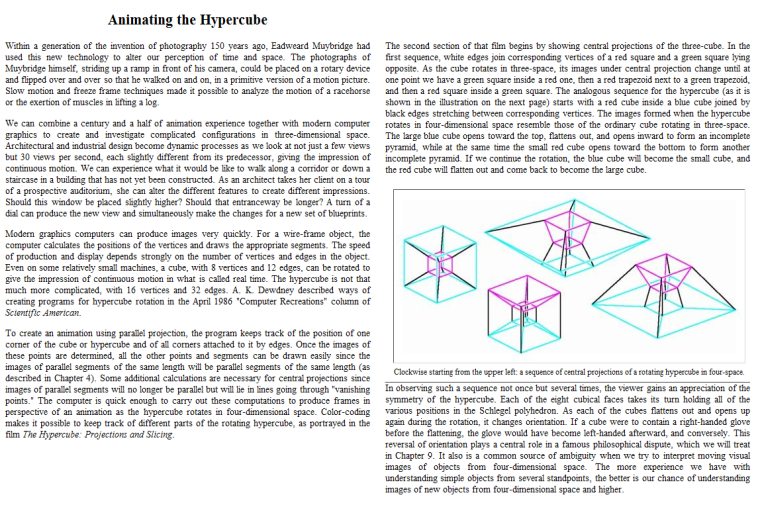
After watching the most recent 'film' on the hypercube, it was interesting to read about the mechanism of changing perspective through "exploratory motion" in regards to the hypercube and torus. Changing the viewpoint seems to be the most effective way of seeing an object's properties, especially if the object is rotated around a particular axis. However, it is very difficult to visualize moving around a hypercube in such a way--- I understand he procedure of viewing the hypercube in continuous motion, 'animating the hypercube,' but it is complicated trying to see the projection of the hypercube as a polyhedral torus. I don't understand how the Clifford torus can resemble both the hypersphere and polyhedral torus in the hypercube. As the number of subdivisions increases, and the polyhedral torus begins to resemble the Clifford torus, things start to get jumbled up. How do these relate to each other?Stereographic projection as a process makes sense to me, the pictures on p. 125 all make sense, but I don't understand the projections from four space. Shouldn't the shadows have some kind of shape and depth? Can shadows have depth?
http://www.math.brown.edu/~banchoff/STG/ma8/papers/tfb/LL9.html
Response from Prof. B.
You are quite right that the animation does make a big difference in trying to see how these objects look in four-space. I find it helpful to imagine a polyhedral torus filling in sixteen of the faces of a hypercube in perspective. In the "cube-within-a-cube" model, it seems all right to use the four vertical squares of the smallest cube and the four vertical squares of the largest cube, with their free quadrilateral rims connected by "flanges". Once you see that, you can imagine what happens as this object begins to rotate in four-space. Try this exercise with the picture of the rotating wire-frame model in the book. You can even trace the picture and shade in some of the faces to help you with the visualization. Then you can try to subdivide once and see a torus with 64 faces as a slight distortion of the 16-face example in the hypercube.
Once again, it is analogy that helps to clarify things. Think of a pair of circles of latitude on the orinary sphere in three-space as they are projected stereographically into the plane. If we approximate one of these circles by a spherical quadrilateral, then the image below will have some distortion in it. In any case, if we look only at the images of the four points, then they can be connected to give an approximation of the image of the circle. Then subdividing further, we approximate the circle in the plane by an octagon that is a "swollen up" version of the square, and so on. Does that help? It is not just an analogy--it represents a slice of what is happening in the higher-dimensional situation.
With respect to the "depth" of shadows, a Flatlander would see the image of a circle under stereographic projection as an ordinary curve in the plane, although we know that it is produced as a shadow of something up in three-space. Just how that shadow is rendered in the plane will affect the illusion of it being something substantial. In a similar way we might see something wraithlike in three-space, as insubstantial as a bubble or perhaps something akin to a "spherical smoke ring". We might not think of it as a "hard surface" but we could still appreciate its shape, I believe. Comments?