Rather
than even attempt to synthesize Sontag’s far ranging criticism, I have
decided to concentrate on a single piece of criticism which has had a
profound influence on the way many people analyze film, myself
included. The essay in question is “Against Interpretation,” which
appeared in the same titled collection of essays, Against
Interpretation. [1]
My aim here is to moderate what appears to be an unabated call to arms
against interpretation in art by situating the piece within its
historical context.
According to Sontag, the emphasis on
“content”-based art analysis stems from the early mimetic art theories
(art as an imitation of reality) which were first meant to be
derogatory (Plato) but later defended (Aristotle, art as catharsis).
This defense, still based on the mimetic theory, continued the
consideration of art as “representing” something (an idea, concept, THE CONTENT) which had to be explained
(interpreted) and hence a separation of content from form.
In
this scenario, early criticism was merely explanatory, interpreting
what was there but encoded or dependent on some additional knowledge on
the part of the critic —something that was “specific-dependent”. As
Sontag points out, hermeneutics, the theory of interpretation, was
originally applied specifically to the biblical text, but since the
19th century has been applied to literature and art as well. Later
modes of hermeneutics “excavated” texts to impose meanings rather than
reveal them. In today’s post-structural/postmodernist context, where
there are no longer meta-narratives or “truths,” interpretation has
exploded into its own discourse, and some would argue, art form.
The
question as I would like to reposition it is, “is Sontag categorically
against interpretation?” I would answer that Sontag is not against
interpretation per se, but rules of interpretation; she is
against the practise of using an interpretative grid over and over to
“decode” disparate works of art. When done indiscriminately the films
in question begin to look alike, and the process reveals more about the
critic than the film. These type of interpretations are reductive
(reducing the film to a preconceived model) and prescriptive rather
than descriptive (based on sensual surface properties of the art).
Sontag
cites two examples of these prescriptive interpretative grids:
Freudianism (or psychoanalysis) and Marxism. She quotes a Freudian
reading of a scene in Bergman’s The Silence –a tank
rumbling down an empty street as a phallic symbol– as an example of a
critic relying on “content” (a tank in an empty street), but stripped
of the filmic context: “Taken as a brute object, as an immediate
sensory equivalent for the mysterious abrupt armored happenings going
on inside the hotel, that sequence with the tank is the most striking
moment in the film. Those who reach for a Freudian interpretation of
the tank are only expressing their lack of response to what is there on
the screen.” [2] For Sontag this is “an
overt contempt for appearances.” The appearances are what is seen and
heard on the screen and what should be described by the critic, and
they should be supported by extra-filmic evidence only when textual
evidence supports it.
To better understand Sontag’s
“anti-interpretation” stance it is necessary to place her in the
historical context in which she wrote. In the early 1960s (the essay
was written in 1964) conceptual art was all the rage. Conceptual art
usually came attached with a theoretical baggage to help explain its
meaning. If the consumer did not get the full picture, they could be
‘coached’ by the artist’s manifesto or the critic’s interpretation. One
thing early modernist artists (1920’s) did to safeguard from over
zealous interpreters was to eliminate content altogether by formal
abstraction, where the form became the content. The later modernists
(1960’s) completed the project by making the content so blatant and
innocuous (Pop Art) that there wasn’t anything there to interpret. Tom
Wolfe wrote an interesting critique of this type of ‘theory art’ in a
book entitled The Painted Word (1975), which bears the stamp
of Sontag. Spearheaded by the avant-garde critical Godheads Clement
Greenberg and Harold Rosenberg, Wolfe writes, “First we got rid of
nineteenth-century storybook realism. Then we got rid of
representational objects. Then we got rid of the third dimension
altogether and got really flat (Abstract Expressionism). Then we got
rid of airiness, brushstrokes, most of the paint, and the last virtues
of drawing and complicated designs (Hard Edge, Color Field, Washington
School).” [3] By the end, all that was
left was artspeak as art, Art Theory. As Sontag wrote a decade earlier,
“Today is such a time, when the project of interpretation is largely
reactionary, stifling… interpretation is the revenge of the intellect
upon art.” [4]
From Sontag’s
1964 context, film becomes the one art still largely untouched by
interpretative zealots. Partly because of cinema’s powerful sense of
immediacy and bigger than life quality; partly because, as she says,
“the latitude it gives for making mistakes…and still being good.” [5]
So that even bad intentions or bad pretensions can give way to a film’s
“beauty and visual sophistication.” But now, 40 plus years later,
through the complete legitimisation of film as an artistic and academic
enterprise it is no longer shielded from over-interpretation.
David
Bordwell has taken this kernel of Sontag’s article and expanded it into
a book length treatment of prescriptive interpretations: Making
Meaning: Inference and Rhetoric in the Interpretation of Cinema
(1989). The title says it all, these interpretations, as clever as they
may be, “make” meaning rather than reveal it.
In
short, there are two main points Sontag is making. One is that we
should not rely on a priori interpretative grids (Freudian, Marxist,
Psychoanalytical, Jungian, etc.) to “excavate” meanings
indiscriminately of the film’s form, and in the process reduce every
film to the same story (an Oedipal journey, a class struggle, etc.). In
other words, the interpretation should not take the place of the
experience of art. Secondly, we should never interpret a film based only
on its content (story, plot, narrative, dialogue). Or put more
reasonably, the better film interpretations are the ones that take into
account aspects of form, style, history, and aesthetics. There is
nothing wrong per se with ‘content-based’ analysis, and some of it can
be very revealing about how a film may relate to external social,
political, or cultural factors. But there is little in such an analysis
to distinguish the film from a book, play, or television show.
Content-only analysis nullifies medium differences.
So
what type of interpretation or ‘understanding’ is Sontag proposing?
First of all, a Sontagian analysis would pay more attention to the
“surface” of a film, its form: camera movement, lighting, angles,
composition, sound, music, editing, etc. It would be predicated upon a
descriptive approach that relies on the senses, or that “recovers the
senses”: “We must learn to see more, to hear more,
to feel more….The function of criticism should be to show how
it is what it is, even that it is what it is, rather
than to show what it means.” [6]
Because
of the context in which she was writing –the powerful influence of art
theory in the 60’s, with minimalism, conceptualism, op art, pop art,
etc.– I think Sontag felt the need to underscore her case by
overvaluing form above content. We must be careful not to read this to
mean that form is more important than content. André Bazin, one of the
greatest critics of film style and form, believed the opposite, that
content determined form. The point is that they inform each other.
To
help moderate Sontag’s anti-interpretation position, I will momentarily
shift my attention to a point made by V.F. Perkins in his essay “Must
We Say What We Mean?” Perkins’ main point in this essay is that the
descriptive component of film analysis, when done correctly,
accurately, and with an awareness of character and plot nuance, is an
operation of interpretation in its own right. The example he provides
is from a scene from Max Ophul’s Caught (1949). The
following is a very long extract where Perkins describes a brief
gesture that the character of Leonora Eames (Barbara Bel Geddes) makes
while driving with the millionaire Smith Ohrlig (Robert Ryan):
Leonora
Eames, ex–waitress, has been picked up by millionaire Smith Ohlrig and
is riding in his car. As he drives, too fast for her comfort, she
answers his mocking quiz about her studies at the Dorothy Dale School
of Charm. Leonora lists some of the skills she has learned, ending with:
‘. . . posture and social usage.’
‘Social what?’
‘Usage. You know, conversation, etiquette, how to pour tea, how to
listen to music, how to … please watch the road.’
When
she speaks of pouring tea and listening to music, she makes two swift
gestures. First she raises her right hand daintily to lift an imagined
teapot, then she opens her hand and shifts it earwards with two fingers
extended, meanwhile tilting her head and disconnecting her gaze from
any supposed object of attention. In a different context, this second
gesture could signify that the thought of music reminds Leonora of some
old enchantment. By showing what music now means to her, it could help
the film affirm the value of Leonora’s education and of her achievement
in working her way through school. Note that the gesture evokes music
of a particular kind –Leonora does not snap her fingers or drum on her
knees here. The kind is one she associates with a world of wealth,
refinement and esteem accessible only in dreams or by magic…
The
two gestures displayed for Ohlrig [‘This is what I’ve learned’] are
also part of a reverie for Leonora [‘This is how it could be if…’]. But
their succession, immediate and without differentiation, exposes
something else –the belief that listening to music is, like pouring
tea, a matter of the appropriately graceful gesture, a question of self
presentation. Leonora has learned that ‘how to listen to music’ means
how to assume the posture in which it is advantageous to be seen while
(posh) music is being played.
Further
aspects of context help to point the meanings. In the face of Ohlrig’s
sarcasm, Leonora is defending the Dorothy Dale regime, so these are
what she understands as the best claims she can advance. She has not
been made aware of anything that a woman might derive from music beyond
an occasion for looking delightful. Leonora’s exposition of the value
of her education also shows her ignorance of its shallowness. Had she
made her gestures while in eye contact with Ohlrig, she could have been
sharing a knowledge of their falsity. The lack of depth to her fantasy
is confirmed by the abruptness with which she can switch back to a
concern with Ohlrig’s driving. ‘Please watch the road’ entails ‘Please
look away from me’ and thus suggests Leonora’s unease in her
performance.
The passage I
have described lasts less than fifteen seconds. My description is far
from exhaustive but I believe that it is accurate and illuminating. In
order to describe Leonora’s gestures I have had to interpret them. The
image would not be evoked, or properly spoken of, by a more extensively
physical account….It is necessary to reflect on what the gestures mean
and where they come from. The camera cannot directly show what is in
Leonora’s mind, but her aims and feelings are as much a part of the
narrative of Caught as the fact that she is sitting in a
millionaire’s car. Films like this are made on the premise that
audiences can see the implications of the acts, words and silences of
movie characters. When, towards the end of our sequence, Leonora tells
Ohlrig ‘I know that you’ve never been married before,’ our
understanding of the wish betrayed by ‘before’ has to be at least the
equal of Ohlrig’s if we are to comprehend the hostility in his
response. We must be alert to both the wish and the hostility if we are
not to be baffled by the twenty seconds without interaction that the
film holds before the image dissolves.
….
No neat disjunction can be drawn between the meanings that Leonora
offers to Smith Ohlrig, that Barbara Bel Geddes offers to the camera
and that the film offers to its audience. An appreciation of this
sequence should encompass all three. The aptness of the writer’s
invention in having Leonora include ‘how to listen to music’ in her
catalogue of social usage; the skill of Bel Geddes in enacting, via a
tiny beat after each ‘how to’, the split second of recall that betrays
Leonora’s gestures as unspontaneous and insecurely learned; the
precisely graded camera position that gives prominence to the listening
gesture while allowing us to see enough of the tea pouring (partially
obscured by the steering wheel in the foreground) to supply the
informing context: these are all achievements in the construction of
meaning. [7]
Perkins’ argument is a partial response to the
assumptions laid out in Bordwell’s book Making Meaning,
which positions criticism between the paradigm building Theory Speak
(the excavators who ‘make meaning’ rather than reveal it) and
Bordwell’s own cognitive based historical poetics, with little
in-between. As Perkins demonstrates, the type of obvious meaning which
Bordwell refers to as “explicit” meaning is 1) not always so obvious,
and 2) dependent on description which can involve interpretation.
Perkins challenges Bordwell’s example of explicit meaning, the final
piece of dialogue in The Wizard of Oz, “There’s no place
like home,” by pointing out the many formal, narrative, and
performative elements which give the line a strong sense of irony. In
the long extract above Perkins demonstrates how a description of
Leonora’s gestures also involves the interpretation of what those
gestures may mean in terms of what/how the character is thinking and
feeling. Hence there are many occasions where description implies
interpretative analysis, and can lead to meanings (explicit or
otherwise) which are ‘on the surface’ but not articulated.
As another example I will present a shot from Don
Siegel’s much discussed 1956 science-fiction/horror classic Invasion
of the Body Snatchers.
The basic premise of the story is that a small community, Santa Mira
—‘mira’ being Spanish for ‘look’— has been invaded by a plant-like
life-force (pods, seeds) from outer space that have the ability to
replicate themselves into the exact likeness of a person. An
‘alien-human’ places a seed pod in the vicinity of the person it is to
take over, usually the basement of the person’s home. Once the pod has
‘sprouted’ and transformed into the likeness of that particular person,
it takes over the identity of that person while they are asleep. Once
the transformation is over, the ‘real’ person is replaced by an
unemotional, zombie-like replicant. In this night time scene the lead
male character, Miles Bennell (Kevin McCarthy), thinks his girlfriend
Betty Driscoll (Dana Wynter) is in danger of being ‘taken over’. He
leaves his home in a hurry, still dressed in his pyjamas, and drives
over to her father’s home. The front door is locked so he breaks in
through the basement window. Once there he looks into a shed and finds
a pod in the image of Betty. He leaves the basement and quietly makes
his way through the kitchen, up to the second floor where Betty and her
alien-possessed father sleep. Unable to wake Betty from her slumber, he
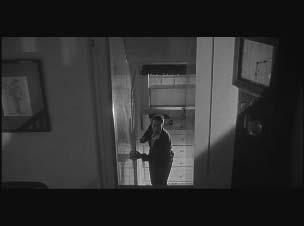
picks her up and carries her out to safety. In this particular shot
from this scene Miles is in the kitchen area about to walk up the
stairs to the second floor. Miles is tentatively walking up the narrow
staircase. The ‘narrow’ space is something which will soon become a
dominant aspect of the mise en scene as a visual expression of Miles
and Betty’s increasing isolation as the remaining few ‘humans’ of Santa
Mira. The center focus of this shot is Miles on the staircase, but also
prominent is a picture of a plant on the wall on the left edge of the
frame, and a large grandfather clock on the right edge of the frame.
What
are we to make of these two objects so strategically placed on the
extreme edges of the frame? At their own face value they may not mean
much, but when placed together within the film’s storyline they mean a
lot. First off, the aliens are a form of plant life, beginning as
seeds, then evolving to large pods (this aspect is expanded as such in
the opening credit sequence of Philip Kaufman’s 1978 remake). Hence the
painting on the house wall can be seen not only as a simple visual
reference to the alien pods, but a comment on how the alien invasion
has infiltrated into the very home of America. The clock, which
symbolizes time and sleep, becomes relevant because the alien takeover
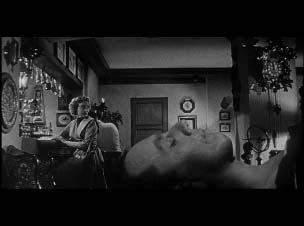
occurs during sleep time. To underscore the importance of clocks and
sleep time, the first time we see a pod come to life, the
pod-body-in-waiting is lying in profile on a billiard table in the
extreme foreground, with a cuckoo clock visible in the upper right
background of the frame. In the left background asleep against the
basement bar is the human body about to be replicated (Jack, played by
King Donovan), and his wife Theodora (Carolyn Jones). Moments after the
clock’s cuckoo chimes the pod’s eyes open. Hence two important
narrative elements in the alien takeover are represented in the
painting (plants) and the clock (sleep, time).
The
interpretation of this shot is by no means earth shattering in its
profundity, nor does it add anything to the debates surrounding the
film’s ideological position (is it anti-Communist or
anti-McCarthyist?). However, it does demonstrate that Siegel and his
crew paid great attention to every aspect of the film, and added story
nuance in every possible detail. With this shot description you could
see how the “content” of a film begins at the very edges of the frame,
and includes everything within it.
The above is an example of what can be called
‘non-obvious’ [8]
meanings in a film, the range of which is contained in reasons ranging
from a film’s complex formal system to the many possible forms of
extra-textual knowledge (cultural codes, political pressures, authorial
intentions, historical context, etc.). Within this range, there is also
a halfway position between ‘explicit’ meaning (a film’s basic plot, for
example) and the type of ‘excavation’ performed by theoretical
paradigms that are willy-nilly transposed from film to film
irrespective of other contextual concerns —Bordwell’s “making meaning.”
Sontag made us all aware of how the “art” of interpretation
(excavation) can be fraught with indecipherable jargon and dull,
repetitive readings. But interpretation also exists on the ‘surface’
for anyone willing to take the time to see, hear, feel, and describe.
Perkins expresses this Sontagian spirit in the following passage which
is extracted from the same piece as above:
I
suggest that a prime task of interpretation is to articulate in the
medium of prose some aspects of what artists have made perfectly and
precisely clear in the medium of film. The meanings I have discussed in
the Caught fragment are neither stated nor in any special
sense implied. They are filmed. Whatever else that means (which it is a
purpose of criticism and theory to explore) it means that they are not
hidden in or behind the movie, and that my interpretation is not an
attempt to clarify what the picture has obscured. I have written about
things that I believe to be in the film for all to see, and to see the
sense of. [9]
I would think that Sontag would not want it any
other way.
ENDNOTES
1 Susan
Sontag. Against Interpretation. New York: Dell Publishing,
1961.
2 Susan
Sontag. Against Interpretation. New York: Dell Publishing,
1961, p. 19
3 Tom
Wolfe. The Painted Word. Toronto: Bantam Books, 1975, p.
97-98.
4 Tom
Wolfe. The Painted Word. Toronto: Bantam Books, 1975, p. 17.
5 Sontag,
p. 21.
6 Ibid.,
p. 23.
7 V.F.
Perkins. “Must We Say What We Mean?” Movie 34/35, Winter 1990.
8 The
term is used by V.F. Perkins in the quoted essay.
9 Perkins.